

Elements of Quantum Theory
95
which is analogous to the classical result that the momentum is the product of
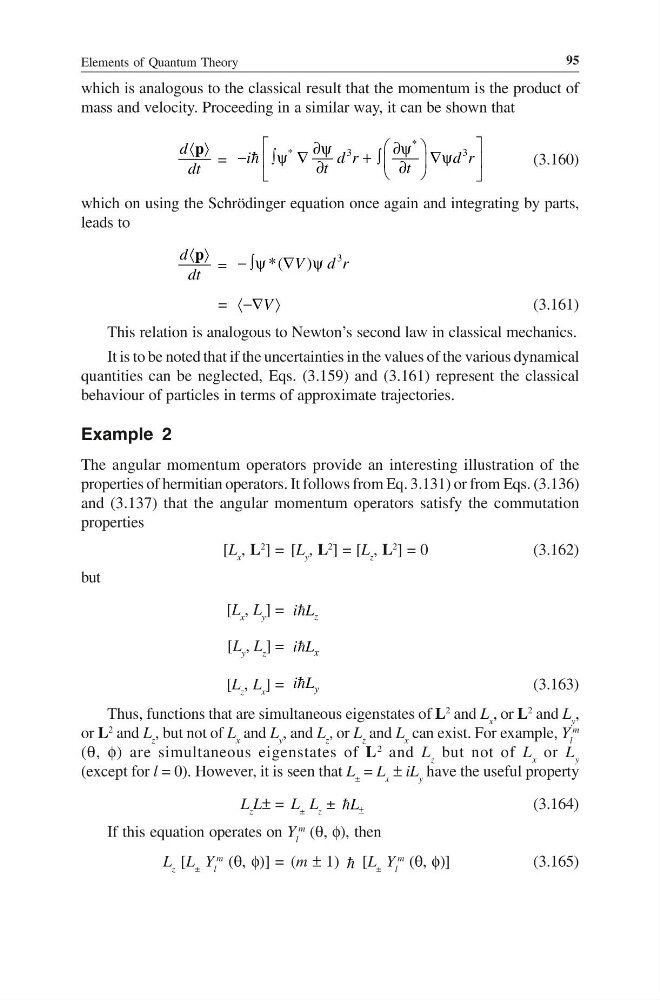
mass and velocity. Proceeding in a similar way, it can be shown that
〈 〉
d
dt
p =
*
*
3
3
i
dr
dr
t
t
∂ψ
∂ψ
− ∫ ψ ∇
+ ∫
∇ψ
∂
∂
(3.160)
which on using the Schrödinger equation once again and integrating by parts,
leads to
〈 〉
d
dt
p =
3
*( )
V d r
− ∫ ψ ∇ ψ
=
V
〈−∇ 〉
(3.161)
This relation is analogous to Newton’s second law in classical mechanics.
It is to be noted that if the uncertainties in the values of the various dynamical
quantities can be neglected, Eqs. (3.159) and (3.161) represent the classical
behaviour of particles in terms of approximate trajectories.
Example 2
The angular momentum operators provide an interesting illustration of the
properties of hermitian operators. It follows from Eq. 3.131) or from Eqs. (3.136)
and (3.137) that the angular momentum operators satisfy the commutation
properties
[L x , L
2
] = [L y , L
2
] = [L z , L
2
] = 0
(3.162)
but
[L x , L y ] =
z
i L
[L y , L z ] =
x
i L
[L z , L x ] =
y
i L
(3.163)
Thus, functions that are simultaneous eigenstates of L
2
and L x , or L
2
and L y ,
or L
2
and L z , but not of L x and L y , and L z , or L z and L x can exist. For example, Y l
m
(θ, φ) are simultaneous eigenstates of L
2
and L z but not of L x or L y
(except for l = 0). However, it is seen that L ± = L x ± iL y have the useful property
L z L± = L ± L z ± L ±
(3.164)
If this equation operates on Y l
m
(θ, φ), then
L z [L ± Y l
m
(θ, φ)] = (m ± 1) [L ± Y l
m
(θ, φ)]
(3.165)
95
which is analogous to the classical result that the momentum is the product of
mass and velocity. Proceeding in a similar way, it can be shown that
〈 〉
d
dt
p =
*
*
3
3
i
dr
dr
t
t
∂ψ
∂ψ
− ∫ ψ ∇
+ ∫
∇ψ
∂
∂
(3.160)
which on using the Schrödinger equation once again and integrating by parts,
leads to
〈 〉
d
dt
p =
3
*( )
V d r
− ∫ ψ ∇ ψ
=
V
〈−∇ 〉
(3.161)
This relation is analogous to Newton’s second law in classical mechanics.
It is to be noted that if the uncertainties in the values of the various dynamical
quantities can be neglected, Eqs. (3.159) and (3.161) represent the classical
behaviour of particles in terms of approximate trajectories.
Example 2
The angular momentum operators provide an interesting illustration of the
properties of hermitian operators. It follows from Eq. 3.131) or from Eqs. (3.136)
and (3.137) that the angular momentum operators satisfy the commutation
properties
[L x , L
2
] = [L y , L
2
] = [L z , L
2
] = 0
(3.162)
but
[L x , L y ] =
z
i L
[L y , L z ] =
x
i L
[L z , L x ] =
y
i L
(3.163)
Thus, functions that are simultaneous eigenstates of L
2
and L x , or L
2
and L y ,
or L
2
and L z , but not of L x and L y , and L z , or L z and L x can exist. For example, Y l
m
(θ, φ) are simultaneous eigenstates of L
2
and L z but not of L x or L y
(except for l = 0). However, it is seen that L ± = L x ± iL y have the useful property
L z L± = L ± L z ± L ±
(3.164)
If this equation operates on Y l
m
(θ, φ), then
L z [L ± Y l
m
(θ, φ)] = (m ± 1) [L ± Y l
m
(θ, φ)]
(3.165)