

xi
Contents
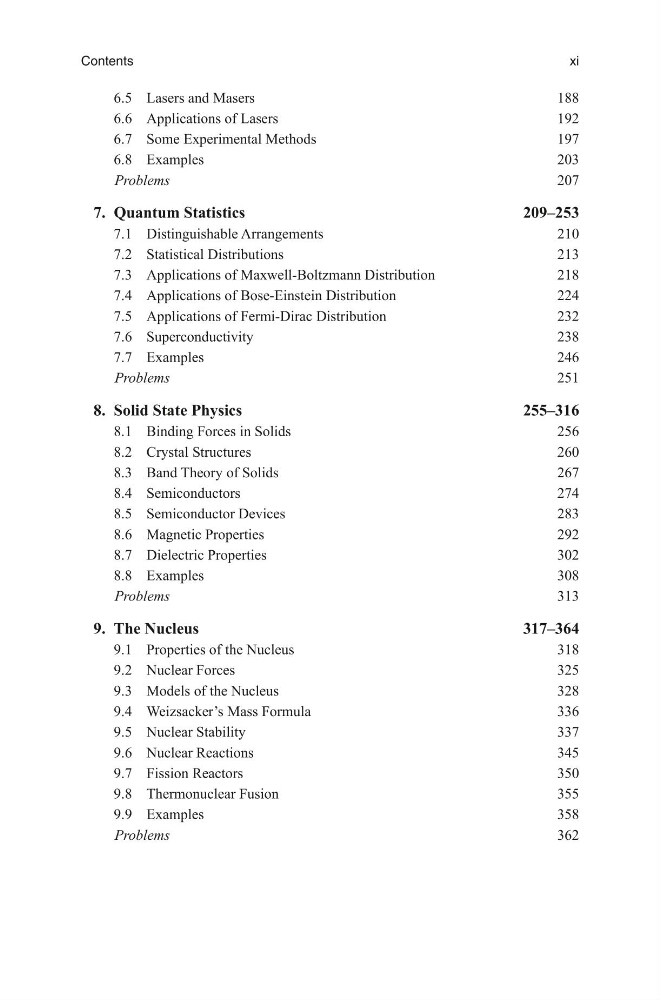
6.5 Lasers and Masers
188
6.6 Applications of Lasers
192
6.7 Some Experimental Methods
197
6.8 Examples
203
Problems
207
7. Quantum Statistics
209–253
7.1 Distinguishable Arrangements
210
7.2 Statistical Distributions
213
7.3 Applications of Maxwell-Boltzmann Distribution
218
7.4 Applications of Bose-Einstein Distribution
224
7.5 Applications of Fermi-Dirac Distribution
232
7.6 Superconductivity
238
7.7 Examples
246
Problems
251
8. Solid State Physics
255–316
8.1 Binding Forces in Solids
256
8.2 Crystal Structures
260
8.3 Band Theory of Solids
267
8.4 Semiconductors
274
8.5 Semiconductor Devices
283
8.6 Magnetic Properties
292
8.7 Dielectric Properties
302
8.8 Examples
308
Problems
313
9. The Nucleus
317–364
9.1 Properties of the Nucleus
318
9.2 Nuclear Forces
325
9.3 Models of the Nucleus
328
9.4 Weizsacker’s Mass Formula
336
9.5 Nuclear Stability
337
9.6 Nuclear Reactions
345
9.7 Fission Reactors
350
9.8 Thermonuclear Fusion
355
9.9 Examples
358
Problems
362
Contents
6.5 Lasers and Masers
188
6.6 Applications of Lasers
192
6.7 Some Experimental Methods
197
6.8 Examples
203
Problems
207
7. Quantum Statistics
209–253
7.1 Distinguishable Arrangements
210
7.2 Statistical Distributions
213
7.3 Applications of Maxwell-Boltzmann Distribution
218
7.4 Applications of Bose-Einstein Distribution
224
7.5 Applications of Fermi-Dirac Distribution
232
7.6 Superconductivity
238
7.7 Examples
246
Problems
251
8. Solid State Physics
255–316
8.1 Binding Forces in Solids
256
8.2 Crystal Structures
260
8.3 Band Theory of Solids
267
8.4 Semiconductors
274
8.5 Semiconductor Devices
283
8.6 Magnetic Properties
292
8.7 Dielectric Properties
302
8.8 Examples
308
Problems
313
9. The Nucleus
317–364
9.1 Properties of the Nucleus
318
9.2 Nuclear Forces
325
9.3 Models of the Nucleus
328
9.4 Weizsacker’s Mass Formula
336
9.5 Nuclear Stability
337
9.6 Nuclear Reactions
345
9.7 Fission Reactors
350
9.8 Thermonuclear Fusion
355
9.9 Examples
358
Problems
362