

80
W. C. Law and S. De W. Wong
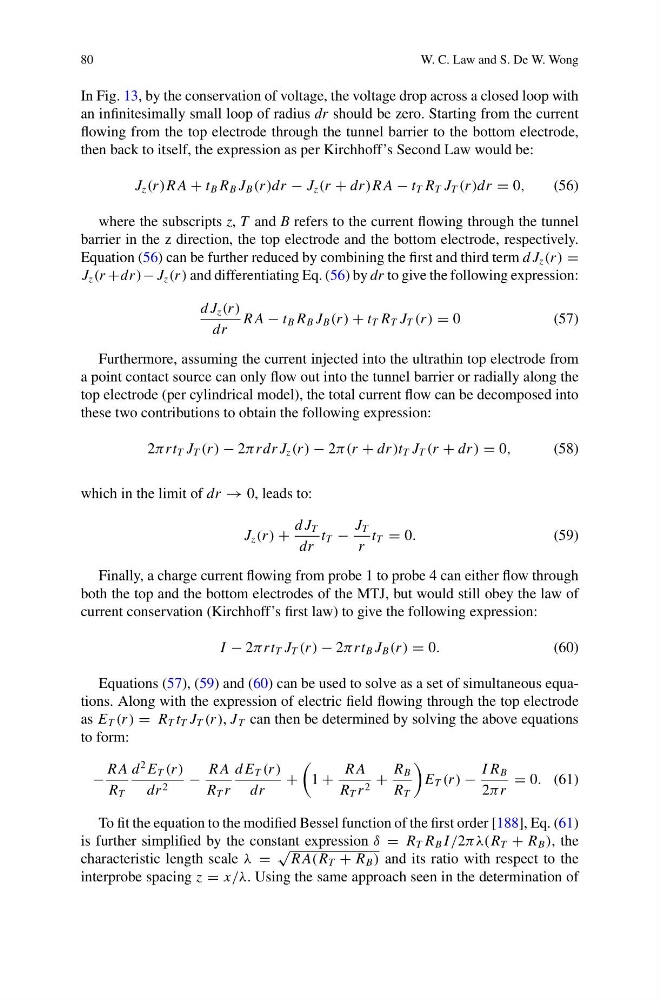
In Fig. 13, by the conservation of voltage, the voltage drop across a closed loop with
an infinitesimally small loop of radius dr should be zero. Starting from the current
flowing from the top electrode through the tunnel barrier to the bottom electrode,
then back to itself, the expression as per Kirchhoff’s Second Law would be:
J z (r )R A + t B R B J B (r )dr − J z (r + dr)R A − t T R T J T (r )dr = 0,
(56)
where the subscripts z, T and B refers to the current flowing through the tunnel
barrier in the z direction, the top electrode and the bottom electrode, respectively.
Equation (56) can be further reduced by combining the first and third term d J z (r ) =
J z (r +dr)− J z (r ) and differentiating Eq. (56) by dr to give the following expression:
d J z (r )
dr
R A − t B R B J B (r ) + t T R T J T (r ) = 0
(57)
Furthermore, assuming the current injected into the ultrathin top electrode from
a point contact source can only flow out into the tunnel barrier or radially along the
top electrode (per cylindrical model), the total current flow can be decomposed into
these two contributions to obtain the following expression:
2πrt T J T (r ) − 2πrdr J z (r ) − 2π (r + dr)t T J T (r + dr) = 0,
(58)
which in the limit of dr → 0, leads to:
J z (r ) +
d J T
dr
t T −
J T
r
t T = 0.
(59)
Finally, a charge current flowing from probe 1 to probe 4 can either flow through
both the top and the bottom electrodes of the MTJ, but would still obey the law of
current conservation (Kirchhoff’s first law) to give the following expression:
I − 2πrt T J T (r ) − 2πrt B J B (r ) = 0.
(60)
Equations (57), (59) and (60) can be used to solve as a set of simultaneous equations. Along with the expression of electric field flowing through the top electrode
as E T (r ) = R T t T J T (r ), J T can then be determined by solving the above equations
to form:
−
R A
R T
d
2 E T (r )
dr 2 −
R A
R T r
d E T (r )
dr
+
1 +
R A
R T r 2 +
R B
R T
E T (r ) −
I R B
2πr
= 0. (61)
To fit the equation to the modified Bessel function of the first order [188], Eq. (61)
is further simplified by the constant expression δ = R T R B I /2πλ(R T + R B ), the
characteristic length scale λ =
√
R A(R T + R B ) and its ratio with respect to the
interprobe spacing z = x/λ. Using the same approach seen in the determination of
W. C. Law and S. De W. Wong
In Fig. 13, by the conservation of voltage, the voltage drop across a closed loop with
an infinitesimally small loop of radius dr should be zero. Starting from the current
flowing from the top electrode through the tunnel barrier to the bottom electrode,
then back to itself, the expression as per Kirchhoff’s Second Law would be:
J z (r )R A + t B R B J B (r )dr − J z (r + dr)R A − t T R T J T (r )dr = 0,
(56)
where the subscripts z, T and B refers to the current flowing through the tunnel
barrier in the z direction, the top electrode and the bottom electrode, respectively.
Equation (56) can be further reduced by combining the first and third term d J z (r ) =
J z (r +dr)− J z (r ) and differentiating Eq. (56) by dr to give the following expression:
d J z (r )
dr
R A − t B R B J B (r ) + t T R T J T (r ) = 0
(57)
Furthermore, assuming the current injected into the ultrathin top electrode from
a point contact source can only flow out into the tunnel barrier or radially along the
top electrode (per cylindrical model), the total current flow can be decomposed into
these two contributions to obtain the following expression:
2πrt T J T (r ) − 2πrdr J z (r ) − 2π (r + dr)t T J T (r + dr) = 0,
(58)
which in the limit of dr → 0, leads to:
J z (r ) +
d J T
dr
t T −
J T
r
t T = 0.
(59)
Finally, a charge current flowing from probe 1 to probe 4 can either flow through
both the top and the bottom electrodes of the MTJ, but would still obey the law of
current conservation (Kirchhoff’s first law) to give the following expression:
I − 2πrt T J T (r ) − 2πrt B J B (r ) = 0.
(60)
Equations (57), (59) and (60) can be used to solve as a set of simultaneous equations. Along with the expression of electric field flowing through the top electrode
as E T (r ) = R T t T J T (r ), J T can then be determined by solving the above equations
to form:
−
R A
R T
d
2 E T (r )
dr 2 −
R A
R T r
d E T (r )
dr
+
1 +
R A
R T r 2 +
R B
R T
E T (r ) −
I R B
2πr
= 0. (61)
To fit the equation to the modified Bessel function of the first order [188], Eq. (61)
is further simplified by the constant expression δ = R T R B I /2πλ(R T + R B ), the
characteristic length scale λ =
√
R A(R T + R B ) and its ratio with respect to the
interprobe spacing z = x/λ. Using the same approach seen in the determination of