

56
W. C. Law and S. De W. Wong
states of the electron shells in accordance to Hund’s rules. In the case where the
outermost electronic shells are not to completely fill up, unpaired electrons would
occupy the states with the same spin orientation. Such materials are known as paramagnetic, as they weakly respond to external magnetic field, giving rise to a net
positive dipole moment until the external magnetic field is removed.
For the case of ferromagnetism, additional exchange interactions that occur
between unpaired electrons are included, such as between neighboring atoms (direct
exchange) or between orbitals within the same atom (intra-atomic exchange).
According to the Pauli exclusion principle, no fermions can occupy the same state,
resulting in an energy difference when two spins are aligned parallel or antiparallel
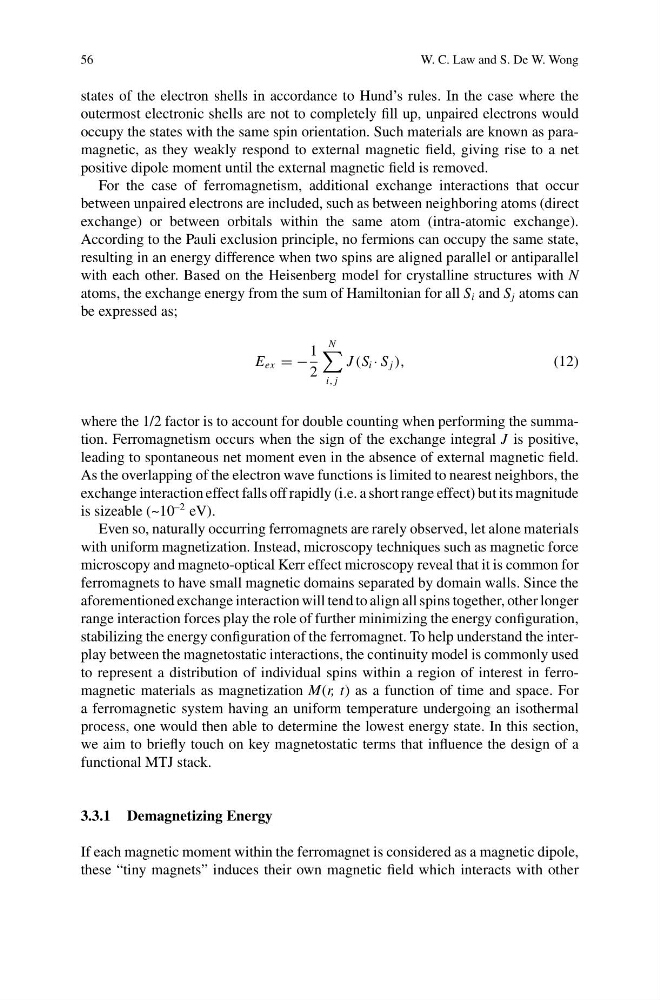
with each other. Based on the Heisenberg model for crystalline structures with N
atoms, the exchange energy from the sum of Hamiltonian for all S i and S j atoms can
be expressed as;
E ex = −
1
2
N
i, j
J (S i · S j ),
(12)
where the 1/2 factor is to account for double counting when performing the summation. Ferromagnetism occurs when the sign of the exchange integral J is positive,
leading to spontaneous net moment even in the absence of external magnetic field.
As the overlapping of the electron wave functions is limited to nearest neighbors, the
exchange interaction effect falls off rapidly (i.e. a short range effect) but its magnitude
is sizeable (~10
–2 eV).
Even so, naturally occurring ferromagnets are rarely observed, let alone materials
with uniform magnetization. Instead, microscopy techniques such as magnetic force
microscopy and magneto-optical Kerr effect microscopy reveal that it is common for
ferromagnets to have small magnetic domains separated by domain walls. Since the
aforementioned exchange interaction will tend to align all spins together, other longer
range interaction forces play the role of further minimizing the energy configuration,
stabilizing the energy configuration of the ferromagnet. To help understand the interplay between the magnetostatic interactions, the continuity model is commonly used
to represent a distribution of individual spins within a region of interest in ferromagnetic materials as magnetization M(r, t) as a function of time and space. For
a ferromagnetic system having an uniform temperature undergoing an isothermal
process, one would then able to determine the lowest energy state. In this section,
we aim to briefly touch on key magnetostatic terms that influence the design of a
functional MTJ stack.
3.3.1 Demagnetizing Energy
If each magnetic moment within the ferromagnet is considered as a magnetic dipole,
these “tiny magnets” induces their own magnetic field which interacts with other
W. C. Law and S. De W. Wong
states of the electron shells in accordance to Hund’s rules. In the case where the
outermost electronic shells are not to completely fill up, unpaired electrons would
occupy the states with the same spin orientation. Such materials are known as paramagnetic, as they weakly respond to external magnetic field, giving rise to a net
positive dipole moment until the external magnetic field is removed.
For the case of ferromagnetism, additional exchange interactions that occur
between unpaired electrons are included, such as between neighboring atoms (direct
exchange) or between orbitals within the same atom (intra-atomic exchange).
According to the Pauli exclusion principle, no fermions can occupy the same state,
resulting in an energy difference when two spins are aligned parallel or antiparallel
with each other. Based on the Heisenberg model for crystalline structures with N
atoms, the exchange energy from the sum of Hamiltonian for all S i and S j atoms can
be expressed as;
E ex = −
1
2
N
i, j
J (S i · S j ),
(12)
where the 1/2 factor is to account for double counting when performing the summation. Ferromagnetism occurs when the sign of the exchange integral J is positive,
leading to spontaneous net moment even in the absence of external magnetic field.
As the overlapping of the electron wave functions is limited to nearest neighbors, the
exchange interaction effect falls off rapidly (i.e. a short range effect) but its magnitude
is sizeable (~10
–2 eV).
Even so, naturally occurring ferromagnets are rarely observed, let alone materials
with uniform magnetization. Instead, microscopy techniques such as magnetic force
microscopy and magneto-optical Kerr effect microscopy reveal that it is common for
ferromagnets to have small magnetic domains separated by domain walls. Since the
aforementioned exchange interaction will tend to align all spins together, other longer
range interaction forces play the role of further minimizing the energy configuration,
stabilizing the energy configuration of the ferromagnet. To help understand the interplay between the magnetostatic interactions, the continuity model is commonly used
to represent a distribution of individual spins within a region of interest in ferromagnetic materials as magnetization M(r, t) as a function of time and space. For
a ferromagnetic system having an uniform temperature undergoing an isothermal
process, one would then able to determine the lowest energy state. In this section,
we aim to briefly touch on key magnetostatic terms that influence the design of a
functional MTJ stack.
3.3.1 Demagnetizing Energy
If each magnetic moment within the ferromagnet is considered as a magnetic dipole,
these “tiny magnets” induces their own magnetic field which interacts with other