

390
P. A. Dananjaya et al.
bits/cell) and 10 years extrapolated retention [29]. The application of this structure as
synaptic device was demonstrated through rigorous optimization of pulse amplitude,
pulse width, and the interval between subsequent pulses during operation to achieve
gradual potentiation and depression [30]. This system was demonstrated as 2nd order
memristor to realize synaptic plasticity in which different parameters involved during
switching operation were considered. The modulation of conductive filament dimension, w, that directly results in the device conductance change was referred as 1st
order parameter, utilizing memristor as a simple programmable memory device. On
the other hand, the 2nd order memristor used the local temperature, T, within the
active switching region that governed the evolution of the 1st order parameter, w,
capturing the dynamics aspect of the device. T provides time-dependent variable that
abruptly increases with the applied pulse and spontaneously decays after its removal.
T enables the system to bio-realistically demonstrate activity-dependent plasticity,
which is analogous to Ca
+ concentration that regulates the weight-state variable.
Other TaO x -based devices used Ti or TiO x layer as oxygen reservoir in the system.
Compared to the HfO x -based devices, the proposed switching mechanism is based
on predominant lateral modulation of filament width instead of vertical modulation
of filament gap connecting the electrodes [31]. This has been proven to be crucial in
achieving gradual and linear weight update. Ta 2 O 5 /TiO x synaptic device was implemented on simulated multilayer perceptron neural network under on-chip training
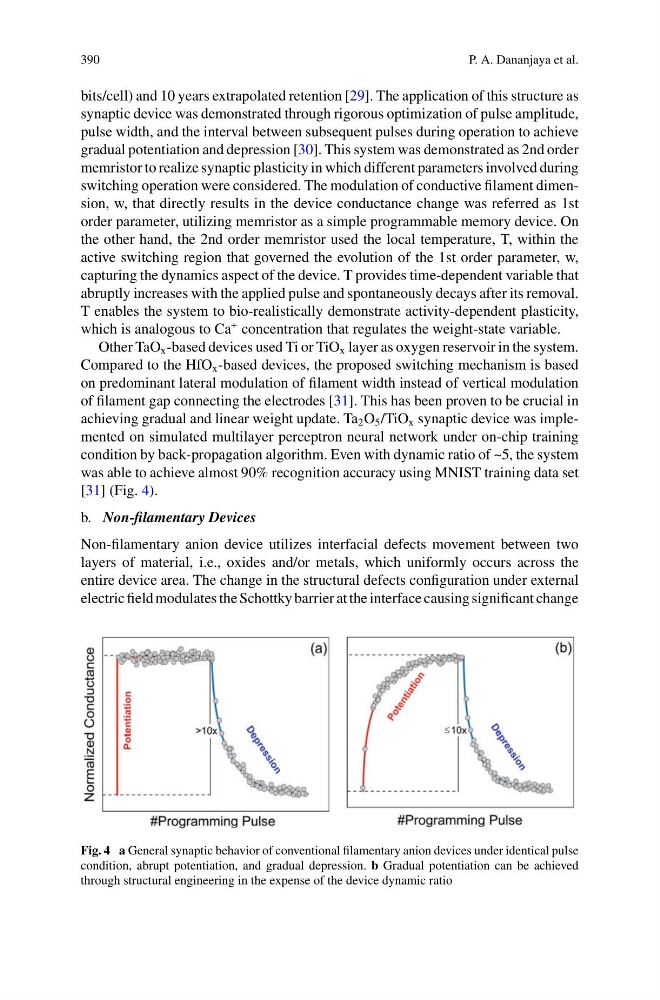
condition by back-propagation algorithm. Even with dynamic ratio of ~5, the system
was able to achieve almost 90% recognition accuracy using MNIST training data set
[31] (Fig. 4).
b. Non-filamentary Devices
Non-filamentary anion device utilizes interfacial defects movement between two
layers of material, i.e., oxides and/or metals, which uniformly occurs across the
entire device area. The change in the structural defects configuration under external
electric field modulates the Schottky barrier at the interface causing significant change
Fig. 4 a General synaptic behavior of conventional filamentary anion devices under identical pulse
condition, abrupt potentiation, and gradual depression. b Gradual potentiation can be achieved
through structural engineering in the expense of the device dynamic ratio
P. A. Dananjaya et al.
bits/cell) and 10 years extrapolated retention [29]. The application of this structure as
synaptic device was demonstrated through rigorous optimization of pulse amplitude,
pulse width, and the interval between subsequent pulses during operation to achieve
gradual potentiation and depression [30]. This system was demonstrated as 2nd order
memristor to realize synaptic plasticity in which different parameters involved during
switching operation were considered. The modulation of conductive filament dimension, w, that directly results in the device conductance change was referred as 1st
order parameter, utilizing memristor as a simple programmable memory device. On
the other hand, the 2nd order memristor used the local temperature, T, within the
active switching region that governed the evolution of the 1st order parameter, w,
capturing the dynamics aspect of the device. T provides time-dependent variable that
abruptly increases with the applied pulse and spontaneously decays after its removal.
T enables the system to bio-realistically demonstrate activity-dependent plasticity,
which is analogous to Ca
+ concentration that regulates the weight-state variable.
Other TaO x -based devices used Ti or TiO x layer as oxygen reservoir in the system.
Compared to the HfO x -based devices, the proposed switching mechanism is based
on predominant lateral modulation of filament width instead of vertical modulation
of filament gap connecting the electrodes [31]. This has been proven to be crucial in
achieving gradual and linear weight update. Ta 2 O 5 /TiO x synaptic device was implemented on simulated multilayer perceptron neural network under on-chip training
condition by back-propagation algorithm. Even with dynamic ratio of ~5, the system
was able to achieve almost 90% recognition accuracy using MNIST training data set
[31] (Fig. 4).
b. Non-filamentary Devices
Non-filamentary anion device utilizes interfacial defects movement between two
layers of material, i.e., oxides and/or metals, which uniformly occurs across the
entire device area. The change in the structural defects configuration under external
electric field modulates the Schottky barrier at the interface causing significant change
Fig. 4 a General synaptic behavior of conventional filamentary anion devices under identical pulse
condition, abrupt potentiation, and gradual depression. b Gradual potentiation can be achieved
through structural engineering in the expense of the device dynamic ratio