

Resistive Random Access Memory Device …
327
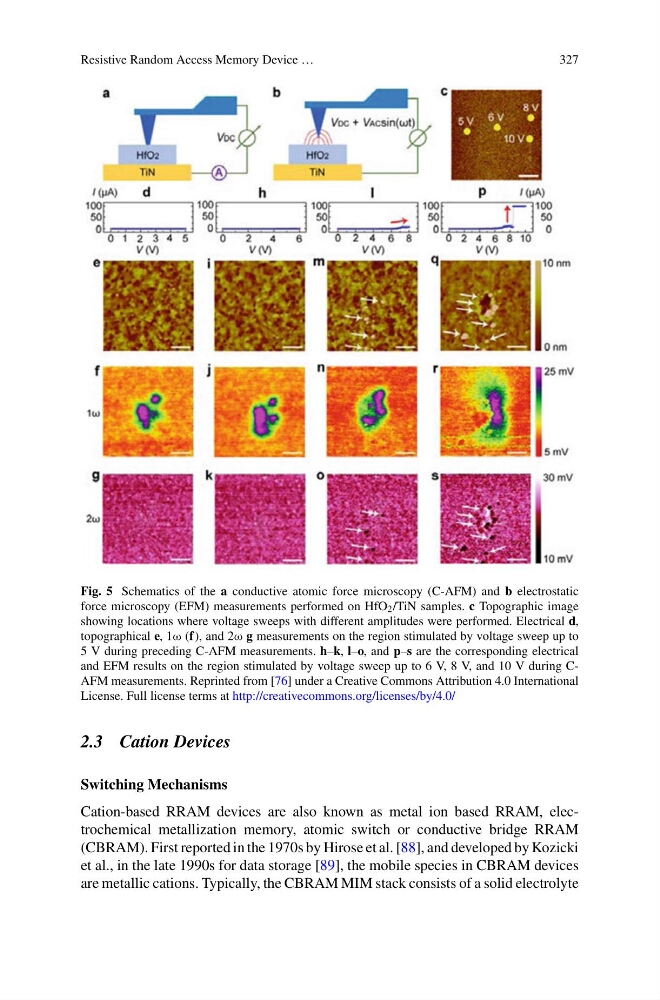
Fig. 5 Schematics of the a conductive atomic force microscopy (C-AFM) and b electrostatic
force microscopy (EFM) measurements performed on HfO 2 /TiN samples. c Topographic image
showing locations where voltage sweeps with different amplitudes were performed. Electrical d,
topographical e, 1ω (f), and 2ω g measurements on the region stimulated by voltage sweep up to
5 V during preceding C-AFM measurements. h–k, l–o, and p–s are the corresponding electrical
and EFM results on the region stimulated by voltage sweep up to 6 V, 8 V, and 10 V during CAFM measurements. Reprinted from [76] under a Creative Commons Attribution 4.0 International
License. Full license terms at http://creativecommons.org/licenses/by/4.0/
2.3 Cation Devices
Switching Mechanisms
Cation-based RRAM devices are also known as metal ion based RRAM, electrochemical metallization memory, atomic switch or conductive bridge RRAM
(CBRAM). First reported in the 1970s by Hirose et al. [88], and developed by Kozicki
et al., in the late 1990s for data storage [89], the mobile species in CBRAM devices
are metallic cations. Typically, the CBRAM MIM stack consists of a solid electrolyte
327
Fig. 5 Schematics of the a conductive atomic force microscopy (C-AFM) and b electrostatic
force microscopy (EFM) measurements performed on HfO 2 /TiN samples. c Topographic image
showing locations where voltage sweeps with different amplitudes were performed. Electrical d,
topographical e, 1ω (f), and 2ω g measurements on the region stimulated by voltage sweep up to
5 V during preceding C-AFM measurements. h–k, l–o, and p–s are the corresponding electrical
and EFM results on the region stimulated by voltage sweep up to 6 V, 8 V, and 10 V during CAFM measurements. Reprinted from [76] under a Creative Commons Attribution 4.0 International
License. Full license terms at http://creativecommons.org/licenses/by/4.0/
2.3 Cation Devices
Switching Mechanisms
Cation-based RRAM devices are also known as metal ion based RRAM, electrochemical metallization memory, atomic switch or conductive bridge RRAM
(CBRAM). First reported in the 1970s by Hirose et al. [88], and developed by Kozicki
et al., in the late 1990s for data storage [89], the mobile species in CBRAM devices
are metallic cations. Typically, the CBRAM MIM stack consists of a solid electrolyte