

324
V. Y. Zhuo et al.
The CF in OxRRAM is usually created by an electroforming process where the
pristine device is subjected to a higher than normal voltage or current to activate
the resistive switching capability [69–71]. Once activated, OxRRAM typically show
either unipolar or bipolar resistive switching and have different switching dynamics
and dominant driving forces.
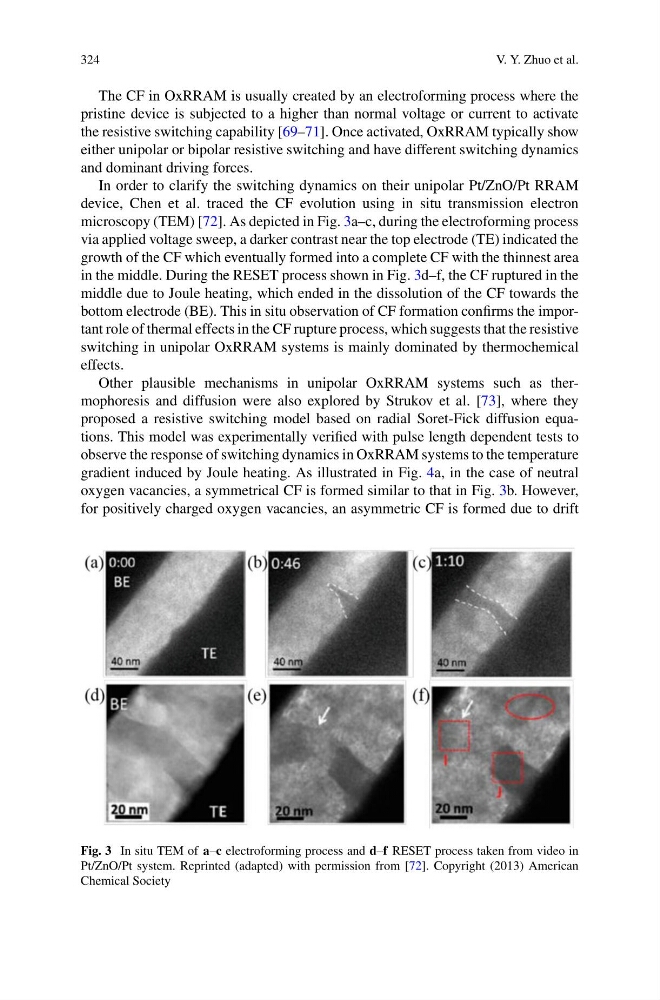
In order to clarify the switching dynamics on their unipolar Pt/ZnO/Pt RRAM
device, Chen et al. traced the CF evolution using in situ transmission electron
microscopy (TEM) [72]. As depicted in Fig. 3a–c, during the electroforming process
via applied voltage sweep, a darker contrast near the top electrode (TE) indicated the
growth of the CF which eventually formed into a complete CF with the thinnest area
in the middle. During the RESET process shown in Fig. 3d–f, the CF ruptured in the
middle due to Joule heating, which ended in the dissolution of the CF towards the
bottom electrode (BE). This in situ observation of CF formation confirms the important role of thermal effects in the CF rupture process, which suggests that the resistive
switching in unipolar OxRRAM systems is mainly dominated by thermochemical
effects.
Other plausible mechanisms in unipolar OxRRAM systems such as thermophoresis and diffusion were also explored by Strukov et al. [73], where they
proposed a resistive switching model based on radial Soret-Fick diffusion equations. This model was experimentally verified with pulse length dependent tests to
observe the response of switching dynamics in OxRRAM systems to the temperature
gradient induced by Joule heating. As illustrated in Fig. 4a, in the case of neutral
oxygen vacancies, a symmetrical CF is formed similar to that in Fig. 3b. However,
for positively charged oxygen vacancies, an asymmetric CF is formed due to drift
Fig. 3 In situ TEM of a–c electroforming process and d–f RESET process taken from video in
Pt/ZnO/Pt system. Reprinted (adapted) with permission from [72]. Copyright (2013) American
Chemical Society
V. Y. Zhuo et al.
The CF in OxRRAM is usually created by an electroforming process where the
pristine device is subjected to a higher than normal voltage or current to activate
the resistive switching capability [69–71]. Once activated, OxRRAM typically show
either unipolar or bipolar resistive switching and have different switching dynamics
and dominant driving forces.
In order to clarify the switching dynamics on their unipolar Pt/ZnO/Pt RRAM
device, Chen et al. traced the CF evolution using in situ transmission electron
microscopy (TEM) [72]. As depicted in Fig. 3a–c, during the electroforming process
via applied voltage sweep, a darker contrast near the top electrode (TE) indicated the
growth of the CF which eventually formed into a complete CF with the thinnest area
in the middle. During the RESET process shown in Fig. 3d–f, the CF ruptured in the
middle due to Joule heating, which ended in the dissolution of the CF towards the
bottom electrode (BE). This in situ observation of CF formation confirms the important role of thermal effects in the CF rupture process, which suggests that the resistive
switching in unipolar OxRRAM systems is mainly dominated by thermochemical
effects.
Other plausible mechanisms in unipolar OxRRAM systems such as thermophoresis and diffusion were also explored by Strukov et al. [73], where they
proposed a resistive switching model based on radial Soret-Fick diffusion equations. This model was experimentally verified with pulse length dependent tests to
observe the response of switching dynamics in OxRRAM systems to the temperature
gradient induced by Joule heating. As illustrated in Fig. 4a, in the case of neutral
oxygen vacancies, a symmetrical CF is formed similar to that in Fig. 3b. However,
for positively charged oxygen vacancies, an asymmetric CF is formed due to drift
Fig. 3 In situ TEM of a–c electroforming process and d–f RESET process taken from video in
Pt/ZnO/Pt system. Reprinted (adapted) with permission from [72]. Copyright (2013) American
Chemical Society