

24
P. K. Muduli et al.
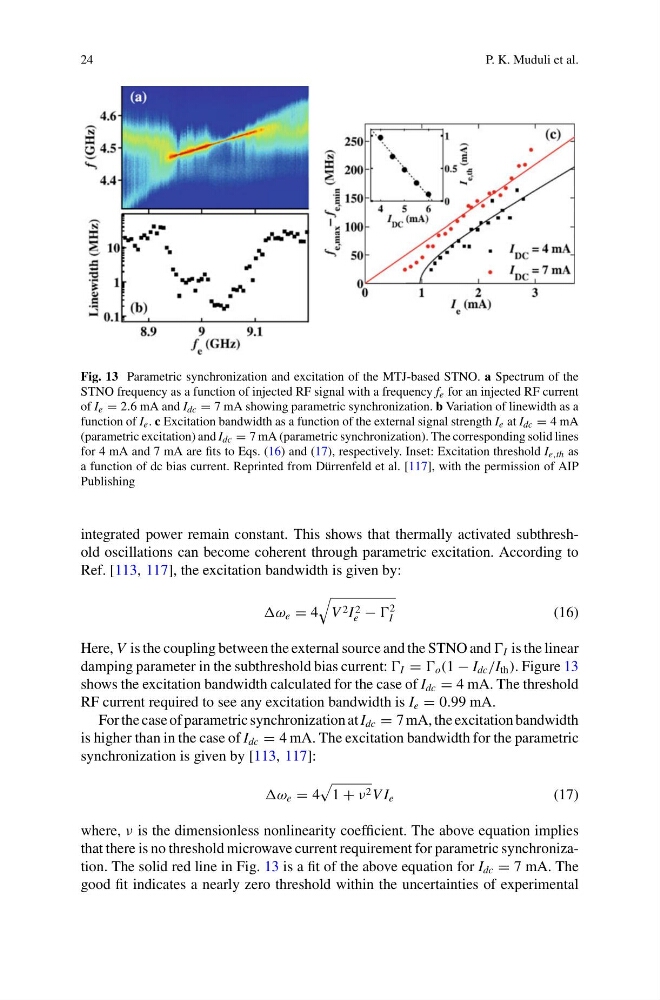
Fig. 13 Parametric synchronization and excitation of the MTJ-based STNO. a Spectrum of the
STNO frequency as a function of injected RF signal with a frequency f e for an injected RF current
of I e = 2.6 mA and I dc = 7 mA showing parametric synchronization. b Variation of linewidth as a
function of I e . c Excitation bandwidth as a function of the external signal strength I e at I dc = 4 mA
(parametric excitation) and I dc = 7 mA (parametric synchronization). The corresponding solid lines
for 4 mA and 7 mA are fits to Eqs. (16) and (17), respectively. Inset: Excitation threshold I e,th as
a function of dc bias current. Reprinted from Dürrenfeld et al. [117], with the permission of AIP
Publishing
integrated power remain constant. This shows that thermally activated subthreshold oscillations can become coherent through parametric excitation. According to
Ref. [113, 117], the excitation bandwidth is given by:
ω e = 4
V 2 I 2
e −
2
I
(16)
Here, V is the coupling between the external source and the STNO and I is the linear
damping parameter in the subthreshold bias current: I = o (1 − I dc /I th ). Figure 13
shows the excitation bandwidth calculated for the case of I dc = 4 mA. The threshold
RF current required to see any excitation bandwidth is I e = 0.99 mA.
For the case of parametric synchronization at I dc = 7 mA, the excitation bandwidth
is higher than in the case of I dc = 4 mA. The excitation bandwidth for the parametric
synchronization is given by [113, 117]:
ω e = 4
1 + ν 2 V I e
(17)
where, ν is the dimensionless nonlinearity coefficient. The above equation implies
that there is no threshold microwave current requirement for parametric synchronization. The solid red line in Fig. 13 is a fit of the above equation for I dc = 7 mA. The
good fit indicates a nearly zero threshold within the uncertainties of experimental
P. K. Muduli et al.
Fig. 13 Parametric synchronization and excitation of the MTJ-based STNO. a Spectrum of the
STNO frequency as a function of injected RF signal with a frequency f e for an injected RF current
of I e = 2.6 mA and I dc = 7 mA showing parametric synchronization. b Variation of linewidth as a
function of I e . c Excitation bandwidth as a function of the external signal strength I e at I dc = 4 mA
(parametric excitation) and I dc = 7 mA (parametric synchronization). The corresponding solid lines
for 4 mA and 7 mA are fits to Eqs. (16) and (17), respectively. Inset: Excitation threshold I e,th as
a function of dc bias current. Reprinted from Dürrenfeld et al. [117], with the permission of AIP
Publishing
integrated power remain constant. This shows that thermally activated subthreshold oscillations can become coherent through parametric excitation. According to
Ref. [113, 117], the excitation bandwidth is given by:
ω e = 4
V 2 I 2
e −
2
I
(16)
Here, V is the coupling between the external source and the STNO and I is the linear
damping parameter in the subthreshold bias current: I = o (1 − I dc /I th ). Figure 13
shows the excitation bandwidth calculated for the case of I dc = 4 mA. The threshold
RF current required to see any excitation bandwidth is I e = 0.99 mA.
For the case of parametric synchronization at I dc = 7 mA, the excitation bandwidth
is higher than in the case of I dc = 4 mA. The excitation bandwidth for the parametric
synchronization is given by [113, 117]:
ω e = 4
1 + ν 2 V I e
(17)
where, ν is the dimensionless nonlinearity coefficient. The above equation implies
that there is no threshold microwave current requirement for parametric synchronization. The solid red line in Fig. 13 is a fit of the above equation for I dc = 7 mA. The
good fit indicates a nearly zero threshold within the uncertainties of experimental