

3D Nanomagnetic Logic
265
M down
M up
y
x
z
down
M
= 0
up
M = 1
H
M up
M
Coupling
a
b
Energy
H z
H z
H z
H s
Energy
t
DW motion
Magnetic field
FIB ANC
2
1
3
3
2
1
3
2
1
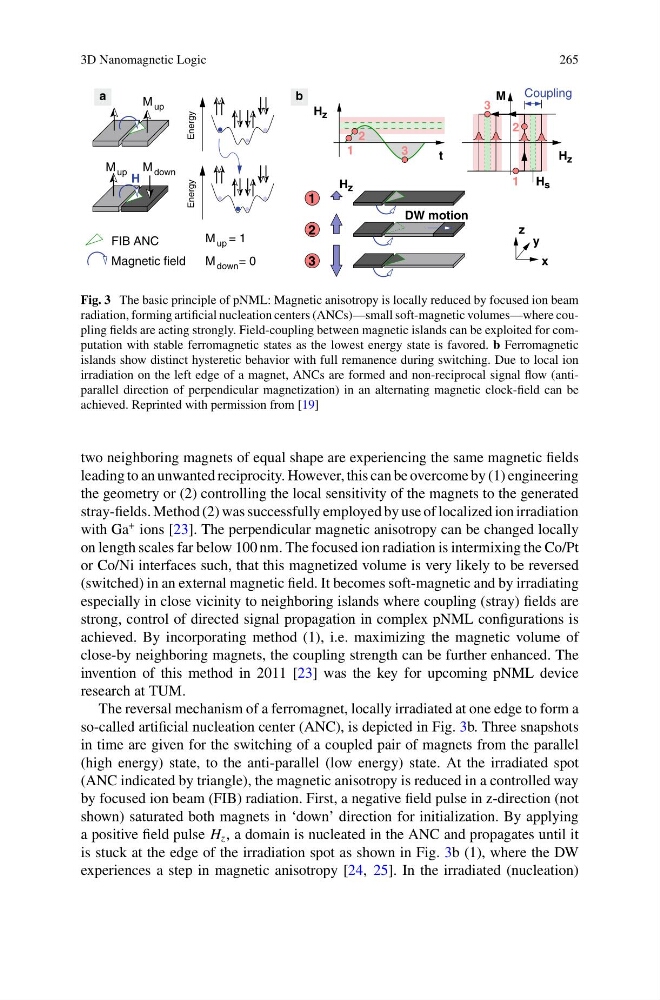
Fig. 3 The basic principle of pNML: Magnetic anisotropy is locally reduced by focused ion beam
radiation, forming artificial nucleation centers (ANCs)—small soft-magnetic volumes—where coupling fields are acting strongly. Field-coupling between magnetic islands can be exploited for computation with stable ferromagnetic states as the lowest energy state is favored. b Ferromagnetic
islands show distinct hysteretic behavior with full remanence during switching. Due to local ion
irradiation on the left edge of a magnet, ANCs are formed and non-reciprocal signal flow (antiparallel direction of perpendicular magnetization) in an alternating magnetic clock-field can be
achieved. Reprinted with permission from [19]
two neighboring magnets of equal shape are experiencing the same magnetic fields
leading to an unwanted reciprocity. However, this can be overcome by (1) engineering
the geometry or (2) controlling the local sensitivity of the magnets to the generated
stray-fields. Method (2) was successfully employed by use of localized ion irradiation
with Ga
+ ions [23]. The perpendicular magnetic anisotropy can be changed locally
on length scales far below 100 nm. The focused ion radiation is intermixing the Co/Pt
or Co/Ni interfaces such, that this magnetized volume is very likely to be reversed
(switched) in an external magnetic field. It becomes soft-magnetic and by irradiating
especially in close vicinity to neighboring islands where coupling (stray) fields are
strong, control of directed signal propagation in complex pNML configurations is
achieved. By incorporating method (1), i.e. maximizing the magnetic volume of
close-by neighboring magnets, the coupling strength can be further enhanced. The
invention of this method in 2011 [23] was the key for upcoming pNML device
research at TUM.
The reversal mechanism of a ferromagnet, locally irradiated at one edge to form a
so-called artificial nucleation center (ANC), is depicted in Fig. 3b. Three snapshots
in time are given for the switching of a coupled pair of magnets from the parallel
(high energy) state, to the anti-parallel (low energy) state. At the irradiated spot
(ANC indicated by triangle), the magnetic anisotropy is reduced in a controlled way
by focused ion beam (FIB) radiation. First, a negative field pulse in z-direction (not
shown) saturated both magnets in ‘down’ direction for initialization. By applying
a positive field pulse H z , a domain is nucleated in the ANC and propagates until it
is stuck at the edge of the irradiation spot as shown in Fig. 3b (1), where the DW
experiences a step in magnetic anisotropy [24, 25]. In the irradiated (nucleation)
265
M down
M up
y
x
z
down
M
= 0
up
M = 1
H
M up
M
Coupling
a
b
Energy
H z
H z
H z
H s
Energy
t
DW motion
Magnetic field
FIB ANC
2
1
3
3
2
1
3
2
1
Fig. 3 The basic principle of pNML: Magnetic anisotropy is locally reduced by focused ion beam
radiation, forming artificial nucleation centers (ANCs)—small soft-magnetic volumes—where coupling fields are acting strongly. Field-coupling between magnetic islands can be exploited for computation with stable ferromagnetic states as the lowest energy state is favored. b Ferromagnetic
islands show distinct hysteretic behavior with full remanence during switching. Due to local ion
irradiation on the left edge of a magnet, ANCs are formed and non-reciprocal signal flow (antiparallel direction of perpendicular magnetization) in an alternating magnetic clock-field can be
achieved. Reprinted with permission from [19]
two neighboring magnets of equal shape are experiencing the same magnetic fields
leading to an unwanted reciprocity. However, this can be overcome by (1) engineering
the geometry or (2) controlling the local sensitivity of the magnets to the generated
stray-fields. Method (2) was successfully employed by use of localized ion irradiation
with Ga
+ ions [23]. The perpendicular magnetic anisotropy can be changed locally
on length scales far below 100 nm. The focused ion radiation is intermixing the Co/Pt
or Co/Ni interfaces such, that this magnetized volume is very likely to be reversed
(switched) in an external magnetic field. It becomes soft-magnetic and by irradiating
especially in close vicinity to neighboring islands where coupling (stray) fields are
strong, control of directed signal propagation in complex pNML configurations is
achieved. By incorporating method (1), i.e. maximizing the magnetic volume of
close-by neighboring magnets, the coupling strength can be further enhanced. The
invention of this method in 2011 [23] was the key for upcoming pNML device
research at TUM.
The reversal mechanism of a ferromagnet, locally irradiated at one edge to form a
so-called artificial nucleation center (ANC), is depicted in Fig. 3b. Three snapshots
in time are given for the switching of a coupled pair of magnets from the parallel
(high energy) state, to the anti-parallel (low energy) state. At the irradiated spot
(ANC indicated by triangle), the magnetic anisotropy is reduced in a controlled way
by focused ion beam (FIB) radiation. First, a negative field pulse in z-direction (not
shown) saturated both magnets in ‘down’ direction for initialization. By applying
a positive field pulse H z , a domain is nucleated in the ANC and propagates until it
is stuck at the edge of the irradiation spot as shown in Fig. 3b (1), where the DW
experiences a step in magnetic anisotropy [24, 25]. In the irradiated (nucleation)