

Chiral Magnetic Domain Wall and Skyrmion Memory Devices
181
2 Spin–Orbit Torques Driven Magnetic Domain Wall
Motion
In addition to the anomalous behaviors found in Co/Pt multilayers, remarkably efficient DW motion of which velocity is about 100 m/s and moving direction is against to
the electrons flow was experimentally observed in ultrathin Co sandwiched between
a nonmagnetic heavy metal and insulator [20]. This anomalously efficient currentinduced DW motion suggested possible contribution from inverse spin galvanic effect
(ISGE) [21, 22] or so-called Rashba-Edelstein effect. The ISGE is an interfacial
spin–orbit coupling present at a surface or interface of materials which lacks inversion symmetry. This inversion asymmetry then result in an electric potential—arising
from the discontinuity in electronic structure at the interface—along the surface or
interface axis. When electrons flow on the interface or surface of a ferromagnetic
layer, the electric field from the asymmetric potential transforms into an effective
magnetic field in the electron’s rest frame. The conduction electrons spins experience an effective magnetic field transverse to the electron flow direction, accordingly
leading to partial spin polarization along the direction of the effective magnetic field.
The conduction electrons spins interact with the magnetization in the ferromagnetic
layer through s-d exchange coupling, exerting torques on the magnetization acting as
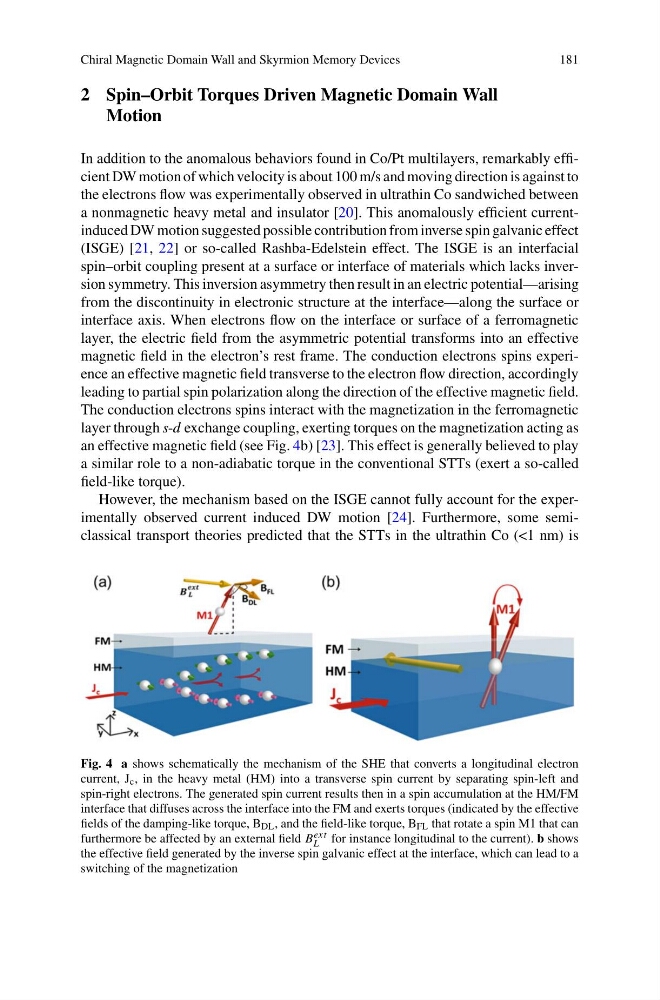
an effective magnetic field (see Fig. 4b) [23]. This effect is generally believed to play
a similar role to a non-adiabatic torque in the conventional STTs (exert a so-called
field-like torque).
However, the mechanism based on the ISGE cannot fully account for the experimentally observed current induced DW motion [24]. Furthermore, some semiclassical transport theories predicted that the STTs in the ultrathin Co (<1 nm) is
Fig. 4 a shows schematically the mechanism of the SHE that converts a longitudinal electron
current, J c , in the heavy metal (HM) into a transverse spin current by separating spin-left and
spin-right electrons. The generated spin current results then in a spin accumulation at the HM/FM
interface that diffuses across the interface into the FM and exerts torques (indicated by the effective
fields of the damping-like torque, B DL , and the field-like torque, B FL that rotate a spin M1 that can
furthermore be affected by an external field B ext
L for instance longitudinal to the current). b shows
the effective field generated by the inverse spin galvanic effect at the interface, which can lead to a
switching of the magnetization
181
2 Spin–Orbit Torques Driven Magnetic Domain Wall
Motion
In addition to the anomalous behaviors found in Co/Pt multilayers, remarkably efficient DW motion of which velocity is about 100 m/s and moving direction is against to
the electrons flow was experimentally observed in ultrathin Co sandwiched between
a nonmagnetic heavy metal and insulator [20]. This anomalously efficient currentinduced DW motion suggested possible contribution from inverse spin galvanic effect
(ISGE) [21, 22] or so-called Rashba-Edelstein effect. The ISGE is an interfacial
spin–orbit coupling present at a surface or interface of materials which lacks inversion symmetry. This inversion asymmetry then result in an electric potential—arising
from the discontinuity in electronic structure at the interface—along the surface or
interface axis. When electrons flow on the interface or surface of a ferromagnetic
layer, the electric field from the asymmetric potential transforms into an effective
magnetic field in the electron’s rest frame. The conduction electrons spins experience an effective magnetic field transverse to the electron flow direction, accordingly
leading to partial spin polarization along the direction of the effective magnetic field.
The conduction electrons spins interact with the magnetization in the ferromagnetic
layer through s-d exchange coupling, exerting torques on the magnetization acting as
an effective magnetic field (see Fig. 4b) [23]. This effect is generally believed to play
a similar role to a non-adiabatic torque in the conventional STTs (exert a so-called
field-like torque).
However, the mechanism based on the ISGE cannot fully account for the experimentally observed current induced DW motion [24]. Furthermore, some semiclassical transport theories predicted that the STTs in the ultrathin Co (<1 nm) is
Fig. 4 a shows schematically the mechanism of the SHE that converts a longitudinal electron
current, J c , in the heavy metal (HM) into a transverse spin current by separating spin-left and
spin-right electrons. The generated spin current results then in a spin accumulation at the HM/FM
interface that diffuses across the interface into the FM and exerts torques (indicated by the effective
fields of the damping-like torque, B DL , and the field-like torque, B FL that rotate a spin M1 that can
furthermore be affected by an external field B ext
L for instance longitudinal to the current). b shows
the effective field generated by the inverse spin galvanic effect at the interface, which can lead to a
switching of the magnetization