

Chiral Magnetic Domain Wall and Skyrmion Memory Devices
179
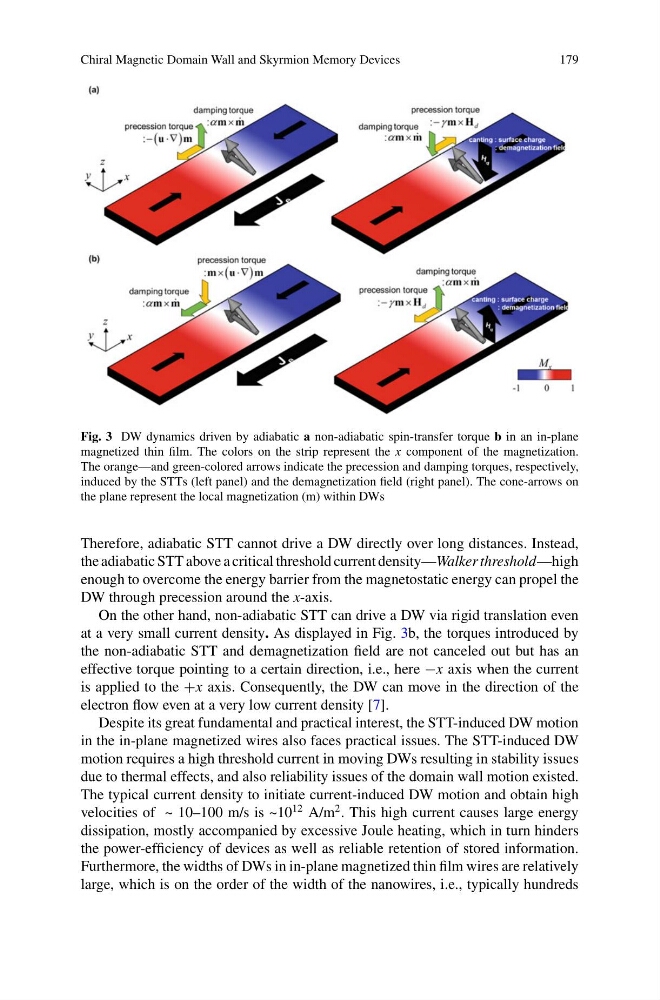
Fig. 3 DW dynamics driven by adiabatic a non-adiabatic spin-transfer torque b in an in-plane
magnetized thin film. The colors on the strip represent the x component of the magnetization.
The orange—and green-colored arrows indicate the precession and damping torques, respectively,
induced by the STTs (left panel) and the demagnetization field (right panel). The cone-arrows on
the plane represent the local magnetization (m) within DWs
Therefore, adiabatic STT cannot drive a DW directly over long distances. Instead,
the adiabatic STT above a critical threshold current density—Walker threshold—high
enough to overcome the energy barrier from the magnetostatic energy can propel the
DW through precession around the x-axis.
On the other hand, non-adiabatic STT can drive a DW via rigid translation even
at a very small current density. As displayed in Fig. 3b, the torques introduced by
the non-adiabatic STT and demagnetization field are not canceled out but has an
effective torque pointing to a certain direction, i.e., here −x axis when the current
is applied to the +x axis. Consequently, the DW can move in the direction of the
electron flow even at a very low current density [7].
Despite its great fundamental and practical interest, the STT-induced DW motion
in the in-plane magnetized wires also faces practical issues. The STT-induced DW
motion requires a high threshold current in moving DWs resulting in stability issues
due to thermal effects, and also reliability issues of the domain wall motion existed.
The typical current density to initiate current-induced DW motion and obtain high
velocities of ~ 10–100 m/s is ~10
12 A/m
2 . This high current causes large energy
dissipation, mostly accompanied by excessive Joule heating, which in turn hinders
the power-efficiency of devices as well as reliable retention of stored information.
Furthermore, the widths of DWs in in-plane magnetized thin film wires are relatively
large, which is on the order of the width of the nanowires, i.e., typically hundreds
179
Fig. 3 DW dynamics driven by adiabatic a non-adiabatic spin-transfer torque b in an in-plane
magnetized thin film. The colors on the strip represent the x component of the magnetization.
The orange—and green-colored arrows indicate the precession and damping torques, respectively,
induced by the STTs (left panel) and the demagnetization field (right panel). The cone-arrows on
the plane represent the local magnetization (m) within DWs
Therefore, adiabatic STT cannot drive a DW directly over long distances. Instead,
the adiabatic STT above a critical threshold current density—Walker threshold—high
enough to overcome the energy barrier from the magnetostatic energy can propel the
DW through precession around the x-axis.
On the other hand, non-adiabatic STT can drive a DW via rigid translation even
at a very small current density. As displayed in Fig. 3b, the torques introduced by
the non-adiabatic STT and demagnetization field are not canceled out but has an
effective torque pointing to a certain direction, i.e., here −x axis when the current
is applied to the +x axis. Consequently, the DW can move in the direction of the
electron flow even at a very low current density [7].
Despite its great fundamental and practical interest, the STT-induced DW motion
in the in-plane magnetized wires also faces practical issues. The STT-induced DW
motion requires a high threshold current in moving DWs resulting in stability issues
due to thermal effects, and also reliability issues of the domain wall motion existed.
The typical current density to initiate current-induced DW motion and obtain high
velocities of ~ 10–100 m/s is ~10
12 A/m
2 . This high current causes large energy
dissipation, mostly accompanied by excessive Joule heating, which in turn hinders
the power-efficiency of devices as well as reliable retention of stored information.
Furthermore, the widths of DWs in in-plane magnetized thin film wires are relatively
large, which is on the order of the width of the nanowires, i.e., typically hundreds