

160
J. Lourembam and J. Huang
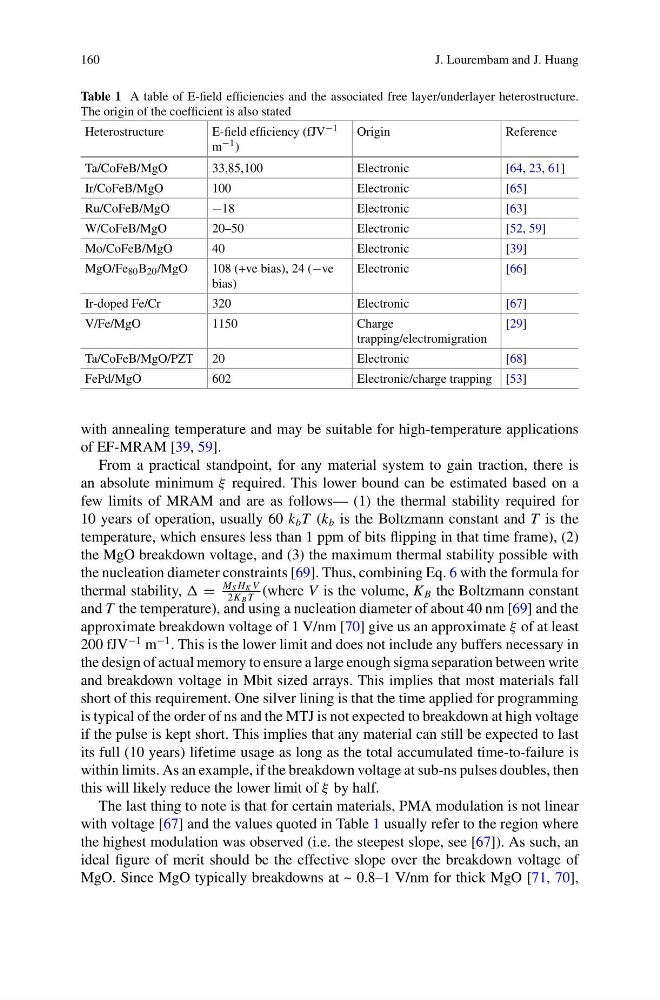
Table 1 A table of E-field efficiencies and the associated free layer/underlayer heterostructure.
The origin of the coefficient is also stated
Heterostructure
E-field efficiency (fJV −1
m −1 )
Origin
Reference
Ta/CoFeB/MgO
33,85,100
Electronic
[64, 23, 61]
Ir/CoFeB/MgO
100
Electronic
[65]
Ru/CoFeB/MgO
−18
Electronic
[63]
W/CoFeB/MgO
20–50
Electronic
[52, 59]
Mo/CoFeB/MgO
40
Electronic
[39]
MgO/Fe 80 B 20 /MgO
108 (+ve bias), 24 (−ve
bias)
Electronic
[66]
Ir-doped Fe/Cr
320
Electronic
[67]
V/Fe/MgO
1150
Charge
trapping/electromigration
[29]
Ta/CoFeB/MgO/PZT 20
Electronic
[68]
FePd/MgO
602
Electronic/charge trapping [53]
with annealing temperature and may be suitable for high-temperature applications
of EF-MRAM [39, 59].
From a practical standpoint, for any material system to gain traction, there is
an absolute minimum ξ required. This lower bound can be estimated based on a
few limits of MRAM and are as follows— (1) the thermal stability required for
10 years of operation, usually 60 k b T (k b is the Boltzmann constant and T is the
temperature, which ensures less than 1 ppm of bits flipping in that time frame), (2)
the MgO breakdown voltage, and (3) the maximum thermal stability possible with
the nucleation diameter constraints [69]. Thus, combining Eq. 6 with the formula for
thermal stability, =
M S H K V
2K B T
(where V is the volume, K B the Boltzmann constant
and T the temperature), and using a nucleation diameter of about 40 nm [69] and the
approximate breakdown voltage of 1 V/nm [70] give us an approximate ξ of at least
200 fJV
−1 m
−1 . This is the lower limit and does not include any buffers necessary in
the design of actual memory to ensure a large enough sigma separation between write
and breakdown voltage in Mbit sized arrays. This implies that most materials fall
short of this requirement. One silver lining is that the time applied for programming
is typical of the order of ns and the MTJ is not expected to breakdown at high voltage
if the pulse is kept short. This implies that any material can still be expected to last
its full (10 years) lifetime usage as long as the total accumulated time-to-failure is
within limits. As an example, if the breakdown voltage at sub-ns pulses doubles, then
this will likely reduce the lower limit of ξ by half.
The last thing to note is that for certain materials, PMA modulation is not linear
with voltage [67] and the values quoted in Table 1 usually refer to the region where
the highest modulation was observed (i.e. the steepest slope, see [67]). As such, an
ideal figure of merit should be the effective slope over the breakdown voltage of
MgO. Since MgO typically breakdowns at ~ 0.8–1 V/nm for thick MgO [71, 70],
J. Lourembam and J. Huang
Table 1 A table of E-field efficiencies and the associated free layer/underlayer heterostructure.
The origin of the coefficient is also stated
Heterostructure
E-field efficiency (fJV −1
m −1 )
Origin
Reference
Ta/CoFeB/MgO
33,85,100
Electronic
[64, 23, 61]
Ir/CoFeB/MgO
100
Electronic
[65]
Ru/CoFeB/MgO
−18
Electronic
[63]
W/CoFeB/MgO
20–50
Electronic
[52, 59]
Mo/CoFeB/MgO
40
Electronic
[39]
MgO/Fe 80 B 20 /MgO
108 (+ve bias), 24 (−ve
bias)
Electronic
[66]
Ir-doped Fe/Cr
320
Electronic
[67]
V/Fe/MgO
1150
Charge
trapping/electromigration
[29]
Ta/CoFeB/MgO/PZT 20
Electronic
[68]
FePd/MgO
602
Electronic/charge trapping [53]
with annealing temperature and may be suitable for high-temperature applications
of EF-MRAM [39, 59].
From a practical standpoint, for any material system to gain traction, there is
an absolute minimum ξ required. This lower bound can be estimated based on a
few limits of MRAM and are as follows— (1) the thermal stability required for
10 years of operation, usually 60 k b T (k b is the Boltzmann constant and T is the
temperature, which ensures less than 1 ppm of bits flipping in that time frame), (2)
the MgO breakdown voltage, and (3) the maximum thermal stability possible with
the nucleation diameter constraints [69]. Thus, combining Eq. 6 with the formula for
thermal stability, =
M S H K V
2K B T
(where V is the volume, K B the Boltzmann constant
and T the temperature), and using a nucleation diameter of about 40 nm [69] and the
approximate breakdown voltage of 1 V/nm [70] give us an approximate ξ of at least
200 fJV
−1 m
−1 . This is the lower limit and does not include any buffers necessary in
the design of actual memory to ensure a large enough sigma separation between write
and breakdown voltage in Mbit sized arrays. This implies that most materials fall
short of this requirement. One silver lining is that the time applied for programming
is typical of the order of ns and the MTJ is not expected to breakdown at high voltage
if the pulse is kept short. This implies that any material can still be expected to last
its full (10 years) lifetime usage as long as the total accumulated time-to-failure is
within limits. As an example, if the breakdown voltage at sub-ns pulses doubles, then
this will likely reduce the lower limit of ξ by half.
The last thing to note is that for certain materials, PMA modulation is not linear
with voltage [67] and the values quoted in Table 1 usually refer to the region where
the highest modulation was observed (i.e. the steepest slope, see [67]). As such, an
ideal figure of merit should be the effective slope over the breakdown voltage of
MgO. Since MgO typically breakdowns at ~ 0.8–1 V/nm for thick MgO [71, 70],