

3.1 Hooke Model
67
0
1
2
3
0
1
2
3
0
1
2
3
t
E(t)/E = H(t)
(t) 0 = H(t)
0
1
2
3
t
C(t) E = H(t)
σ(t)/σ0 = H(t)
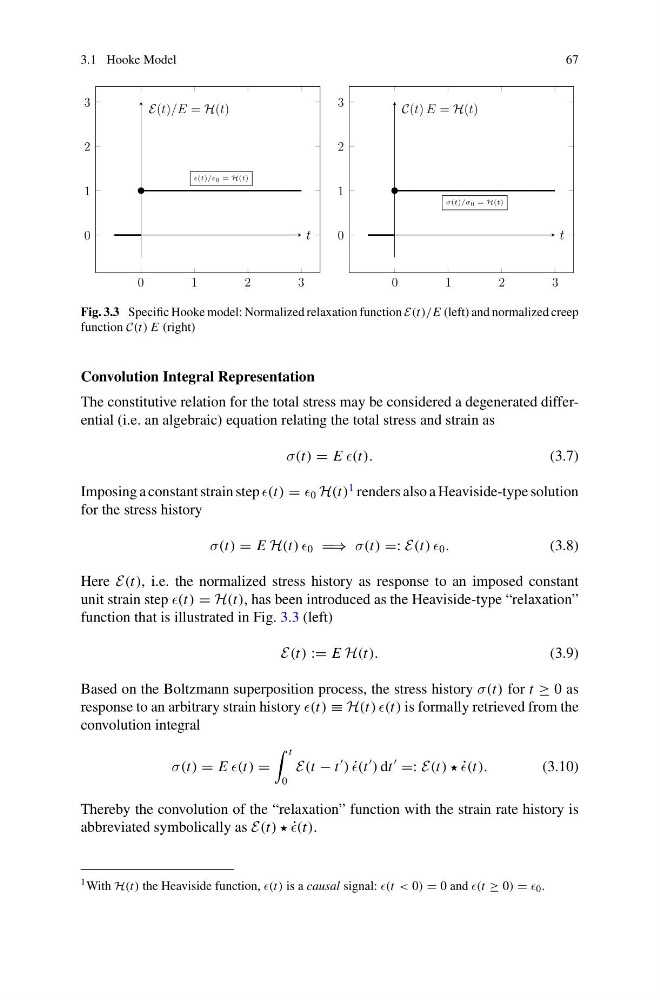
Fig. 3.3 Specific Hooke model: Normalized relaxation function E(t)/E (left) and normalized creep
function C(t) E (right)
Convolution Integral Representation
The constitutive relation for the total stress may be considered a degenerated differential (i.e. an algebraic) equation relating the total stress and strain as
σ(t) = E
(3.7)
Imposing a constant strain step = 0 H(t)
1 renders also a Heaviside-type solution
for the stress history
σ(t) = E H(t) 0 =⇒ σ(t) =: E(t) 0 .
(3.8)
Here E(t), i.e. the normalized stress history as response to an imposed constant
unit strain step = H(t), has been introduced as the Heaviside-type “relaxation”
function that is illustrated in Fig. 3.3 (left)
E(t) := E H(t).
(3.9)
Based on the Boltzmann superposition process, the stress history σ(t) for t ≥ 0 as
response to an arbitrary strain history ≡ H(t) is formally retrieved from the
convolution integral
σ(t) = E =
t
0
E(t − t
) ˙
) dt
=: E(t) ) ˙
(3.10)
Thereby the convolution of the “relaxation” function with the strain rate history is
abbreviated symbolically as E(t) ) ˙
1 With H(t) the Heaviside function, is a causal signal: < 0) = 0 and ≥ 0) = 0 .
67
0
1
2
3
0
1
2
3
0
1
2
3
t
E(t)/E = H(t)
(t) 0 = H(t)
0
1
2
3
t
C(t) E = H(t)
σ(t)/σ0 = H(t)
Fig. 3.3 Specific Hooke model: Normalized relaxation function E(t)/E (left) and normalized creep
function C(t) E (right)
Convolution Integral Representation
The constitutive relation for the total stress may be considered a degenerated differential (i.e. an algebraic) equation relating the total stress and strain as
σ(t) = E
(3.7)
Imposing a constant strain step = 0 H(t)
1 renders also a Heaviside-type solution
for the stress history
σ(t) = E H(t) 0 =⇒ σ(t) =: E(t) 0 .
(3.8)
Here E(t), i.e. the normalized stress history as response to an imposed constant
unit strain step = H(t), has been introduced as the Heaviside-type “relaxation”
function that is illustrated in Fig. 3.3 (left)
E(t) := E H(t).
(3.9)
Based on the Boltzmann superposition process, the stress history σ(t) for t ≥ 0 as
response to an arbitrary strain history ≡ H(t) is formally retrieved from the
convolution integral
σ(t) = E =
t
0
E(t − t
) ˙
) dt
=: E(t) ) ˙
(3.10)
Thereby the convolution of the “relaxation” function with the strain rate history is
abbreviated symbolically as E(t) ) ˙
1 With H(t) the Heaviside function, is a causal signal: < 0) = 0 and ≥ 0) = 0 .