

34
2 Preliminaries
{
n−1
, α
n−1 ;
n
}
Integrator
{σ
n
, α
n
, E
n
a }
n = n+ 1
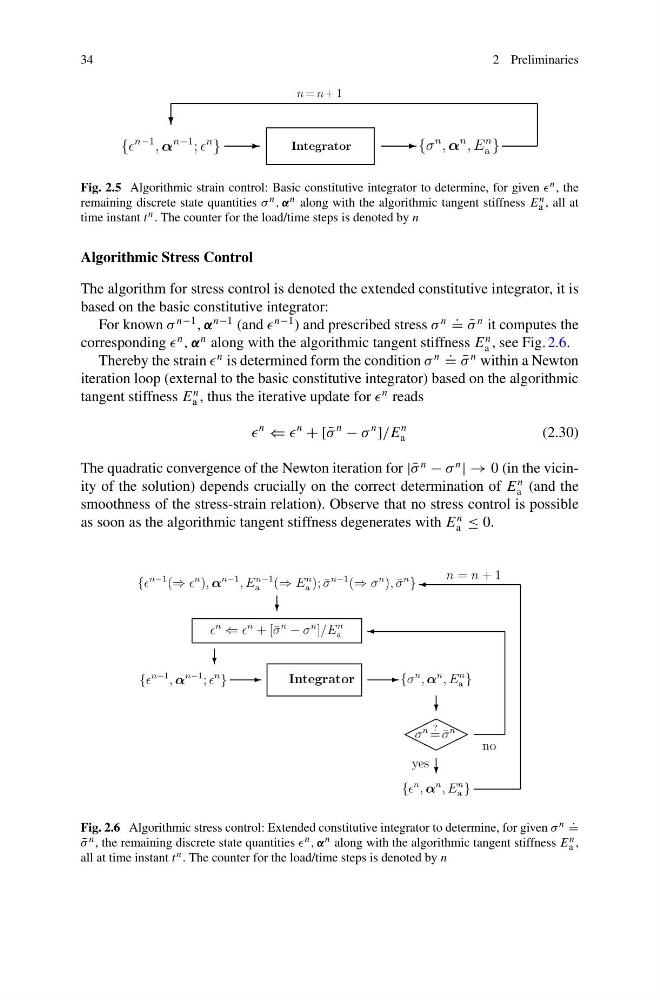
Fig. 2.5 Algorithmic strain control: Basic constitutive integrator to determine, for given n , the
remaining discrete state quantities σ n , α n along with the algorithmic tangent stiffness E n
a , all at
time instant t n . The counter for the load/time steps is denoted by n
Algorithmic Stress Control
The algorithm for stress control is denoted the extended constitutive integrator, it is
based on the basic constitutive integrator:
For known σ
n−1
, α
n−1 (and
n−1 ) and prescribed stress σ
n .
= ¯
σ
n it computes the
corresponding
n
, α
n along with the algorithmic tangent stiffness E
n
a , see Fig. 2.6.
Thereby the strain
n is determined form the condition σ
n .
= ¯
σ
n within a Newton
iteration loop (external to the basic constitutive integrator) based on the algorithmic
tangent stiffness E
n
a , thus the iterative update for
n reads
n
⇐
n
+ [ ¯
σ
n
− σ
n
]/E
n
a
(2.30)
The quadratic convergence of the Newton iteration for | ¯
σ
n
− σ
n
| → 0 (in the vicinity of the solution) depends crucially on the correct determination of E
n
a (and the
smoothness of the stress-strain relation). Observe that no stress control is possible
as soon as the algorithmic tangent stiffness degenerates with E
n
a ≤ 0.
{
n−1 , α
n−1 ;
n }
Integrator
{σ
n , α
n , E
n
a }
σ
n ?
= ¯
σ
n
no
yes
{
n , α
n , E
n
a }
n ⇐
n + [¯ σ
n − σ
n ]/E
n
a
{
n−1 (⇒
n ), α
n−1 , E
n−1
a
(⇒ E
n
a ); ¯
σ
n−1 (⇒ σ
n ), ¯
σ
n }
n = n + 1
Fig. 2.6 Algorithmic stress control: Extended constitutive integrator to determine, for given σ n .
=
¯
σ n , the remaining discrete state quantities n , α n along with the algorithmic tangent stiffness E n
a ,
all at time instant t n . The counter for the load/time steps is denoted by n
2 Preliminaries
{
n−1
, α
n−1 ;
n
}
Integrator
{σ
n
, α
n
, E
n
a }
n = n+ 1
Fig. 2.5 Algorithmic strain control: Basic constitutive integrator to determine, for given n , the
remaining discrete state quantities σ n , α n along with the algorithmic tangent stiffness E n
a , all at
time instant t n . The counter for the load/time steps is denoted by n
Algorithmic Stress Control
The algorithm for stress control is denoted the extended constitutive integrator, it is
based on the basic constitutive integrator:
For known σ
n−1
, α
n−1 (and
n−1 ) and prescribed stress σ
n .
= ¯
σ
n it computes the
corresponding
n
, α
n along with the algorithmic tangent stiffness E
n
a , see Fig. 2.6.
Thereby the strain
n is determined form the condition σ
n .
= ¯
σ
n within a Newton
iteration loop (external to the basic constitutive integrator) based on the algorithmic
tangent stiffness E
n
a , thus the iterative update for
n reads
n
⇐
n
+ [ ¯
σ
n
− σ
n
]/E
n
a
(2.30)
The quadratic convergence of the Newton iteration for | ¯
σ
n
− σ
n
| → 0 (in the vicinity of the solution) depends crucially on the correct determination of E
n
a (and the
smoothness of the stress-strain relation). Observe that no stress control is possible
as soon as the algorithmic tangent stiffness degenerates with E
n
a ≤ 0.
{
n−1 , α
n−1 ;
n }
Integrator
{σ
n , α
n , E
n
a }
σ
n ?
= ¯
σ
n
no
yes
{
n , α
n , E
n
a }
n ⇐
n + [¯ σ
n − σ
n ]/E
n
a
{
n−1 (⇒
n ), α
n−1 , E
n−1
a
(⇒ E
n
a ); ¯
σ
n−1 (⇒ σ
n ), ¯
σ
n }
n = n + 1
Fig. 2.6 Algorithmic stress control: Extended constitutive integrator to determine, for given σ n .
=
¯
σ n , the remaining discrete state quantities n , α n along with the algorithmic tangent stiffness E n
a ,
all at time instant t n . The counter for the load/time steps is denoted by n