

400
6 Visco-Plasticity
hardening strain)
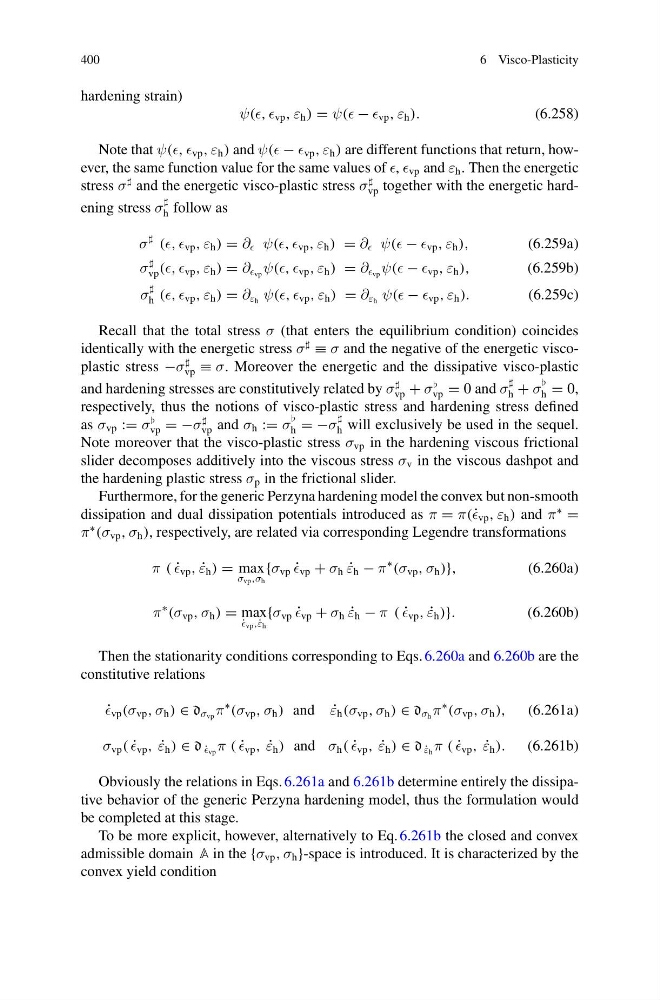
ψ(, vp , ε h ) = ψ( − vp , ε h ).
(6.258)
Note that ψ(, vp , ε h ) and ψ( − vp , ε h ) are different functions that return, however, the same function value for the same values of , vp and ε h . Then the energetic
stress σ
and the energetic visco-plastic stress σ
vp together with the energetic hardening stress σ
h follow as
σ
(, vp , ε h ) = ∂ ψ(, vp , ε h ) = ∂ ψ( − vp , ε h ),
(6.259a)
σ
vp (, vp , ε h ) = ∂ vp ψ(, vp , ε h ) = ∂ vp ψ( − vp , ε h ),
(6.259b)
σ
h (, vp , ε h ) = ∂ ε h ψ(, vp , ε h ) = ∂ ε h ψ( − vp , ε h ).
(6.259c)
Recall that the total stress σ (that enters the equilibrium condition) coincides
identically with the energetic stress σ
≡ σ and the negative of the energetic viscoplastic stress −σ
vp ≡ σ. Moreover the energetic and the dissipative visco-plastic
and hardening stresses are constitutively related by σ
vp + σ
vp = 0 and σ
h + σ
h = 0,
respectively, thus the notions of visco-plastic stress and hardening stress defined
as σ vp := σ
vp = −σ
vp and σ h := σ
h = −σ
h will exclusively be used in the sequel.
Note moreover that the visco-plastic stress σ vp in the hardening viscous frictional
slider decomposes additively into the viscous stress σ v in the viscous dashpot and
the hardening plastic stress σ p in the frictional slider.
Furthermore, for the generic Perzyna hardening model the convex but non-smooth
dissipation and dual dissipation potentials introduced as π = π(˙ vp , ε h ) and π
∗
=
π
∗
(σ vp , σ h ), respectively, are related via corresponding Legendre transformations
π ( ˙
vp , ˙
ε h ) = max
σ vp ,σ h
{σ vp ˙
vp + σ h ˙
ε h − π
∗
(σ vp , σ h )},
(6.260a)
π
∗
(σ vp , σ h ) = max
˙
vp ,˙ ε h
{σ vp ˙
vp + σ h ˙
ε h − π ( ˙
vp , ˙
ε h )}.
(6.260b)
Then the stationarity conditions corresponding to Eqs. 6.260a and 6.260b are the
constitutive relations
˙
vp (σ vp , σ h ) ∈ d σ vp π
∗
(σ vp , σ h ) and ˙
ε h (σ vp , σ h ) ∈ d σ h π
∗
(σ vp , σ h ), (6.261a)
σ vp ( ˙
vp , ˙
ε h ) ∈ d ˙
vp π ( ˙
vp , ˙
ε h ) and σ h ( ˙
vp , ˙
ε h ) ∈ d ˙
ε h π ( ˙
vp , ˙
ε h ). (6.261b)
Obviously the relations in Eqs. 6.261a and 6.261b determine entirely the dissipative behavior of the generic Perzyna hardening model, thus the formulation would
be completed at this stage.
To be more explicit, however, alternatively to Eq. 6.261b the closed and convex
admissible domain A in the {σ vp , σ h }-space is introduced. It is characterized by the
convex yield condition
6 Visco-Plasticity
hardening strain)
ψ(, vp , ε h ) = ψ( − vp , ε h ).
(6.258)
Note that ψ(, vp , ε h ) and ψ( − vp , ε h ) are different functions that return, however, the same function value for the same values of , vp and ε h . Then the energetic
stress σ
and the energetic visco-plastic stress σ
vp together with the energetic hardening stress σ
h follow as
σ
(, vp , ε h ) = ∂ ψ(, vp , ε h ) = ∂ ψ( − vp , ε h ),
(6.259a)
σ
vp (, vp , ε h ) = ∂ vp ψ(, vp , ε h ) = ∂ vp ψ( − vp , ε h ),
(6.259b)
σ
h (, vp , ε h ) = ∂ ε h ψ(, vp , ε h ) = ∂ ε h ψ( − vp , ε h ).
(6.259c)
Recall that the total stress σ (that enters the equilibrium condition) coincides
identically with the energetic stress σ
≡ σ and the negative of the energetic viscoplastic stress −σ
vp ≡ σ. Moreover the energetic and the dissipative visco-plastic
and hardening stresses are constitutively related by σ
vp + σ
vp = 0 and σ
h + σ
h = 0,
respectively, thus the notions of visco-plastic stress and hardening stress defined
as σ vp := σ
vp = −σ
vp and σ h := σ
h = −σ
h will exclusively be used in the sequel.
Note moreover that the visco-plastic stress σ vp in the hardening viscous frictional
slider decomposes additively into the viscous stress σ v in the viscous dashpot and
the hardening plastic stress σ p in the frictional slider.
Furthermore, for the generic Perzyna hardening model the convex but non-smooth
dissipation and dual dissipation potentials introduced as π = π(˙ vp , ε h ) and π
∗
=
π
∗
(σ vp , σ h ), respectively, are related via corresponding Legendre transformations
π ( ˙
vp , ˙
ε h ) = max
σ vp ,σ h
{σ vp ˙
vp + σ h ˙
ε h − π
∗
(σ vp , σ h )},
(6.260a)
π
∗
(σ vp , σ h ) = max
˙
vp ,˙ ε h
{σ vp ˙
vp + σ h ˙
ε h − π ( ˙
vp , ˙
ε h )}.
(6.260b)
Then the stationarity conditions corresponding to Eqs. 6.260a and 6.260b are the
constitutive relations
˙
vp (σ vp , σ h ) ∈ d σ vp π
∗
(σ vp , σ h ) and ˙
ε h (σ vp , σ h ) ∈ d σ h π
∗
(σ vp , σ h ), (6.261a)
σ vp ( ˙
vp , ˙
ε h ) ∈ d ˙
vp π ( ˙
vp , ˙
ε h ) and σ h ( ˙
vp , ˙
ε h ) ∈ d ˙
ε h π ( ˙
vp , ˙
ε h ). (6.261b)
Obviously the relations in Eqs. 6.261a and 6.261b determine entirely the dissipative behavior of the generic Perzyna hardening model, thus the formulation would
be completed at this stage.
To be more explicit, however, alternatively to Eq. 6.261b the closed and convex
admissible domain A in the {σ vp , σ h }-space is introduced. It is characterized by the
convex yield condition