

388
6 Visco-Plasticity
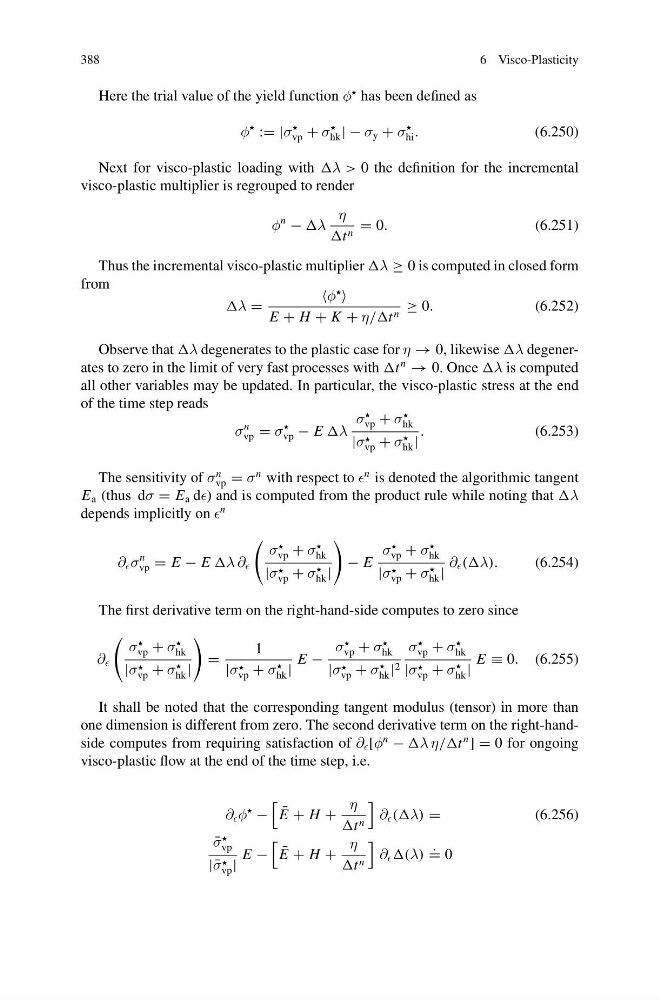
Here the trial value of the yield function φ
has been defined as
φ
:= |σ
vp + σ
hk | − σ y + σ
hi .
(6.250)
Next for visco-plastic loading with λ > 0 the definition for the incremental
visco-plastic multiplier is regrouped to render
φ
n
− λ
η
t n = 0.
(6.251)
Thus the incremental visco-plastic multiplier λ ≥ 0 is computed in closed form
from
λ =
φ
E + H + K + η//t n ≥ 0.
(6.252)
Observe that λ degenerates to the plastic case for η → 0, likewise λ degenerates to zero in the limit of very fast processes with t
n
→ 0. Once λ is computed
all other variables may be updated. In particular, the visco-plastic stress at the end
of the time step reads
σ
n
vp = σ
vp − E λ
σ
vp + σ
hk
|σ
vp + σ
hk |
.
(6.253)
The sensitivity of σ
n
vp = σ
n with respect to
n is denoted the algorithmic tangent
E a (thus dσ = E a d) and is computed from the product rule while noting that λ
depends implicitly on
n
∂ σ
n
vp = E − E λ ∂
σ
vp + σ
hk
|σ
vp + σ
hk |
− E
σ
vp + σ
hk
|σ
vp + σ
hk |
∂ ((λ).
(6.254)
The first derivative term on the right-hand-side computes to zero since
∂
σ
vp + σ
hk
|σ
vp + σ
hk |
=
1
|σ
vp + σ
hk |
E −
σ
vp + σ
hk
|σ
vp + σ
hk | 2
σ
vp + σ
hk
|σ
vp + σ
hk |
E ≡ 0. (6.255)
It shall be noted that the corresponding tangent modulus (tensor) in more than
one dimension is different from zero. The second derivative term on the right-handside computes from requiring satisfaction of ∂ [φ
n
− λ η//t
n
] = 0 for ongoing
visco-plastic flow at the end of the time step, i.e.
∂ φ
−
¯
E + H +
η
t n
∂ ((λ) =
(6.256)
¯
σ
vp
| ¯
σ
vp |
E −
¯
E + H +
η
t n
∂ (λ)
.
= 0
6 Visco-Plasticity
Here the trial value of the yield function φ
has been defined as
φ
:= |σ
vp + σ
hk | − σ y + σ
hi .
(6.250)
Next for visco-plastic loading with λ > 0 the definition for the incremental
visco-plastic multiplier is regrouped to render
φ
n
− λ
η
t n = 0.
(6.251)
Thus the incremental visco-plastic multiplier λ ≥ 0 is computed in closed form
from
λ =
φ
E + H + K + η//t n ≥ 0.
(6.252)
Observe that λ degenerates to the plastic case for η → 0, likewise λ degenerates to zero in the limit of very fast processes with t
n
→ 0. Once λ is computed
all other variables may be updated. In particular, the visco-plastic stress at the end
of the time step reads
σ
n
vp = σ
vp − E λ
σ
vp + σ
hk
|σ
vp + σ
hk |
.
(6.253)
The sensitivity of σ
n
vp = σ
n with respect to
n is denoted the algorithmic tangent
E a (thus dσ = E a d) and is computed from the product rule while noting that λ
depends implicitly on
n
∂ σ
n
vp = E − E λ ∂
σ
vp + σ
hk
|σ
vp + σ
hk |
− E
σ
vp + σ
hk
|σ
vp + σ
hk |
∂ ((λ).
(6.254)
The first derivative term on the right-hand-side computes to zero since
∂
σ
vp + σ
hk
|σ
vp + σ
hk |
=
1
|σ
vp + σ
hk |
E −
σ
vp + σ
hk
|σ
vp + σ
hk | 2
σ
vp + σ
hk
|σ
vp + σ
hk |
E ≡ 0. (6.255)
It shall be noted that the corresponding tangent modulus (tensor) in more than
one dimension is different from zero. The second derivative term on the right-handside computes from requiring satisfaction of ∂ [φ
n
− λ η//t
n
] = 0 for ongoing
visco-plastic flow at the end of the time step, i.e.
∂ φ
−
¯
E + H +
η
t n
∂ ((λ) =
(6.256)
¯
σ
vp
| ¯
σ
vp |
E −
¯
E + H +
η
t n
∂ (λ)
.
= 0