

6.3 Perzyna Hardening Model
383
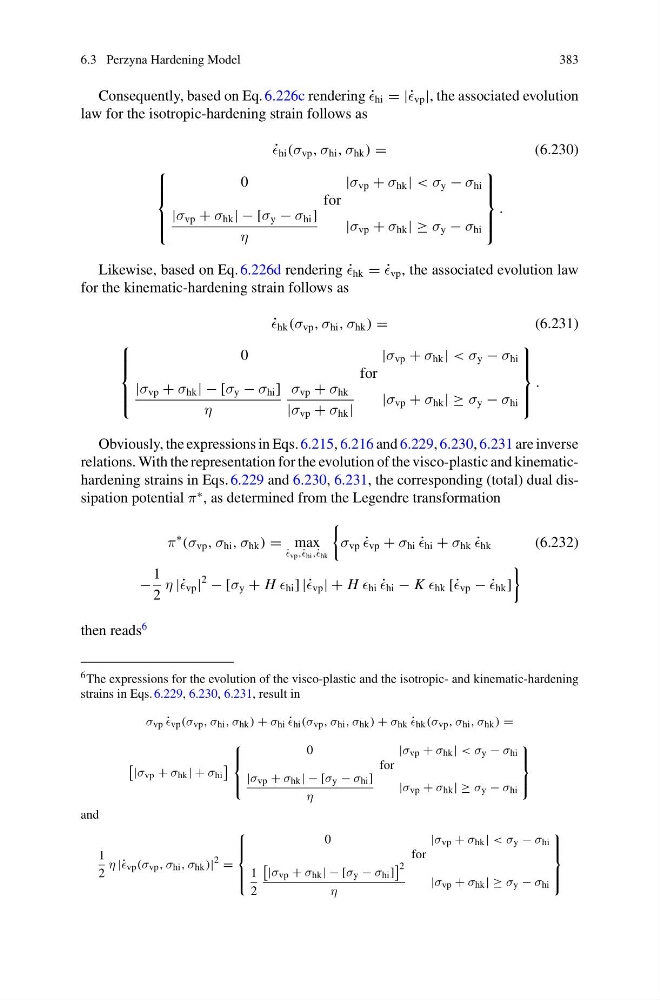
Consequently, based on Eq. 6.226c rendering ˙
hi = |˙ vp |, the associated evolution
law for the isotropic-hardening strain follows as
˙
hi (σ vp , σ hi , σ hk ) =
(6.230)
⎧
⎪ ⎪ ⎨
⎪ ⎪ ⎩
0
|σ vp + σ hk | < σ y − σ hi
for
|σ vp + σ hk | − [σ y − σ hi ]
η
|σ vp + σ hk | ≥ σ y − σ hi
⎫
⎪ ⎪ ⎬
⎪ ⎪ ⎭
.
Likewise, based on Eq. 6.226d rendering ˙
hk = ˙
vp , the associated evolution law
for the kinematic-hardening strain follows as
˙
hk (σ vp , σ hi , σ hk ) =
(6.231)
⎧
⎪ ⎪ ⎨
⎪ ⎪ ⎩
0
|σ vp + σ hk | < σ y − σ hi
for
|σ vp + σ hk | − [σ y − σ hi ]
η
σ vp + σ hk
|σ vp + σ hk |
|σ vp + σ hk | ≥ σ y − σ hi
⎫
⎪ ⎪ ⎬
⎪ ⎪ ⎭
.
Obviously, the expressions in Eqs. 6.215, 6.216 and 6.229, 6.230, 6.231 are inverse
relations. With the representation for the evolution of the visco-plastic and kinematichardening strains in Eqs. 6.229 and 6.230, 6.231, the corresponding (total) dual dissipation potential π
∗ , as determined from the Legendre transformation
π
∗
(σ vp , σ hi , σ hk ) = max
˙
vp ,˙ hi ,˙ hk
σ vp ˙
vp + σ hi ˙
hi + σ hk ˙
hk
(6.232)
−
1
2
η |˙ vp |
2
− [σ y + H hi ] |˙ vp | + H hi ˙
hi − K hk [˙ vp − ˙
hk ]
then reads
6
6 The expressions for the evolution of the visco-plastic and the isotropic- and kinematic-hardening
strains in Eqs. 6.229, 6.230, 6.231, result in
σ vp ˙
vp (σ vp , σ hi , σ hk ) + σ hi ˙
hi (σ vp , σ hi , σ hk ) + σ hk ˙
hk (σ vp , σ hi , σ hk ) =
|σ vp + σ hk | + σ hi
⎧
⎪ ⎨
⎪ ⎩
0
|σ vp + σ hk | < σ y − σ hi
for
|σ vp + σ hk | − [σ y − σ hi ]
η
|σ vp + σ hk | ≥ σ y − σ hi
⎫
⎪ ⎬
⎪ ⎭
and
1
2
η |˙ vp (σ vp , σ hi , σ hk )|
2 =
⎧
⎪ ⎪ ⎨
⎪ ⎪ ⎩
0
|σ vp + σ hk | < σ y − σ hi
for
1
2
|σ vp + σ hk | − [σ y − σ hi ]
2
η
|σ vp + σ hk | ≥ σ y − σ hi
⎫
⎪ ⎪ ⎬
⎪ ⎪ ⎭
383
Consequently, based on Eq. 6.226c rendering ˙
hi = |˙ vp |, the associated evolution
law for the isotropic-hardening strain follows as
˙
hi (σ vp , σ hi , σ hk ) =
(6.230)
⎧
⎪ ⎪ ⎨
⎪ ⎪ ⎩
0
|σ vp + σ hk | < σ y − σ hi
for
|σ vp + σ hk | − [σ y − σ hi ]
η
|σ vp + σ hk | ≥ σ y − σ hi
⎫
⎪ ⎪ ⎬
⎪ ⎪ ⎭
.
Likewise, based on Eq. 6.226d rendering ˙
hk = ˙
vp , the associated evolution law
for the kinematic-hardening strain follows as
˙
hk (σ vp , σ hi , σ hk ) =
(6.231)
⎧
⎪ ⎪ ⎨
⎪ ⎪ ⎩
0
|σ vp + σ hk | < σ y − σ hi
for
|σ vp + σ hk | − [σ y − σ hi ]
η
σ vp + σ hk
|σ vp + σ hk |
|σ vp + σ hk | ≥ σ y − σ hi
⎫
⎪ ⎪ ⎬
⎪ ⎪ ⎭
.
Obviously, the expressions in Eqs. 6.215, 6.216 and 6.229, 6.230, 6.231 are inverse
relations. With the representation for the evolution of the visco-plastic and kinematichardening strains in Eqs. 6.229 and 6.230, 6.231, the corresponding (total) dual dissipation potential π
∗ , as determined from the Legendre transformation
π
∗
(σ vp , σ hi , σ hk ) = max
˙
vp ,˙ hi ,˙ hk
σ vp ˙
vp + σ hi ˙
hi + σ hk ˙
hk
(6.232)
−
1
2
η |˙ vp |
2
− [σ y + H hi ] |˙ vp | + H hi ˙
hi − K hk [˙ vp − ˙
hk ]
then reads
6
6 The expressions for the evolution of the visco-plastic and the isotropic- and kinematic-hardening
strains in Eqs. 6.229, 6.230, 6.231, result in
σ vp ˙
vp (σ vp , σ hi , σ hk ) + σ hi ˙
hi (σ vp , σ hi , σ hk ) + σ hk ˙
hk (σ vp , σ hi , σ hk ) =
|σ vp + σ hk | + σ hi
⎧
⎪ ⎨
⎪ ⎩
0
|σ vp + σ hk | < σ y − σ hi
for
|σ vp + σ hk | − [σ y − σ hi ]
η
|σ vp + σ hk | ≥ σ y − σ hi
⎫
⎪ ⎬
⎪ ⎭
and
1
2
η |˙ vp (σ vp , σ hi , σ hk )|
2 =
⎧
⎪ ⎪ ⎨
⎪ ⎪ ⎩
0
|σ vp + σ hk | < σ y − σ hi
for
1
2
|σ vp + σ hk | − [σ y − σ hi ]
2
η
|σ vp + σ hk | ≥ σ y − σ hi
⎫
⎪ ⎪ ⎬
⎪ ⎪ ⎭