

6.3 Perzyna Hardening Model
381
d σ hk π
∗
p (σ p , σ hi , σ hk ) = d σ hk I A (σ p , σ hk , σ hk ) =
(6.226d)
⎧
⎪ ⎪ ⎨
⎪ ⎪ ⎩
0
|σ p + σ hk | < σ y − σ hi
for
λ
σ p + σ hk
|σ p + σ hk |
|σ p + σ hk | = σ y − σ hi
⎫
⎪ ⎪ ⎬
⎪ ⎪ ⎭
,
whereby d σ p π
∗
p , d σ hi π
∗
p and d σ hk π
∗
p denote the sets of sub-derivatives, i.e. the subdifferentials of π
∗
p with respect to σ p , σ hi and σ hk , respectively, and λ is a positive
Lagrange (or rather plastic) multiplier.
Obviously, the expressions in Eqs. 6.215, 6.216 and 6.225 are inverse relations.
The smooth viscous dissipation and dual viscous dissipation potentials π v = π v (˙ vp )
and π
∗
v = π
∗
v (σ v ) together with the resulting smooth constitutive relations σ v =
σ v (˙ vp ) and ˙
vp = ˙
vp (σ v ) are similar to those displayed in Fig. 4.2. Identifying ˙
hi
with |˙ vp | and ˙
hk with ˙
vp and setting σ hi = 0 and σ hk = 0, the remaining non-smooth
plastic dissipation and dual plastic dissipation potentials π p = π p (˙ vp ) and π
∗
p =
π
∗
p (σ p ) together with the resulting non-smooth constitutive relations σ p = σ p (˙ vp )
and ˙
vp = ˙
vp (σ p ) are similar to those displayed in Fig. 5.3.
Visco-Plastic Stress
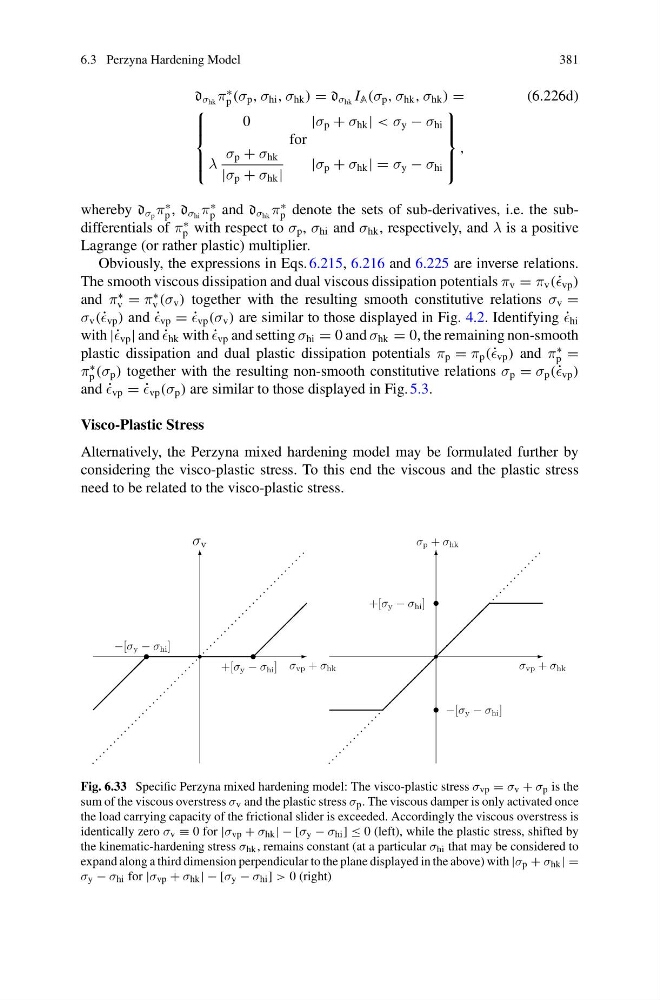
Alternatively, the Perzyna mixed hardening model may be formulated further by
considering the visco-plastic stress. To this end the viscous and the plastic stress
need to be related to the visco-plastic stress.
σ vp + σ hk
σ v
−[σ y − σ hi ]
+[σ y − σ hi ]
σ vp + σ hk
σ p + σ hk
+[σ y − σ hi ]
−[σ y − σ hi ]
Fig. 6.33 Specific Perzyna mixed hardening model: The visco-plastic stress σ vp = σ v + σ p is the
sum of the viscous overstress σ v and the plastic stress σ p . The viscous damper is only activated once
the load carrying capacity of the frictional slider is exceeded. Accordingly the viscous overstress is
identically zero σ v ≡ 0 for |σ vp + σ hk | − [σ y − σ hi ] ≤ 0 (left), while the plastic stress, shifted by
the kinematic-hardening stress σ hk , remains constant (at a particular σ hi that may be considered to
expand along a third dimension perpendicular to the plane displayed in the above) with |σ p + σ hk | =
σ y − σ hi for |σ vp + σ hk | − [σ y − σ hi ] > 0 (right)
381
d σ hk π
∗
p (σ p , σ hi , σ hk ) = d σ hk I A (σ p , σ hk , σ hk ) =
(6.226d)
⎧
⎪ ⎪ ⎨
⎪ ⎪ ⎩
0
|σ p + σ hk | < σ y − σ hi
for
λ
σ p + σ hk
|σ p + σ hk |
|σ p + σ hk | = σ y − σ hi
⎫
⎪ ⎪ ⎬
⎪ ⎪ ⎭
,
whereby d σ p π
∗
p , d σ hi π
∗
p and d σ hk π
∗
p denote the sets of sub-derivatives, i.e. the subdifferentials of π
∗
p with respect to σ p , σ hi and σ hk , respectively, and λ is a positive
Lagrange (or rather plastic) multiplier.
Obviously, the expressions in Eqs. 6.215, 6.216 and 6.225 are inverse relations.
The smooth viscous dissipation and dual viscous dissipation potentials π v = π v (˙ vp )
and π
∗
v = π
∗
v (σ v ) together with the resulting smooth constitutive relations σ v =
σ v (˙ vp ) and ˙
vp = ˙
vp (σ v ) are similar to those displayed in Fig. 4.2. Identifying ˙
hi
with |˙ vp | and ˙
hk with ˙
vp and setting σ hi = 0 and σ hk = 0, the remaining non-smooth
plastic dissipation and dual plastic dissipation potentials π p = π p (˙ vp ) and π
∗
p =
π
∗
p (σ p ) together with the resulting non-smooth constitutive relations σ p = σ p (˙ vp )
and ˙
vp = ˙
vp (σ p ) are similar to those displayed in Fig. 5.3.
Visco-Plastic Stress
Alternatively, the Perzyna mixed hardening model may be formulated further by
considering the visco-plastic stress. To this end the viscous and the plastic stress
need to be related to the visco-plastic stress.
σ vp + σ hk
σ v
−[σ y − σ hi ]
+[σ y − σ hi ]
σ vp + σ hk
σ p + σ hk
+[σ y − σ hi ]
−[σ y − σ hi ]
Fig. 6.33 Specific Perzyna mixed hardening model: The visco-plastic stress σ vp = σ v + σ p is the
sum of the viscous overstress σ v and the plastic stress σ p . The viscous damper is only activated once
the load carrying capacity of the frictional slider is exceeded. Accordingly the viscous overstress is
identically zero σ v ≡ 0 for |σ vp + σ hk | − [σ y − σ hi ] ≤ 0 (left), while the plastic stress, shifted by
the kinematic-hardening stress σ hk , remains constant (at a particular σ hi that may be considered to
expand along a third dimension perpendicular to the plane displayed in the above) with |σ p + σ hk | =
σ y − σ hi for |σ vp + σ hk | − [σ y − σ hi ] > 0 (right)