

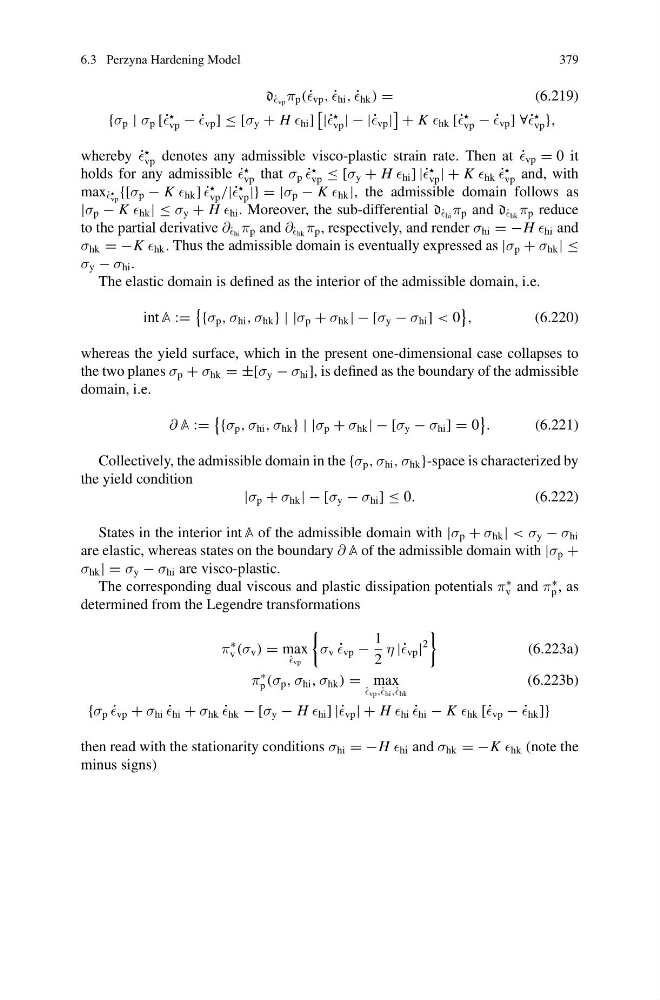
6.3 Perzyna Hardening Model
379
d ˙
vp π p (˙ vp , ˙
hi , ˙
hk ) =
(6.219)
{σ p | σ p [˙
vp − ˙
vp ] ≤ [σ y + H hi ]
|˙
vp | − |˙ vp |
+ K hk [˙
vp − ˙
vp ] ∀˙
vp },
whereby ˙
vp denotes any admissible visco-plastic strain rate. Then at ˙
vp = 0 it
holds for any admissible ˙
vp that σ p ˙
vp ≤ [σ y + H hi ] |˙
vp | + K hk ˙
vp and, with
max ˙
vp
{[σ p − K hk ] ˙
vp /|˙
vp |} = |σ p − K hk |, the admissible domain follows as
|σ p − K hk | ≤ σ y + H hi . Moreover, the sub-differential d ˙
hi π p and d ˙
hk π p reduce
to the partial derivative ∂ ˙
hi π p and ∂ ˙
hk π p , respectively, and render σ hi = −H hi and
σ hk = −K hk . Thus the admissible domain is eventually expressed as |σ p + σ hk | ≤
σ y − σ hi .
The elastic domain is defined as the interior of the admissible domain, i.e.
int A :=
{σ p , σ hi , σ hk } | |σ p + σ hk | − [σ y − σ hi ] < 0
,
(6.220)
whereas the yield surface, which in the present one-dimensional case collapses to
the two planes σ p + σ hk = ±[σ y − σ hi ], is defined as the boundary of the admissible
domain, i.e.
∂ A :=
{σ p , σ hi , σ hk } | |σ p + σ hk | − [σ y − σ hi ] = 0
.
(6.221)
Collectively, the admissible domain in the {σ p , σ hi , σ hk }-space is characterized by
the yield condition
|σ p + σ hk | − [σ y − σ hi ] ≤ 0.
(6.222)
States in the interior int A of the admissible domain with |σ p + σ hk | < σ y − σ hi
are elastic, whereas states on the boundary ∂ A of the admissible domain with |σ p +
σ hk | = σ y − σ hi are visco-plastic.
The corresponding dual viscous and plastic dissipation potentials π
∗
v and π
∗
p , as
determined from the Legendre transformations
π
∗
v (σ v ) = max
˙
vp
σ v ˙
vp −
1
2
η |˙ vp |
2
(6.223a)
π
∗
p (σ p , σ hi , σ hk ) = max
˙
vp ,˙ hi ,˙ hk
(6.223b)
{σ p ˙
vp + σ hi ˙
hi + σ hk ˙
hk − [σ y − H hi ] |˙ vp | + H hi ˙
hi − K hk [˙ vp − ˙
hk ]}
then read with the stationarity conditions σ hi = −H hi and σ hk = −K hk (note the
minus signs)
379
d ˙
vp π p (˙ vp , ˙
hi , ˙
hk ) =
(6.219)
{σ p | σ p [˙
vp − ˙
vp ] ≤ [σ y + H hi ]
|˙
vp | − |˙ vp |
+ K hk [˙
vp − ˙
vp ] ∀˙
vp },
whereby ˙
vp denotes any admissible visco-plastic strain rate. Then at ˙
vp = 0 it
holds for any admissible ˙
vp that σ p ˙
vp ≤ [σ y + H hi ] |˙
vp | + K hk ˙
vp and, with
max ˙
vp
{[σ p − K hk ] ˙
vp /|˙
vp |} = |σ p − K hk |, the admissible domain follows as
|σ p − K hk | ≤ σ y + H hi . Moreover, the sub-differential d ˙
hi π p and d ˙
hk π p reduce
to the partial derivative ∂ ˙
hi π p and ∂ ˙
hk π p , respectively, and render σ hi = −H hi and
σ hk = −K hk . Thus the admissible domain is eventually expressed as |σ p + σ hk | ≤
σ y − σ hi .
The elastic domain is defined as the interior of the admissible domain, i.e.
int A :=
{σ p , σ hi , σ hk } | |σ p + σ hk | − [σ y − σ hi ] < 0
,
(6.220)
whereas the yield surface, which in the present one-dimensional case collapses to
the two planes σ p + σ hk = ±[σ y − σ hi ], is defined as the boundary of the admissible
domain, i.e.
∂ A :=
{σ p , σ hi , σ hk } | |σ p + σ hk | − [σ y − σ hi ] = 0
.
(6.221)
Collectively, the admissible domain in the {σ p , σ hi , σ hk }-space is characterized by
the yield condition
|σ p + σ hk | − [σ y − σ hi ] ≤ 0.
(6.222)
States in the interior int A of the admissible domain with |σ p + σ hk | < σ y − σ hi
are elastic, whereas states on the boundary ∂ A of the admissible domain with |σ p +
σ hk | = σ y − σ hi are visco-plastic.
The corresponding dual viscous and plastic dissipation potentials π
∗
v and π
∗
p , as
determined from the Legendre transformations
π
∗
v (σ v ) = max
˙
vp
σ v ˙
vp −
1
2
η |˙ vp |
2
(6.223a)
π
∗
p (σ p , σ hi , σ hk ) = max
˙
vp ,˙ hi ,˙ hk
(6.223b)
{σ p ˙
vp + σ hi ˙
hi + σ hk ˙
hk − [σ y − H hi ] |˙ vp | + H hi ˙
hi − K hk [˙ vp − ˙
hk ]}
then read with the stationarity conditions σ hi = −H hi and σ hk = −K hk (note the
minus signs)