

24
2 Preliminaries
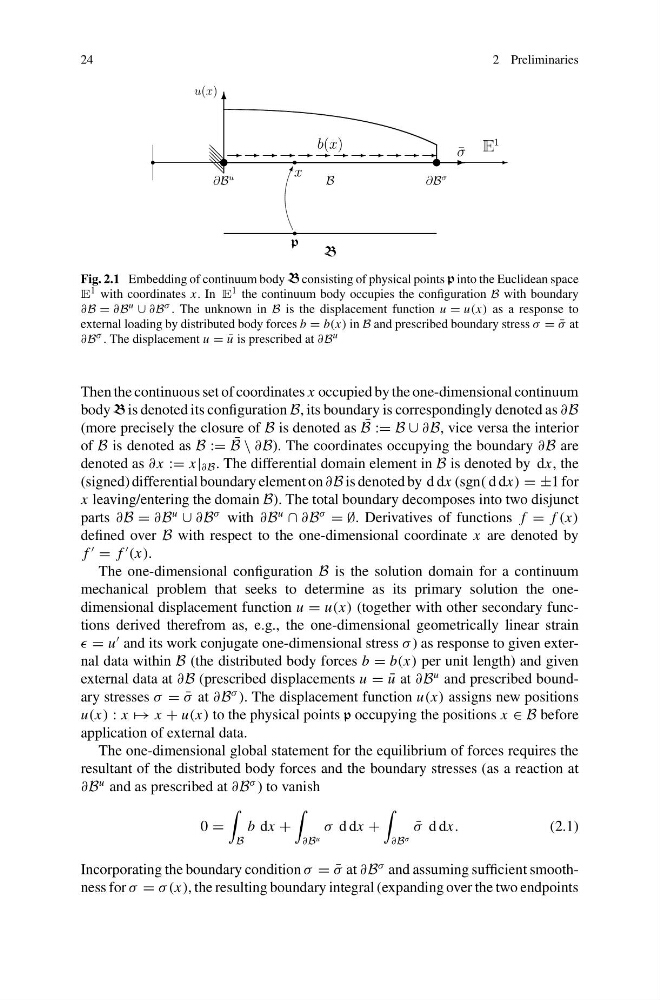
Fig. 2.1 Embedding of continuum body B consisting of physical points p into the Euclidean space
E 1 with coordinates x. In E 1 the continuum body occupies the configuration B with boundary
∂B = ∂B u ∪ ∂B σ . The unknown in B is the displacement function u = u(x) as a response to
external loading by distributed body forces b = b(x) in B and prescribed boundary stress σ = ¯
σ at
∂B σ . The displacement u = ¯
u is prescribed at ∂B u
Then the continuous set of coordinates x occupied by the one-dimensional continuum
body B is denoted its configuration B, its boundary is correspondingly denoted as ∂B
(more precisely the closure of B is denoted as ¯
B := B ∪ ∂B, vice versa the interior
of B is denoted as B := ¯
B \ ∂B). The coordinates occupying the boundary ∂B are
denoted as ∂ x := x| ∂B . The differential domain element in B is denoted by dx, the
(signed) differential boundary element on ∂B is denoted by d dx (sgn( d dx) = ±1 for
x leaving/entering the domain B). The total boundary decomposes into two disjunct
parts ∂B = ∂B
u
∪ ∂B
σ with ∂B
u
∩ ∂B
σ
= ∅. Derivatives of functions f = f (x)
defined over B with respect to the one-dimensional coordinate x are denoted by
f
= f
(x).
The one-dimensional configuration B is the solution domain for a continuum
mechanical problem that seeks to determine as its primary solution the onedimensional displacement function u = u(x) (together with other secondary functions derived therefrom as, e.g., the one-dimensional geometrically linear strain
= u
and its work conjugate one-dimensional stress σ ) as response to given external data within B (the distributed body forces b = b(x) per unit length) and given
external data at ∂B (prescribed displacements u = ¯
u at ∂B
u and prescribed boundary stresses σ = ¯
σ at ∂B
σ ). The displacement function u(x) assigns new positions
u(x) : x → x + u(x) to the physical points p occupying the positions x ∈ B before
application of external data.
The one-dimensional global statement for the equilibrium of forces requires the
resultant of the distributed body forces and the boundary stresses (as a reaction at
∂B
u and as prescribed at ∂B
σ ) to vanish
0 =
B
b dx +
∂B u
σ d dx +
∂B σ
¯
σ d dx.
(2.1)
Incorporating the boundary condition σ = ¯
σ at ∂B
σ and assuming sufficient smoothness for σ = σ (x), the resulting boundary integral (expanding over the two endpoints
2 Preliminaries
Fig. 2.1 Embedding of continuum body B consisting of physical points p into the Euclidean space
E 1 with coordinates x. In E 1 the continuum body occupies the configuration B with boundary
∂B = ∂B u ∪ ∂B σ . The unknown in B is the displacement function u = u(x) as a response to
external loading by distributed body forces b = b(x) in B and prescribed boundary stress σ = ¯
σ at
∂B σ . The displacement u = ¯
u is prescribed at ∂B u
Then the continuous set of coordinates x occupied by the one-dimensional continuum
body B is denoted its configuration B, its boundary is correspondingly denoted as ∂B
(more precisely the closure of B is denoted as ¯
B := B ∪ ∂B, vice versa the interior
of B is denoted as B := ¯
B \ ∂B). The coordinates occupying the boundary ∂B are
denoted as ∂ x := x| ∂B . The differential domain element in B is denoted by dx, the
(signed) differential boundary element on ∂B is denoted by d dx (sgn( d dx) = ±1 for
x leaving/entering the domain B). The total boundary decomposes into two disjunct
parts ∂B = ∂B
u
∪ ∂B
σ with ∂B
u
∩ ∂B
σ
= ∅. Derivatives of functions f = f (x)
defined over B with respect to the one-dimensional coordinate x are denoted by
f
= f
(x).
The one-dimensional configuration B is the solution domain for a continuum
mechanical problem that seeks to determine as its primary solution the onedimensional displacement function u = u(x) (together with other secondary functions derived therefrom as, e.g., the one-dimensional geometrically linear strain
= u
and its work conjugate one-dimensional stress σ ) as response to given external data within B (the distributed body forces b = b(x) per unit length) and given
external data at ∂B (prescribed displacements u = ¯
u at ∂B
u and prescribed boundary stresses σ = ¯
σ at ∂B
σ ). The displacement function u(x) assigns new positions
u(x) : x → x + u(x) to the physical points p occupying the positions x ∈ B before
application of external data.
The one-dimensional global statement for the equilibrium of forces requires the
resultant of the distributed body forces and the boundary stresses (as a reaction at
∂B
u and as prescribed at ∂B
σ ) to vanish
0 =
B
b dx +
∂B u
σ d dx +
∂B σ
¯
σ d dx.
(2.1)
Incorporating the boundary condition σ = ¯
σ at ∂B
σ and assuming sufficient smoothness for σ = σ (x), the resulting boundary integral (expanding over the two endpoints