

338
6 Visco-Plasticity
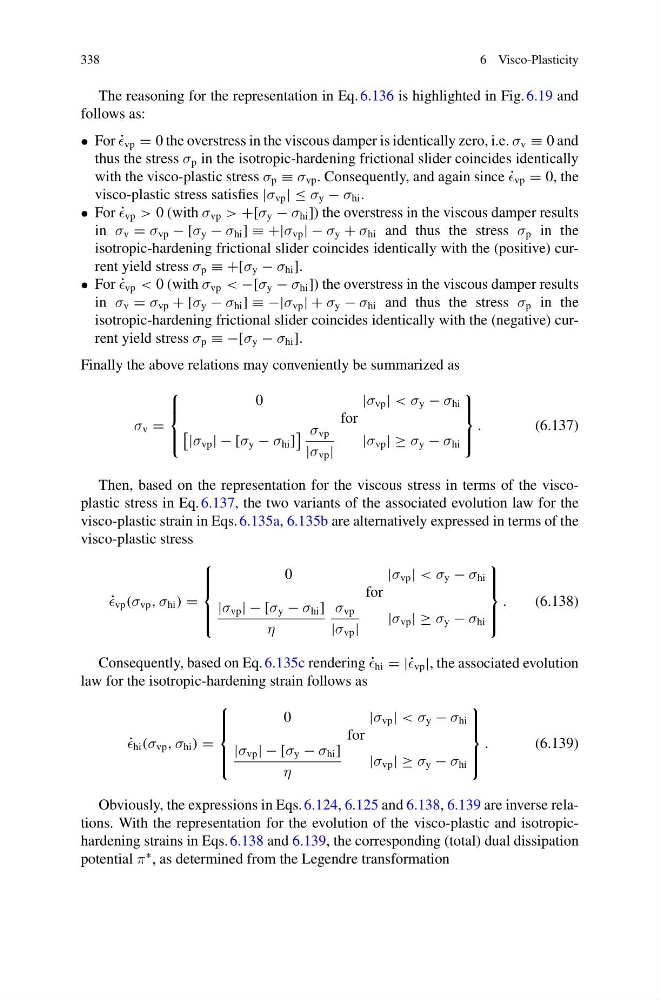
The reasoning for the representation in Eq. 6.136 is highlighted in Fig. 6.19 and
follows as:
• For ˙
vp = 0 the overstress in the viscous damper is identically zero, i.e. σ v ≡ 0 and
thus the stress σ p in the isotropic-hardening frictional slider coincides identically
with the visco-plastic stress σ p ≡ σ vp . Consequently, and again since ˙
vp = 0, the
visco-plastic stress satisfies |σ vp | ≤ σ y − σ hi .
• For ˙
vp > 0 (with σ vp > +[σ y − σ hi ]) the overstress in the viscous damper results
in σ v = σ vp − [σ y − σ hi ] ≡ +|σ vp | − σ y + σ hi and thus the stress σ p in the
isotropic-hardening frictional slider coincides identically with the (positive) current yield stress σ p ≡ +[σ y − σ hi ].
• For ˙
vp < 0 (with σ vp < −[σ y − σ hi ]) the overstress in the viscous damper results
in σ v = σ vp + [σ y − σ hi ] ≡ −|σ vp | + σ y − σ hi and thus the stress σ p in the
isotropic-hardening frictional slider coincides identically with the (negative) current yield stress σ p ≡ −[σ y − σ hi ].
Finally the above relations may conveniently be summarized as
σ v =
⎧
⎪ ⎨
⎪ ⎩
0
|σ vp | < σ y − σ hi
for
|σ vp | − [σ y − σ hi ]
σ vp
|σ vp |
|σ vp | ≥ σ y − σ hi
⎫
⎪ ⎬
⎪ ⎭
.
(6.137)
Then, based on the representation for the viscous stress in terms of the viscoplastic stress in Eq. 6.137, the two variants of the associated evolution law for the
visco-plastic strain in Eqs. 6.135a, 6.135b are alternatively expressed in terms of the
visco-plastic stress
˙
vp (σ vp , σ hi ) =
⎧
⎪ ⎪ ⎨
⎪ ⎪ ⎩
0
|σ vp | < σ y − σ hi
for
|σ vp | − [σ y − σ hi ]
η
σ vp
|σ vp |
|σ vp | ≥ σ y − σ hi
⎫
⎪ ⎪ ⎬
⎪ ⎪ ⎭
.
(6.138)
Consequently, based on Eq. 6.135c rendering ˙
hi = |˙ vp |, the associated evolution
law for the isotropic-hardening strain follows as
˙
hi (σ vp , σ hi ) =
⎧
⎪ ⎪ ⎨
⎪ ⎪ ⎩
0
|σ vp | < σ y − σ hi
for
|σ vp | − [σ y − σ hi ]
η
|σ vp | ≥ σ y − σ hi
⎫
⎪ ⎪ ⎬
⎪ ⎪ ⎭
.
(6.139)
Obviously, the expressions in Eqs. 6.124, 6.125 and 6.138, 6.139 are inverse relations. With the representation for the evolution of the visco-plastic and isotropichardening strains in Eqs. 6.138 and 6.139, the corresponding (total) dual dissipation
potential π
∗ , as determined from the Legendre transformation
6 Visco-Plasticity
The reasoning for the representation in Eq. 6.136 is highlighted in Fig. 6.19 and
follows as:
• For ˙
vp = 0 the overstress in the viscous damper is identically zero, i.e. σ v ≡ 0 and
thus the stress σ p in the isotropic-hardening frictional slider coincides identically
with the visco-plastic stress σ p ≡ σ vp . Consequently, and again since ˙
vp = 0, the
visco-plastic stress satisfies |σ vp | ≤ σ y − σ hi .
• For ˙
vp > 0 (with σ vp > +[σ y − σ hi ]) the overstress in the viscous damper results
in σ v = σ vp − [σ y − σ hi ] ≡ +|σ vp | − σ y + σ hi and thus the stress σ p in the
isotropic-hardening frictional slider coincides identically with the (positive) current yield stress σ p ≡ +[σ y − σ hi ].
• For ˙
vp < 0 (with σ vp < −[σ y − σ hi ]) the overstress in the viscous damper results
in σ v = σ vp + [σ y − σ hi ] ≡ −|σ vp | + σ y − σ hi and thus the stress σ p in the
isotropic-hardening frictional slider coincides identically with the (negative) current yield stress σ p ≡ −[σ y − σ hi ].
Finally the above relations may conveniently be summarized as
σ v =
⎧
⎪ ⎨
⎪ ⎩
0
|σ vp | < σ y − σ hi
for
|σ vp | − [σ y − σ hi ]
σ vp
|σ vp |
|σ vp | ≥ σ y − σ hi
⎫
⎪ ⎬
⎪ ⎭
.
(6.137)
Then, based on the representation for the viscous stress in terms of the viscoplastic stress in Eq. 6.137, the two variants of the associated evolution law for the
visco-plastic strain in Eqs. 6.135a, 6.135b are alternatively expressed in terms of the
visco-plastic stress
˙
vp (σ vp , σ hi ) =
⎧
⎪ ⎪ ⎨
⎪ ⎪ ⎩
0
|σ vp | < σ y − σ hi
for
|σ vp | − [σ y − σ hi ]
η
σ vp
|σ vp |
|σ vp | ≥ σ y − σ hi
⎫
⎪ ⎪ ⎬
⎪ ⎪ ⎭
.
(6.138)
Consequently, based on Eq. 6.135c rendering ˙
hi = |˙ vp |, the associated evolution
law for the isotropic-hardening strain follows as
˙
hi (σ vp , σ hi ) =
⎧
⎪ ⎪ ⎨
⎪ ⎪ ⎩
0
|σ vp | < σ y − σ hi
for
|σ vp | − [σ y − σ hi ]
η
|σ vp | ≥ σ y − σ hi
⎫
⎪ ⎪ ⎬
⎪ ⎪ ⎭
.
(6.139)
Obviously, the expressions in Eqs. 6.124, 6.125 and 6.138, 6.139 are inverse relations. With the representation for the evolution of the visco-plastic and isotropichardening strains in Eqs. 6.138 and 6.139, the corresponding (total) dual dissipation
potential π
∗ , as determined from the Legendre transformation