

314
6 Visco-Plasticity
sub-derivative of the dual plastic dissipation potential, in either case with respect to
its conjugated variable
˙
vp (σ v ) = ∂ σ v π
∗
v (σ v )
=
1
η
σ v
(6.80a)
˙
vp (σ p ) ∈ d σ p π
∗
p (σ p ) = d σ p I A (σ p ) =
⎧
⎪ ⎨
⎪ ⎩
0
|σ p | < σ y
for
λ
σ p
|σ p |
|σ p | = σ y
⎫
⎪ ⎬
⎪ ⎭
,
(6.80b)
whereby d σ p π
∗
p denotes the set of sub-derivatives, i.e. the sub-differential of π
∗
p with
respect to σ p and λ is a positive Lagrange (or rather plastic) multiplier.
Obviously, the expressions in Eqs. 6.71, 6.72 and 6.80a, 6.80b are inverse relations. The smooth viscous dissipation and dual viscous dissipation potentials π v =
π v (˙ vp ) and π
∗
v = π
∗
v (σ v ) together with the resulting smooth constitutive relations
σ v = σ v (˙ vp ) and ˙
vp = ˙
vp (σ v ) are similar to those displayed in Fig. 4.2. The nonsmooth plastic dissipation and dual plastic dissipation potentials π p = π p (˙ vp ) and
π
∗
p = π
∗
p (σ p ) together with the resulting non-smooth constitutive relations σ p =
σ p (˙ vp ) and ˙
vp = ˙
vp (σ p ) are similar to those displayed in Fig. 5.3.
Visco-Plastic Stress
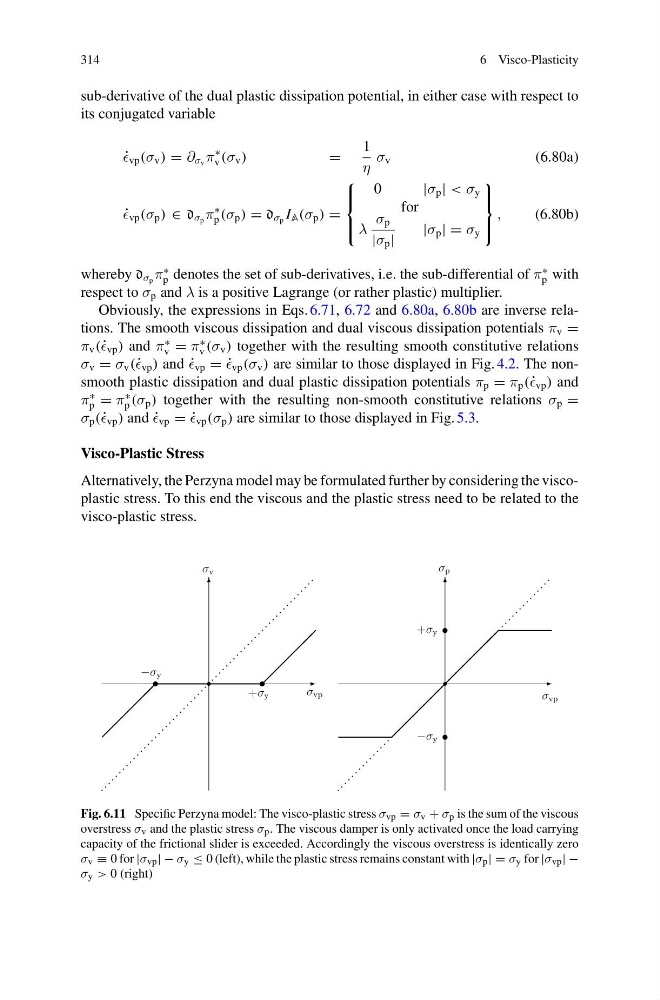
Alternatively, the Perzyna model may be formulated further by considering the viscoplastic stress. To this end the viscous and the plastic stress need to be related to the
visco-plastic stress.
σ vp
σ v
−σ y
+σ y
σ vp
σ p
+σ y
−σ y
Fig. 6.11 Specific Perzyna model: The visco-plastic stress σ vp = σ v + σ p is the sum of the viscous
overstress σ v and the plastic stress σ p . The viscous damper is only activated once the load carrying
capacity of the frictional slider is exceeded. Accordingly the viscous overstress is identically zero
σ v ≡ 0 for |σ vp | − σ y ≤ 0 (left), while the plastic stress remains constant with |σ p | = σ y for |σ vp | −
σ y > 0 (right)
6 Visco-Plasticity
sub-derivative of the dual plastic dissipation potential, in either case with respect to
its conjugated variable
˙
vp (σ v ) = ∂ σ v π
∗
v (σ v )
=
1
η
σ v
(6.80a)
˙
vp (σ p ) ∈ d σ p π
∗
p (σ p ) = d σ p I A (σ p ) =
⎧
⎪ ⎨
⎪ ⎩
0
|σ p | < σ y
for
λ
σ p
|σ p |
|σ p | = σ y
⎫
⎪ ⎬
⎪ ⎭
,
(6.80b)
whereby d σ p π
∗
p denotes the set of sub-derivatives, i.e. the sub-differential of π
∗
p with
respect to σ p and λ is a positive Lagrange (or rather plastic) multiplier.
Obviously, the expressions in Eqs. 6.71, 6.72 and 6.80a, 6.80b are inverse relations. The smooth viscous dissipation and dual viscous dissipation potentials π v =
π v (˙ vp ) and π
∗
v = π
∗
v (σ v ) together with the resulting smooth constitutive relations
σ v = σ v (˙ vp ) and ˙
vp = ˙
vp (σ v ) are similar to those displayed in Fig. 4.2. The nonsmooth plastic dissipation and dual plastic dissipation potentials π p = π p (˙ vp ) and
π
∗
p = π
∗
p (σ p ) together with the resulting non-smooth constitutive relations σ p =
σ p (˙ vp ) and ˙
vp = ˙
vp (σ p ) are similar to those displayed in Fig. 5.3.
Visco-Plastic Stress
Alternatively, the Perzyna model may be formulated further by considering the viscoplastic stress. To this end the viscous and the plastic stress need to be related to the
visco-plastic stress.
σ vp
σ v
−σ y
+σ y
σ vp
σ p
+σ y
−σ y
Fig. 6.11 Specific Perzyna model: The visco-plastic stress σ vp = σ v + σ p is the sum of the viscous
overstress σ v and the plastic stress σ p . The viscous damper is only activated once the load carrying
capacity of the frictional slider is exceeded. Accordingly the viscous overstress is identically zero
σ v ≡ 0 for |σ vp | − σ y ≤ 0 (left), while the plastic stress remains constant with |σ p | = σ y for |σ vp | −
σ y > 0 (right)