

284
5 Plasticity
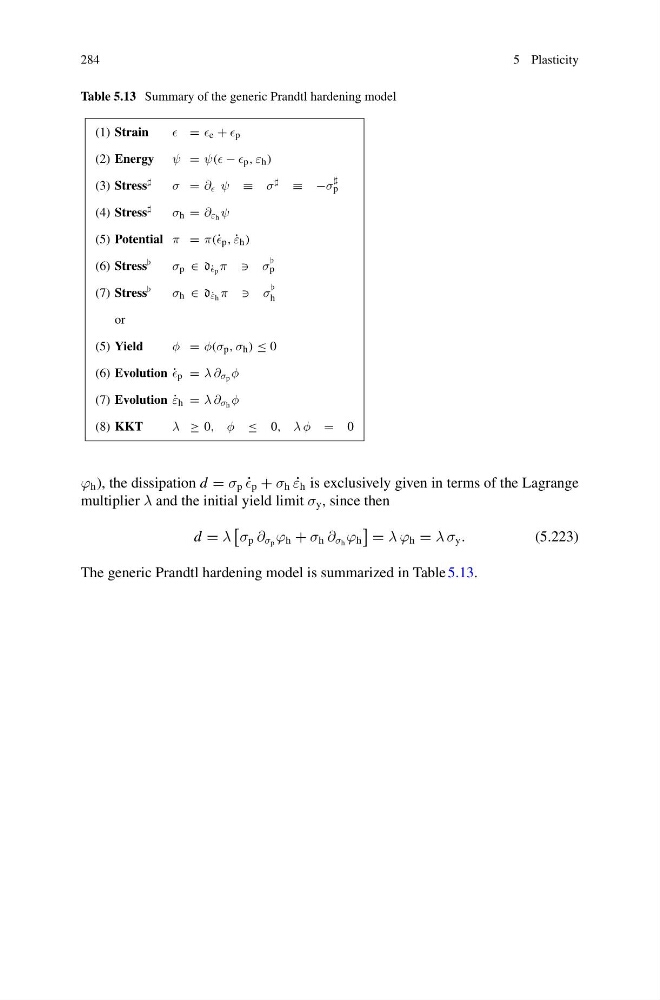
Table 5.13 Summary of the generic Prandtl hardening model
(1) Strain
= e + p
(2) Energy ψ = ψ( − p , ε h )
(3) Stress
σ = ∂ ψ ≡ σ ≡ −σ
p
(4) Stress
σ h = ∂ εh ψ
(5) Potential π = π(˙ p , ˙
ε h )
(6) Stress
σ p ∈ d ˙
p π σ
p
(7) Stress
σ h ∈ d ˙
εh π σ
h
or
(5) Yield
φ = φ(σ p , σ h ) ≤ 0
(6) Evolution ˙
p = λ ∂ σp φ
(7) Evolution ˙
ε h = λ ∂ σh φ
(8) KKT
λ ≥ 0, φ ≤ 0, λ φ = 0
ϕ h ), the dissipation d = σ p ˙
p + σ h ˙
ε h is exclusively given in terms of the Lagrange
multiplier λ and the initial yield limit σ y , since then
d = λ
σ p ∂ σ p ϕ h + σ h ∂ σ h ϕ h
= λ ϕ h = λ σ y .
(5.223)
The generic Prandtl hardening model is summarized in Table 5.13.
5 Plasticity
Table 5.13 Summary of the generic Prandtl hardening model
(1) Strain
= e + p
(2) Energy ψ = ψ( − p , ε h )
(3) Stress
σ = ∂ ψ ≡ σ ≡ −σ
p
(4) Stress
σ h = ∂ εh ψ
(5) Potential π = π(˙ p , ˙
ε h )
(6) Stress
σ p ∈ d ˙
p π σ
p
(7) Stress
σ h ∈ d ˙
εh π σ
h
or
(5) Yield
φ = φ(σ p , σ h ) ≤ 0
(6) Evolution ˙
p = λ ∂ σp φ
(7) Evolution ˙
ε h = λ ∂ σh φ
(8) KKT
λ ≥ 0, φ ≤ 0, λ φ = 0
ϕ h ), the dissipation d = σ p ˙
p + σ h ˙
ε h is exclusively given in terms of the Lagrange
multiplier λ and the initial yield limit σ y , since then
d = λ
σ p ∂ σ p ϕ h + σ h ∂ σ h ϕ h
= λ ϕ h = λ σ y .
(5.223)
The generic Prandtl hardening model is summarized in Table 5.13.