

16
1 Introduction
σ
σ
σ
σ
σ
σ
1
2
3
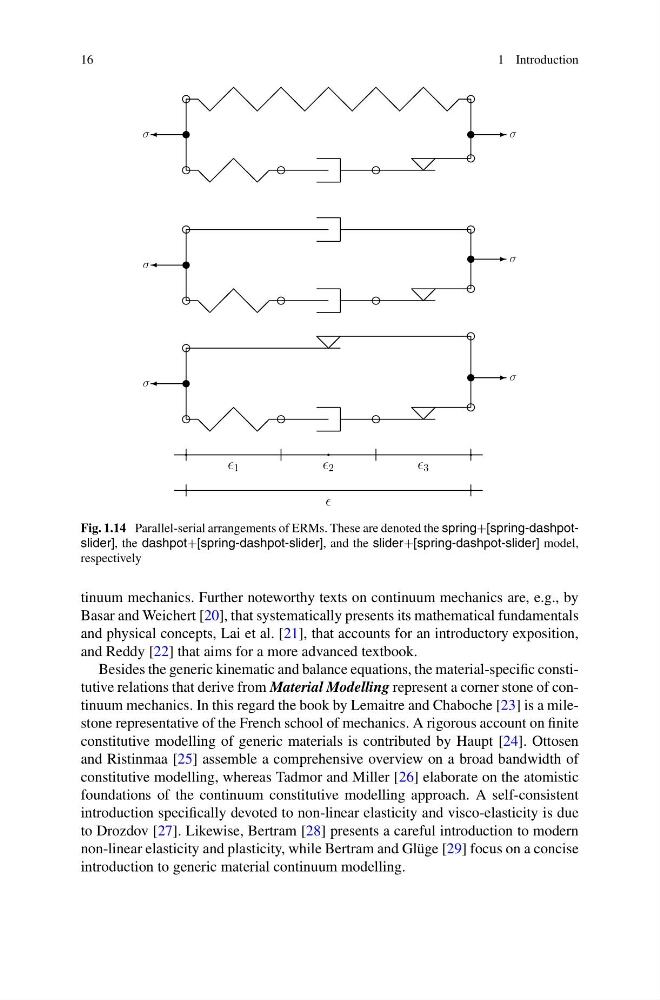
Fig. 1.14 Parallel-serial arrangements of ERMs. These are denoted the spring+[spring-dashpotslider], the dashpot+[spring-dashpot-slider], and the slider+[spring-dashpot-slider] model,
respectively
tinuum mechanics. Further noteworthy texts on continuum mechanics are, e.g., by
Basar and Weichert [20], that systematically presents its mathematical fundamentals
and physical concepts, Lai et al. [21], that accounts for an introductory exposition,
and Reddy [22] that aims for a more advanced textbook.
Besides the generic kinematic and balance equations, the material-specific constitutive relations that derive from Material Modelling represent a corner stone of continuum mechanics. In this regard the book by Lemaitre and Chaboche [23] is a milestone representative of the French school of mechanics. A rigorous account on finite
constitutive modelling of generic materials is contributed by Haupt [24]. Ottosen
and Ristinmaa [25] assemble a comprehensive overview on a broad bandwidth of
constitutive modelling, whereas Tadmor and Miller [26] elaborate on the atomistic
foundations of the continuum constitutive modelling approach. A self-consistent
introduction specifically devoted to non-linear elasticity and visco-elasticity is due
to Drozdov [27]. Likewise, Bertram [28] presents a careful introduction to modern
non-linear elasticity and plasticity, while Bertram and Glüge [29] focus on a concise
introduction to generic material continuum modelling.
1 Introduction
σ
σ
σ
σ
σ
σ
1
2
3
Fig. 1.14 Parallel-serial arrangements of ERMs. These are denoted the spring+[spring-dashpotslider], the dashpot+[spring-dashpot-slider], and the slider+[spring-dashpot-slider] model,
respectively
tinuum mechanics. Further noteworthy texts on continuum mechanics are, e.g., by
Basar and Weichert [20], that systematically presents its mathematical fundamentals
and physical concepts, Lai et al. [21], that accounts for an introductory exposition,
and Reddy [22] that aims for a more advanced textbook.
Besides the generic kinematic and balance equations, the material-specific constitutive relations that derive from Material Modelling represent a corner stone of continuum mechanics. In this regard the book by Lemaitre and Chaboche [23] is a milestone representative of the French school of mechanics. A rigorous account on finite
constitutive modelling of generic materials is contributed by Haupt [24]. Ottosen
and Ristinmaa [25] assemble a comprehensive overview on a broad bandwidth of
constitutive modelling, whereas Tadmor and Miller [26] elaborate on the atomistic
foundations of the continuum constitutive modelling approach. A self-consistent
introduction specifically devoted to non-linear elasticity and visco-elasticity is due
to Drozdov [27]. Likewise, Bertram [28] presents a careful introduction to modern
non-linear elasticity and plasticity, while Bertram and Glüge [29] focus on a concise
introduction to generic material continuum modelling.