

14
1 Introduction
σ
σ
σ
σ
σ
σ
1
2
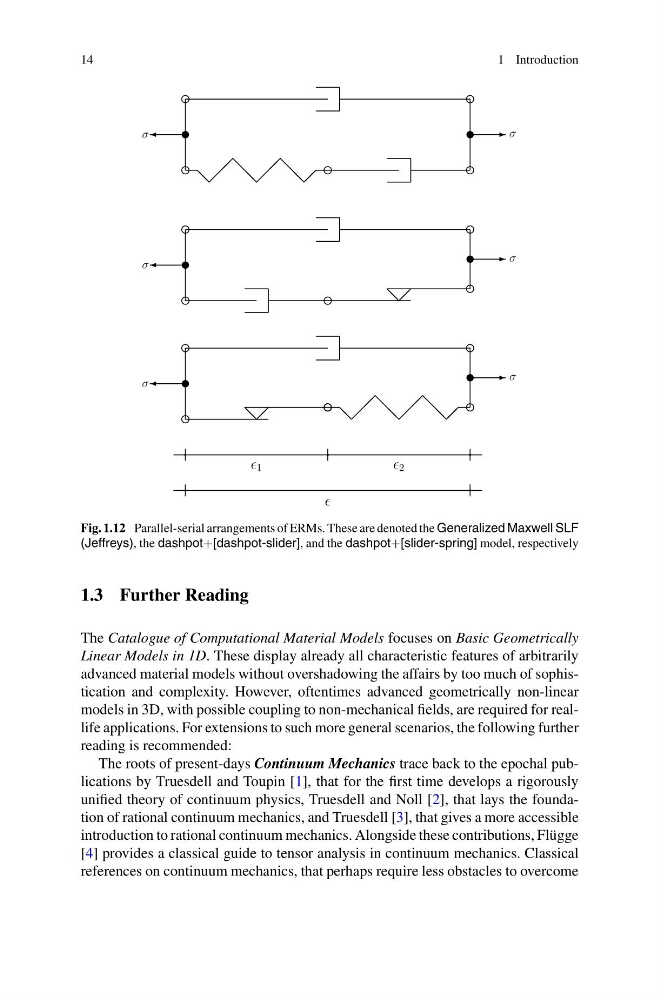
Fig. 1.12 Parallel-serial arrangements of ERMs. These are denoted the Generalized Maxwell SLF
(Jeffreys), the dashpot+[dashpot-slider], and the dashpot+[slider-spring] model, respectively
1.3 Further Reading
The Catalogue of Computational Material Models focuses on Basic Geometrically
Linear Models in 1D. These display already all characteristic features of arbitrarily
advanced material models without overshadowing the affairs by too much of sophistication and complexity. However, oftentimes advanced geometrically non-linear
models in 3D, with possible coupling to non-mechanical fields, are required for reallife applications. For extensions to such more general scenarios, the following further
reading is recommended:
The roots of present-days Continuum Mechanics trace back to the epochal publications by Truesdell and Toupin [1], that for the first time develops a rigorously
unified theory of continuum physics, Truesdell and Noll [2], that lays the foundation of rational continuum mechanics, and Truesdell [3], that gives a more accessible
introduction to rational continuum mechanics. Alongside these contributions, Flügge
[4] provides a classical guide to tensor analysis in continuum mechanics. Classical
references on continuum mechanics, that perhaps require less obstacles to overcome
1 Introduction
σ
σ
σ
σ
σ
σ
1
2
Fig. 1.12 Parallel-serial arrangements of ERMs. These are denoted the Generalized Maxwell SLF
(Jeffreys), the dashpot+[dashpot-slider], and the dashpot+[slider-spring] model, respectively
1.3 Further Reading
The Catalogue of Computational Material Models focuses on Basic Geometrically
Linear Models in 1D. These display already all characteristic features of arbitrarily
advanced material models without overshadowing the affairs by too much of sophistication and complexity. However, oftentimes advanced geometrically non-linear
models in 3D, with possible coupling to non-mechanical fields, are required for reallife applications. For extensions to such more general scenarios, the following further
reading is recommended:
The roots of present-days Continuum Mechanics trace back to the epochal publications by Truesdell and Toupin [1], that for the first time develops a rigorously
unified theory of continuum physics, Truesdell and Noll [2], that lays the foundation of rational continuum mechanics, and Truesdell [3], that gives a more accessible
introduction to rational continuum mechanics. Alongside these contributions, Flügge
[4] provides a classical guide to tensor analysis in continuum mechanics. Classical
references on continuum mechanics, that perhaps require less obstacles to overcome