

246
5 Plasticity
K
K
hk
σ p
0
+σ y
σ p = +σ y +
hk
−σ y
σ p = −σ y +
hk
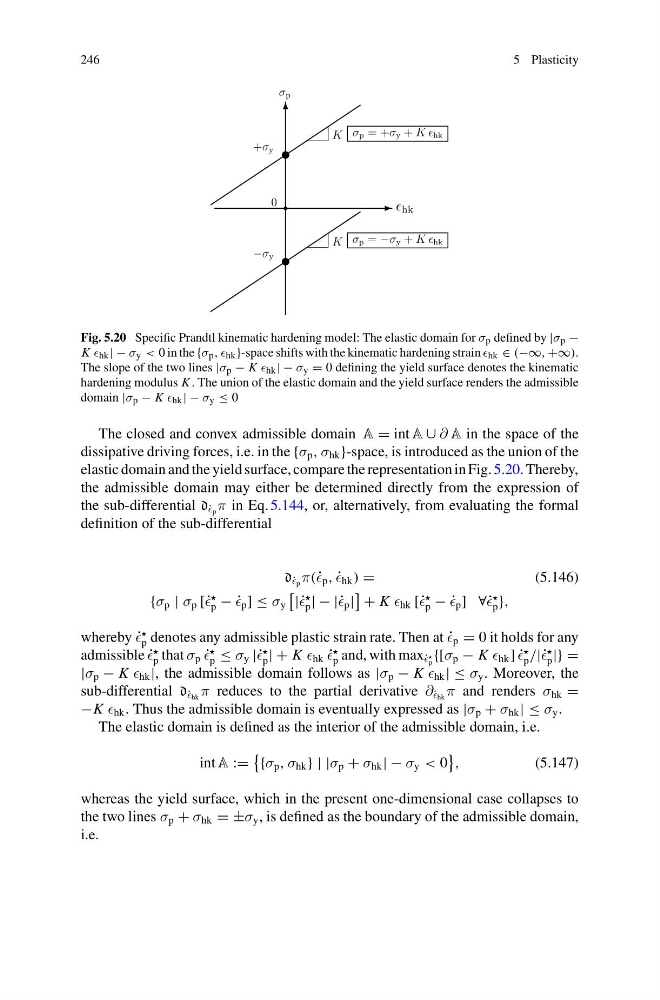
Fig. 5.20 Specific Prandtl kinematic hardening model: The elastic domain for σ p defined by |σ p −
K hk | − σ y < 0 in the {σ p , hk }-space shifts with the kinematic hardening strain hk ∈ (−∞, +∞).
The slope of the two lines |σ p − K hk | − σ y = 0 defining the yield surface denotes the kinematic
hardening modulus K . The union of the elastic domain and the yield surface renders the admissible
domain |σ p − K hk | − σ y ≤ 0
The closed and convex admissible domain A = int A ∪ ∂ A in the space of the
dissipative driving forces, i.e. in the {σ p , σ hk }-space, is introduced as the union of the
elastic domain and the yield surface, compare the representation in Fig. 5.20. Thereby,
the admissible domain may either be determined directly from the expression of
the sub-differential d ˙
p π in Eq. 5.144, or, alternatively, from evaluating the formal
definition of the sub-differential
d ˙
p π(˙ p , ˙
hk ) =
(5.146)
{σ p | σ p [˙
p − ˙
p ] ≤ σ y
|˙
p | − |˙ p |
+ K hk [˙
p − ˙
p ] ∀˙
p },
whereby ˙
p denotes any admissible plastic strain rate. Then at ˙
p = 0 it holds for any
admissible ˙
p that σ p ˙
p ≤ σ y |˙
p | + K hk ˙
p and, with max ˙
p
{[σ p − K hk ] ˙
p /|˙
p |} =
|σ p − K hk |, the admissible domain follows as |σ p − K hk | ≤ σ y . Moreover, the
sub-differential d ˙
hk π reduces to the partial derivative ∂ ˙
hk π and renders σ hk =
−K hk . Thus the admissible domain is eventually expressed as |σ p + σ hk | ≤ σ y .
The elastic domain is defined as the interior of the admissible domain, i.e.
int A :=
{σ p , σ hk } | |σ p + σ hk | − σ y < 0
,
(5.147)
whereas the yield surface, which in the present one-dimensional case collapses to
the two lines σ p + σ hk = ±σ y , is defined as the boundary of the admissible domain,
i.e.
5 Plasticity
K
K
hk
σ p
0
+σ y
σ p = +σ y +
hk
−σ y
σ p = −σ y +
hk
Fig. 5.20 Specific Prandtl kinematic hardening model: The elastic domain for σ p defined by |σ p −
K hk | − σ y < 0 in the {σ p , hk }-space shifts with the kinematic hardening strain hk ∈ (−∞, +∞).
The slope of the two lines |σ p − K hk | − σ y = 0 defining the yield surface denotes the kinematic
hardening modulus K . The union of the elastic domain and the yield surface renders the admissible
domain |σ p − K hk | − σ y ≤ 0
The closed and convex admissible domain A = int A ∪ ∂ A in the space of the
dissipative driving forces, i.e. in the {σ p , σ hk }-space, is introduced as the union of the
elastic domain and the yield surface, compare the representation in Fig. 5.20. Thereby,
the admissible domain may either be determined directly from the expression of
the sub-differential d ˙
p π in Eq. 5.144, or, alternatively, from evaluating the formal
definition of the sub-differential
d ˙
p π(˙ p , ˙
hk ) =
(5.146)
{σ p | σ p [˙
p − ˙
p ] ≤ σ y
|˙
p | − |˙ p |
+ K hk [˙
p − ˙
p ] ∀˙
p },
whereby ˙
p denotes any admissible plastic strain rate. Then at ˙
p = 0 it holds for any
admissible ˙
p that σ p ˙
p ≤ σ y |˙
p | + K hk ˙
p and, with max ˙
p
{[σ p − K hk ] ˙
p /|˙
p |} =
|σ p − K hk |, the admissible domain follows as |σ p − K hk | ≤ σ y . Moreover, the
sub-differential d ˙
hk π reduces to the partial derivative ∂ ˙
hk π and renders σ hk =
−K hk . Thus the admissible domain is eventually expressed as |σ p + σ hk | ≤ σ y .
The elastic domain is defined as the interior of the admissible domain, i.e.
int A :=
{σ p , σ hk } | |σ p + σ hk | − σ y < 0
,
(5.147)
whereas the yield surface, which in the present one-dimensional case collapses to
the two lines σ p + σ hk = ±σ y , is defined as the boundary of the admissible domain,
i.e.