

5.2 Prandtl Model
213
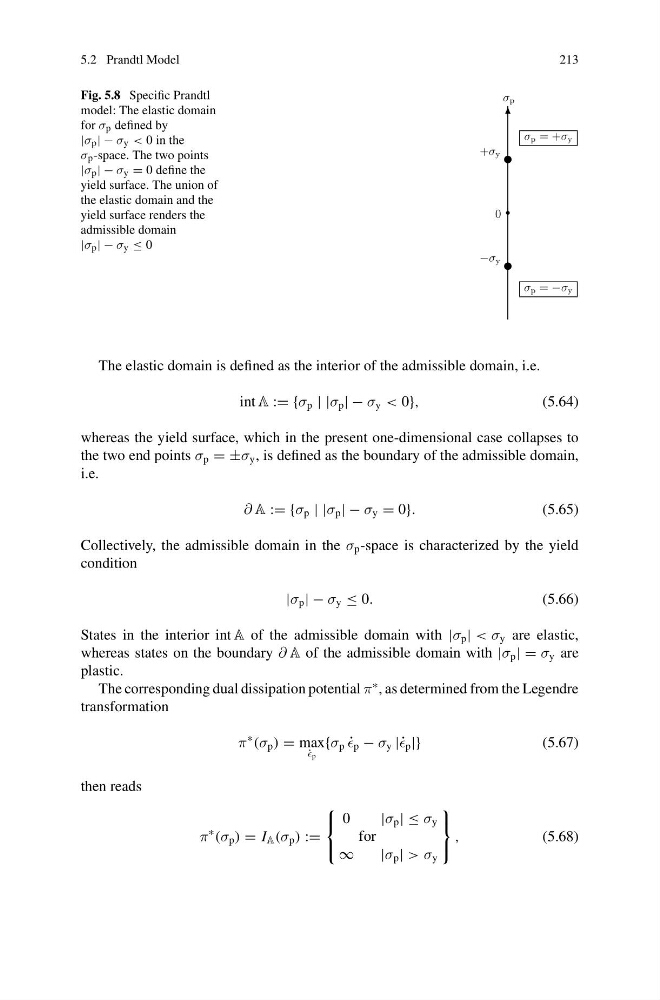
Fig. 5.8 Specific Prandtl
model: The elastic domain
for σ p defined by
|σ p | − σ y < 0 in the
σ p -space. The two points
|σ p | − σ y = 0 define the
yield surface. The union of
the elastic domain and the
yield surface renders the
admissible domain
|σ p | − σ y ≤ 0
σ p
0
+σ y
σ p = +σ y
−σ y
σ p = −σ y
The elastic domain is defined as the interior of the admissible domain, i.e.
int A := {σ p | |σ p | − σ y < 0},
(5.64)
whereas the yield surface, which in the present one-dimensional case collapses to
the two end points σ p = ±σ y , is defined as the boundary of the admissible domain,
i.e.
∂ A := {σ p | |σ p | − σ y = 0}.
(5.65)
Collectively, the admissible domain in the σ p -space is characterized by the yield
condition
|σ p | − σ y ≤ 0.
(5.66)
States in the interior int A of the admissible domain with |σ p | < σ y are elastic,
whereas states on the boundary ∂ A of the admissible domain with |σ p | = σ y are
plastic.
The corresponding dual dissipation potential π
∗ , as determined from the Legendre
transformation
π
∗
(σ p ) = max
˙
p
{σ p ˙
p − σ y |˙ p |}
(5.67)
then reads
π
∗
(σ p ) = I A (σ p ) :=
⎧
⎨
⎩
0
|σ p | ≤ σ y
for
∞
|σ p | > σ y
⎫
⎬
⎭
,
(5.68)
213
Fig. 5.8 Specific Prandtl
model: The elastic domain
for σ p defined by
|σ p | − σ y < 0 in the
σ p -space. The two points
|σ p | − σ y = 0 define the
yield surface. The union of
the elastic domain and the
yield surface renders the
admissible domain
|σ p | − σ y ≤ 0
σ p
0
+σ y
σ p = +σ y
−σ y
σ p = −σ y
The elastic domain is defined as the interior of the admissible domain, i.e.
int A := {σ p | |σ p | − σ y < 0},
(5.64)
whereas the yield surface, which in the present one-dimensional case collapses to
the two end points σ p = ±σ y , is defined as the boundary of the admissible domain,
i.e.
∂ A := {σ p | |σ p | − σ y = 0}.
(5.65)
Collectively, the admissible domain in the σ p -space is characterized by the yield
condition
|σ p | − σ y ≤ 0.
(5.66)
States in the interior int A of the admissible domain with |σ p | < σ y are elastic,
whereas states on the boundary ∂ A of the admissible domain with |σ p | = σ y are
plastic.
The corresponding dual dissipation potential π
∗ , as determined from the Legendre
transformation
π
∗
(σ p ) = max
˙
p
{σ p ˙
p − σ y |˙ p |}
(5.67)
then reads
π
∗
(σ p ) = I A (σ p ) :=
⎧
⎨
⎩
0
|σ p | ≤ σ y
for
∞
|σ p | > σ y
⎫
⎬
⎭
,
(5.68)