

194
5 Plasticity
5.1 St. Venant Model
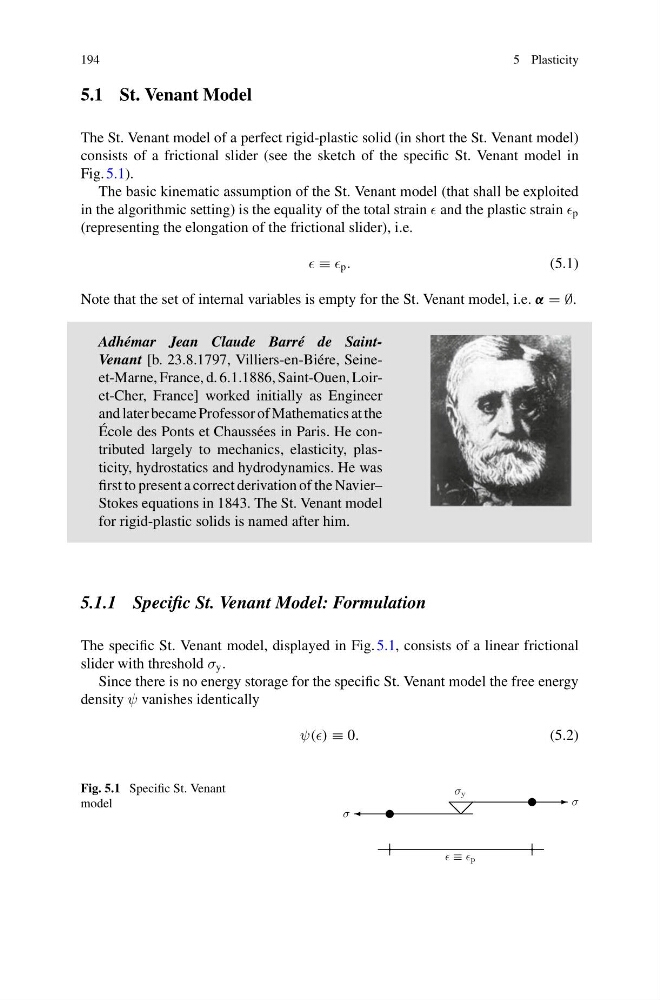
The St. Venant model of a perfect rigid-plastic solid (in short the St. Venant model)
consists of a frictional slider (see the sketch of the specific St. Venant model in
Fig. 5.1).
The basic kinematic assumption of the St. Venant model (that shall be exploited
in the algorithmic setting) is the equality of the total strain and the plastic strain p
(representing the elongation of the frictional slider), i.e.
≡ p .
(5.1)
Note that the set of internal variables is empty for the St. Venant model, i.e. α = ∅.
Adhémar Jean Claude Barré de SaintVenant [b. 23.8.1797, Villiers-en-Biére, Seineet-Marne, France, d. 6.1.1886, Saint-Ouen, Loiret-Cher, France] worked initially as Engineer
and later became Professor of Mathematics at the
École des Ponts et Chaussées in Paris. He contributed largely to mechanics, elasticity, plasticity, hydrostatics and hydrodynamics. He was
first to present a correct derivation of the Navier–
Stokes equations in 1843. The St. Venant model
for rigid-plastic solids is named after him.
5.1.1 Specific St. Venant Model: Formulation
The specific St. Venant model, displayed in Fig. 5.1, consists of a linear frictional
slider with threshold σ y .
Since there is no energy storage for the specific St. Venant model the free energy
density ψ vanishes identically
ψ( ≡ 0.
(5.2)
Fig. 5.1 Specific St. Venant
model
σ
σ
≡ p
σ y
5 Plasticity
5.1 St. Venant Model
The St. Venant model of a perfect rigid-plastic solid (in short the St. Venant model)
consists of a frictional slider (see the sketch of the specific St. Venant model in
Fig. 5.1).
The basic kinematic assumption of the St. Venant model (that shall be exploited
in the algorithmic setting) is the equality of the total strain and the plastic strain p
(representing the elongation of the frictional slider), i.e.
≡ p .
(5.1)
Note that the set of internal variables is empty for the St. Venant model, i.e. α = ∅.
Adhémar Jean Claude Barré de SaintVenant [b. 23.8.1797, Villiers-en-Biére, Seineet-Marne, France, d. 6.1.1886, Saint-Ouen, Loiret-Cher, France] worked initially as Engineer
and later became Professor of Mathematics at the
École des Ponts et Chaussées in Paris. He contributed largely to mechanics, elasticity, plasticity, hydrostatics and hydrodynamics. He was
first to present a correct derivation of the Navier–
Stokes equations in 1843. The St. Venant model
for rigid-plastic solids is named after him.
5.1.1 Specific St. Venant Model: Formulation
The specific St. Venant model, displayed in Fig. 5.1, consists of a linear frictional
slider with threshold σ y .
Since there is no energy storage for the specific St. Venant model the free energy
density ψ vanishes identically
ψ( ≡ 0.
(5.2)
Fig. 5.1 Specific St. Venant
model
σ
σ
≡ p
σ y