

4.5 Generalized-Maxwell Model
189
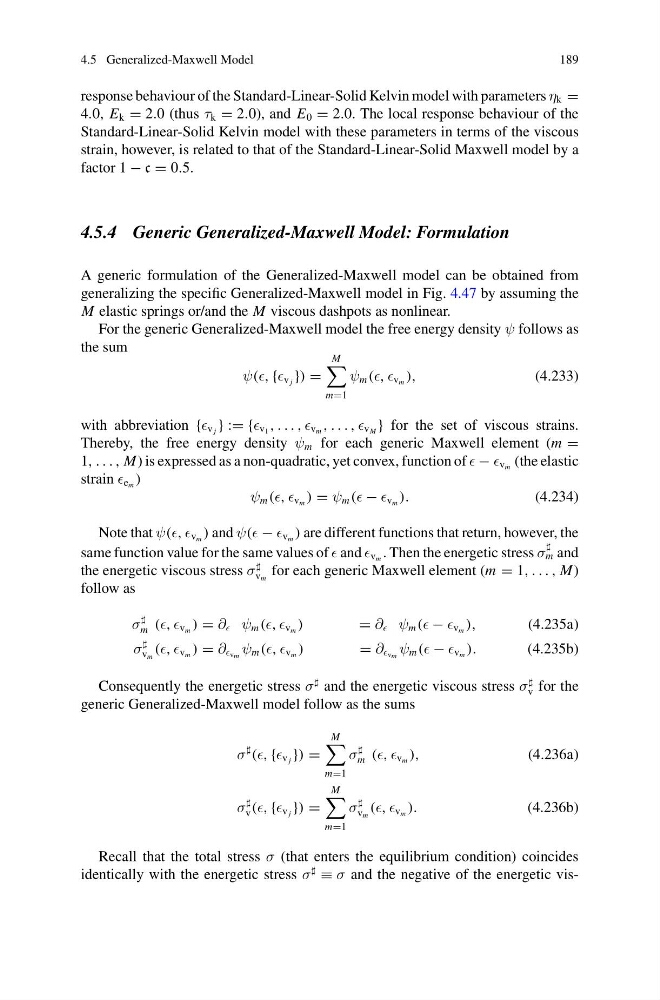
response behaviour of the Standard-Linear-Solid Kelvin model with parameters η k =
4.0, E k = 2.0 (thus τ k = 2.0), and E 0 = 2.0. The local response behaviour of the
Standard-Linear-Solid Kelvin model with these parameters in terms of the viscous
strain, however, is related to that of the Standard-Linear-Solid Maxwell model by a
factor 1 − c = 0.5.
4.5.4 Generic Generalized-Maxwell Model: Formulation
A generic formulation of the Generalized-Maxwell model can be obtained from
generalizing the specific Generalized-Maxwell model in Fig. 4.47 by assuming the
M elastic springs or/and the M viscous dashpots as nonlinear.
For the generic Generalized-Maxwell model the free energy density ψ follows as
the sum
ψ(, { v j }) =
M
m=1
ψ m (, v m ),
(4.233)
with abbreviation { v j } := { v 1 , . . . , v m , . . . , v M } for the set of viscous strains.
Thereby, the free energy density ψ m for each generic Maxwell element (m =
1, . . . , M) is expressed as a non-quadratic, yet convex, function of − v m (the elastic
strain e m )
ψ m (, v m ) = ψ m ( − v m ).
(4.234)
Note that ψ(, v m ) and ψ( − v m ) are different functions that return, however, the
same function value for the same values of and v m . Then the energetic stress σ
m and
the energetic viscous stress σ
v m
for each generic Maxwell element (m = 1, . . . , M)
follow as
σ
m (, v m ) = ∂ ψ m (, v m )
= ∂ ψ m ( − v m ),
(4.235a)
σ
v m
(, v m ) = ∂ vm ψ m (, v m )
= ∂ vm ψ m ( − v m ).
(4.235b)
Consequently the energetic stress σ
and the energetic viscous stress σ
v for the
generic Generalized-Maxwell model follow as the sums
σ
(, { v j }) =
M
m=1
σ
m (, v m ),
(4.236a)
σ
v (, { v j }) =
M
m=1
σ
v m
(, v m ).
(4.236b)
Recall that the total stress σ (that enters the equilibrium condition) coincides
identically with the energetic stress σ
≡ σ and the negative of the energetic vis-
189
response behaviour of the Standard-Linear-Solid Kelvin model with parameters η k =
4.0, E k = 2.0 (thus τ k = 2.0), and E 0 = 2.0. The local response behaviour of the
Standard-Linear-Solid Kelvin model with these parameters in terms of the viscous
strain, however, is related to that of the Standard-Linear-Solid Maxwell model by a
factor 1 − c = 0.5.
4.5.4 Generic Generalized-Maxwell Model: Formulation
A generic formulation of the Generalized-Maxwell model can be obtained from
generalizing the specific Generalized-Maxwell model in Fig. 4.47 by assuming the
M elastic springs or/and the M viscous dashpots as nonlinear.
For the generic Generalized-Maxwell model the free energy density ψ follows as
the sum
ψ(, { v j }) =
M
m=1
ψ m (, v m ),
(4.233)
with abbreviation { v j } := { v 1 , . . . , v m , . . . , v M } for the set of viscous strains.
Thereby, the free energy density ψ m for each generic Maxwell element (m =
1, . . . , M) is expressed as a non-quadratic, yet convex, function of − v m (the elastic
strain e m )
ψ m (, v m ) = ψ m ( − v m ).
(4.234)
Note that ψ(, v m ) and ψ( − v m ) are different functions that return, however, the
same function value for the same values of and v m . Then the energetic stress σ
m and
the energetic viscous stress σ
v m
for each generic Maxwell element (m = 1, . . . , M)
follow as
σ
m (, v m ) = ∂ ψ m (, v m )
= ∂ ψ m ( − v m ),
(4.235a)
σ
v m
(, v m ) = ∂ vm ψ m (, v m )
= ∂ vm ψ m ( − v m ).
(4.235b)
Consequently the energetic stress σ
and the energetic viscous stress σ
v for the
generic Generalized-Maxwell model follow as the sums
σ
(, { v j }) =
M
m=1
σ
m (, v m ),
(4.236a)
σ
v (, { v j }) =
M
m=1
σ
v m
(, v m ).
(4.236b)
Recall that the total stress σ (that enters the equilibrium condition) coincides
identically with the energetic stress σ
≡ σ and the negative of the energetic vis-