

172
4 Visco-Elasticity
0
2
4
6
8
10
−10
−5
0
5
10
t
σ(t)/E
˜
E sin (ω t) +
˜
E
co s( ωt )
− ˜
E e
−t/τ
0
2
4
6
8
10
−4
−2
0
2
4
t
(t)/C
˜
C sin(ωt) − ˜
C cos(ωt)
˜
C
e
−
t / [e
τ ]
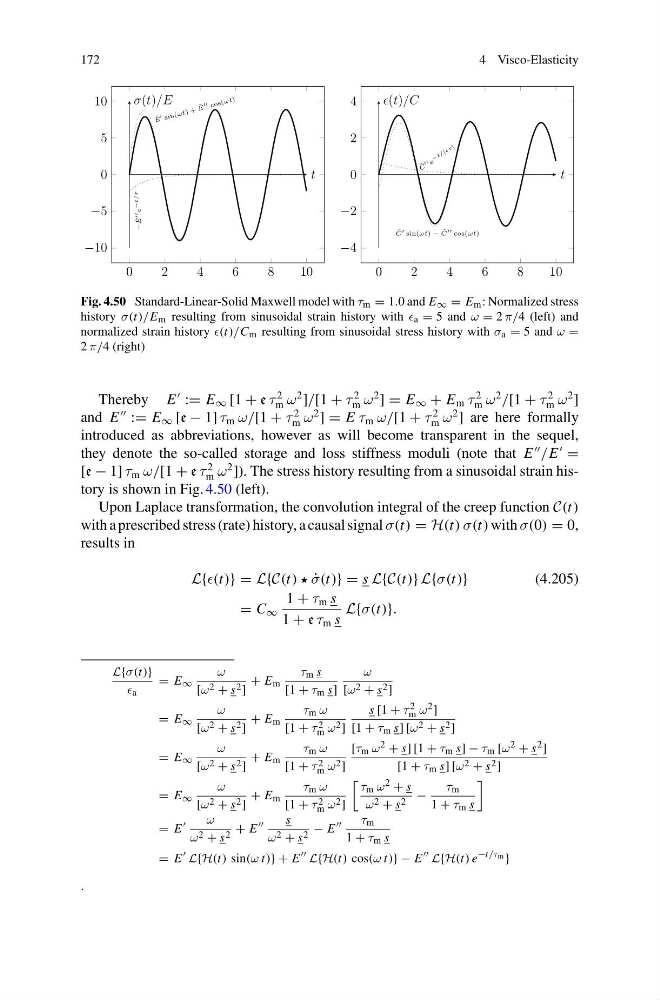
Fig. 4.50 Standard-Linear-Solid Maxwell model with τ m = 1.0 and E ∞ = E m : Normalized stress
history σ(t)/E m resulting from sinusoidal strain history with a = 5 and ω = 2 π/4 (left) and
normalized strain history m resulting from sinusoidal stress history with σ a = 5 and ω =
2 π/4 (right)
Thereby E
:= E ∞ [1 + e τ
2
m ω
2
]/[1 + τ
2
m ω
2
] = E ∞ + E m τ
2
m ω
2
/[1 + τ
2
m ω
2
]
and E
:= E ∞ [e − 1] τ m ω/[1 + τ
2
m ω
2
] = E τ m ω/[1 + τ
2
m ω
2
] are here formally
introduced as abbreviations, however as will become transparent in the sequel,
they denote the so-called storage and loss stiffness moduli (note that E
/E
=
[e − 1] τ m ω/[1 + e τ
2
m ω
2
]). The stress history resulting from a sinusoidal strain history is shown in Fig. 4.50 (left).
Upon Laplace transformation, the convolution integral of the creep function C(t)
with a prescribed stress (rate) history, a causal signal σ(t) = H(t) σ(t) with σ(0) = 0,
results in
L{ = L{C(t) ) ˙
σ(t)} = s L{C(t)} L{σ(t)}
(4.205)
= C ∞
1 + τ m s
1 + e τ m s
L{σ(t)}.
L{σ(t)}
a
= E ∞
ω
[ω 2 + s 2 ]
+ E m
τ m s
[1 + τ m s]
ω
[ω 2 + s 2 ]
= E ∞
ω
[ω 2 + s 2 ]
+ E m
τ m ω
[1 + τ 2
m ω 2 ]
s [1 + τ 2
m ω 2 ]
[1 + τ m s] [ω 2 + s 2 ]
= E ∞
ω
[ω 2 + s 2 ]
+ E m
τ m ω
[1 + τ 2
m ω 2 ]
[τ m ω 2 + s] [1 + τ m s] − τ m [ω 2 + s 2 ]
[1 + τ m s] [ω 2 + s 2 ]
= E ∞
ω
[ω 2 + s 2 ]
+ E m
τ m ω
[1 + τ 2
m ω 2 ]
τ m ω 2 + s
ω 2 + s 2 −
τ m
1 + τ m s
= E
ω
ω 2 + s 2 + E
s
ω 2 + s 2 − E
τ m
1 + τ m s
= E
L{H(t) sin(ω t)} + E
L{H(t) cos(ω t)} − E
L{H(t) e
−t/τm }
.
4 Visco-Elasticity
0
2
4
6
8
10
−10
−5
0
5
10
t
σ(t)/E
˜
E sin (ω t) +
˜
E
co s( ωt )
− ˜
E e
−t/τ
0
2
4
6
8
10
−4
−2
0
2
4
t
(t)/C
˜
C sin(ωt) − ˜
C cos(ωt)
˜
C
e
−
t / [e
τ ]
Fig. 4.50 Standard-Linear-Solid Maxwell model with τ m = 1.0 and E ∞ = E m : Normalized stress
history σ(t)/E m resulting from sinusoidal strain history with a = 5 and ω = 2 π/4 (left) and
normalized strain history m resulting from sinusoidal stress history with σ a = 5 and ω =
2 π/4 (right)
Thereby E
:= E ∞ [1 + e τ
2
m ω
2
]/[1 + τ
2
m ω
2
] = E ∞ + E m τ
2
m ω
2
/[1 + τ
2
m ω
2
]
and E
:= E ∞ [e − 1] τ m ω/[1 + τ
2
m ω
2
] = E τ m ω/[1 + τ
2
m ω
2
] are here formally
introduced as abbreviations, however as will become transparent in the sequel,
they denote the so-called storage and loss stiffness moduli (note that E
/E
=
[e − 1] τ m ω/[1 + e τ
2
m ω
2
]). The stress history resulting from a sinusoidal strain history is shown in Fig. 4.50 (left).
Upon Laplace transformation, the convolution integral of the creep function C(t)
with a prescribed stress (rate) history, a causal signal σ(t) = H(t) σ(t) with σ(0) = 0,
results in
L{ = L{C(t) ) ˙
σ(t)} = s L{C(t)} L{σ(t)}
(4.205)
= C ∞
1 + τ m s
1 + e τ m s
L{σ(t)}.
L{σ(t)}
a
= E ∞
ω
[ω 2 + s 2 ]
+ E m
τ m s
[1 + τ m s]
ω
[ω 2 + s 2 ]
= E ∞
ω
[ω 2 + s 2 ]
+ E m
τ m ω
[1 + τ 2
m ω 2 ]
s [1 + τ 2
m ω 2 ]
[1 + τ m s] [ω 2 + s 2 ]
= E ∞
ω
[ω 2 + s 2 ]
+ E m
τ m ω
[1 + τ 2
m ω 2 ]
[τ m ω 2 + s] [1 + τ m s] − τ m [ω 2 + s 2 ]
[1 + τ m s] [ω 2 + s 2 ]
= E ∞
ω
[ω 2 + s 2 ]
+ E m
τ m ω
[1 + τ 2
m ω 2 ]
τ m ω 2 + s
ω 2 + s 2 −
τ m
1 + τ m s
= E
ω
ω 2 + s 2 + E
s
ω 2 + s 2 − E
τ m
1 + τ m s
= E
L{H(t) sin(ω t)} + E
L{H(t) cos(ω t)} − E
L{H(t) e
−t/τm }
.