

170
4 Visco-Elasticity
0
1
2
3
t
τ
E(t)/E ∞ = H(t) [1 + ¯ e e
−t/τ ]
(t) 0 = H(t)
0
1
2
3
0
1
2
3
0
1
2
3
t
C(t)/C ∞ = H(t) [1 + ¯ c e
−ct/τ ]
σ(t)/σ0 = H(t)
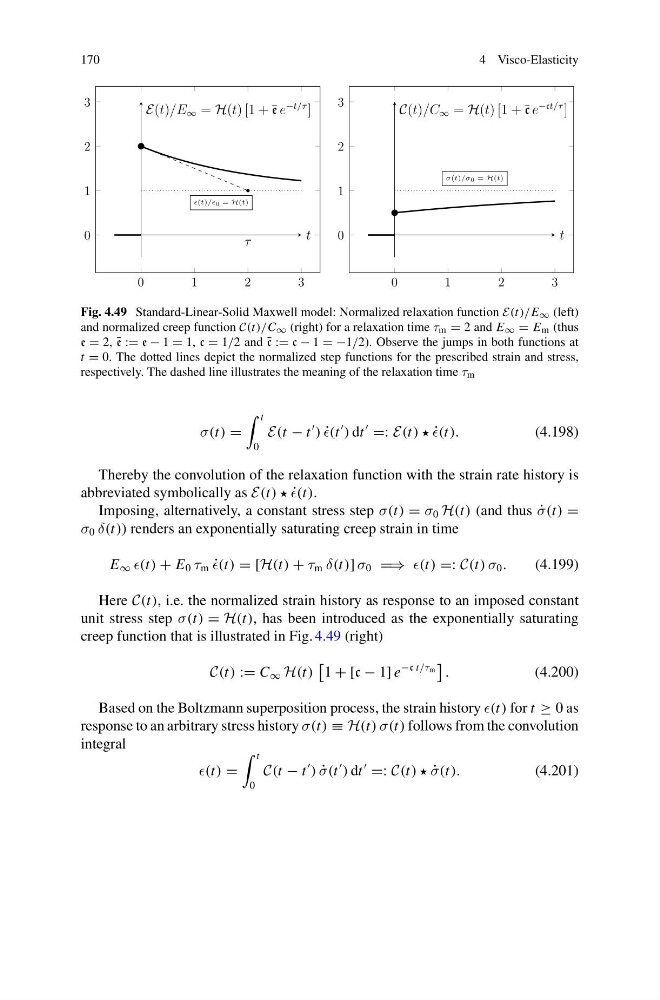
Fig. 4.49 Standard-Linear-Solid Maxwell model: Normalized relaxation function E(t)/E ∞ (left)
and normalized creep function C(t)/C ∞ (right) for a relaxation time τ m = 2 and E ∞ = E m (thus
e = 2, ¯
e := e − 1 = 1, c = 1/2 and ¯
c := c − 1 = −1/2). Observe the jumps in both functions at
t = 0. The dotted lines depict the normalized step functions for the prescribed strain and stress,
respectively. The dashed line illustrates the meaning of the relaxation time τ m
σ(t) =
t
0
E(t − t
) ˙
) dt
=: E(t) ) ˙
(4.198)
Thereby the convolution of the relaxation function with the strain rate history is
abbreviated symbolically as E(t) ) ˙
Imposing, alternatively, a constant stress step σ(t) = σ 0 H(t) (and thus ˙
σ(t) =
σ 0 δ(t)) renders an exponentially saturating creep strain in time
E ∞ + E 0 τ m ˙
= [H(t) + τ m δ(t)] σ 0 =⇒ =: C(t) σ 0 .
(4.199)
Here C(t), i.e. the normalized strain history as response to an imposed constant
unit stress step σ(t) = H(t), has been introduced as the exponentially saturating
creep function that is illustrated in Fig. 4.49 (right)
C(t) := C ∞ H(t)
1 + [c − 1] e
−c t/τ m
.
(4.200)
Based on the Boltzmann superposition process, the strain history for t ≥ 0 as
response to an arbitrary stress history σ(t) ≡ H(t) σ(t) follows from the convolution
integral
=
t
0
C(t − t
) ˙
σ(t
) dt
=: C(t) ) ˙
σ(t).
(4.201)
4 Visco-Elasticity
0
1
2
3
t
τ
E(t)/E ∞ = H(t) [1 + ¯ e e
−t/τ ]
(t) 0 = H(t)
0
1
2
3
0
1
2
3
0
1
2
3
t
C(t)/C ∞ = H(t) [1 + ¯ c e
−ct/τ ]
σ(t)/σ0 = H(t)
Fig. 4.49 Standard-Linear-Solid Maxwell model: Normalized relaxation function E(t)/E ∞ (left)
and normalized creep function C(t)/C ∞ (right) for a relaxation time τ m = 2 and E ∞ = E m (thus
e = 2, ¯
e := e − 1 = 1, c = 1/2 and ¯
c := c − 1 = −1/2). Observe the jumps in both functions at
t = 0. The dotted lines depict the normalized step functions for the prescribed strain and stress,
respectively. The dashed line illustrates the meaning of the relaxation time τ m
σ(t) =
t
0
E(t − t
) ˙
) dt
=: E(t) ) ˙
(4.198)
Thereby the convolution of the relaxation function with the strain rate history is
abbreviated symbolically as E(t) ) ˙
Imposing, alternatively, a constant stress step σ(t) = σ 0 H(t) (and thus ˙
σ(t) =
σ 0 δ(t)) renders an exponentially saturating creep strain in time
E ∞ + E 0 τ m ˙
= [H(t) + τ m δ(t)] σ 0 =⇒ =: C(t) σ 0 .
(4.199)
Here C(t), i.e. the normalized strain history as response to an imposed constant
unit stress step σ(t) = H(t), has been introduced as the exponentially saturating
creep function that is illustrated in Fig. 4.49 (right)
C(t) := C ∞ H(t)
1 + [c − 1] e
−c t/τ m
.
(4.200)
Based on the Boltzmann superposition process, the strain history for t ≥ 0 as
response to an arbitrary stress history σ(t) ≡ H(t) σ(t) follows from the convolution
integral
=
t
0
C(t − t
) ˙
σ(t
) dt
=: C(t) ) ˙
σ(t).
(4.201)