

4.4 Maxwell Model
165
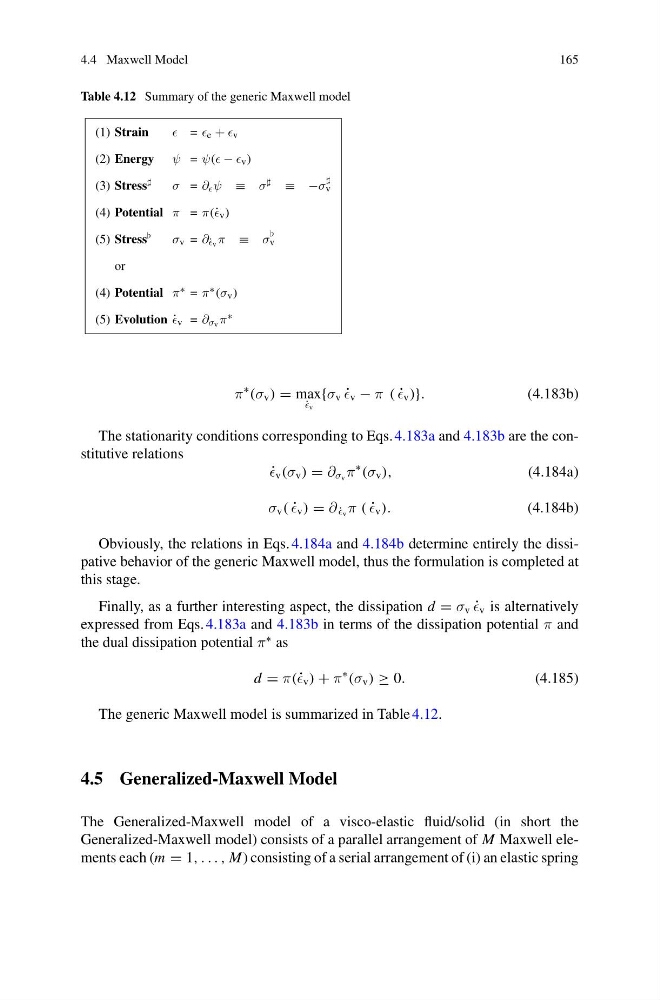
Table 4.12 Summary of the generic Maxwell model
(1) Strain
= e + v
(2) Energy ψ = ψ( − v )
(3) Stress
σ = ∂ ψ ≡ σ ≡ −σ
v
(4) Potential π = π(˙ v )
(5) Stress
σ v = ∂ ˙
v π ≡ σ
v
or
(4) Potential π ∗ = π ∗ (σ v )
(5) Evolution ˙
v = ∂ σv π ∗
π
∗
(σ v ) = max
˙
v
{σ v ˙
v − π ( ˙
v )}.
(4.183b)
The stationarity conditions corresponding to Eqs. 4.183a and 4.183b are the constitutive relations
˙
v (σ v ) = ∂ σ v π
∗
(σ v ),
(4.184a)
σ v ( ˙
v ) = ∂ ˙
v π ( ˙
v ).
(4.184b)
Obviously, the relations in Eqs. 4.184a and 4.184b determine entirely the dissipative behavior of the generic Maxwell model, thus the formulation is completed at
this stage.
Finally, as a further interesting aspect, the dissipation d = σ v ˙
v is alternatively
expressed from Eqs. 4.183a and 4.183b in terms of the dissipation potential π and
the dual dissipation potential π
∗ as
d = π(˙ v ) + π
∗
(σ v ) ≥ 0.
(4.185)
The generic Maxwell model is summarized in Table 4.12.
4.5 Generalized-Maxwell Model
The Generalized-Maxwell model of a visco-elastic fluid/solid (in short the
Generalized-Maxwell model) consists of a parallel arrangement of M Maxwell elements each (m = 1, . . . , M) consisting of a serial arrangement of (i) an elastic spring
165
Table 4.12 Summary of the generic Maxwell model
(1) Strain
= e + v
(2) Energy ψ = ψ( − v )
(3) Stress
σ = ∂ ψ ≡ σ ≡ −σ
v
(4) Potential π = π(˙ v )
(5) Stress
σ v = ∂ ˙
v π ≡ σ
v
or
(4) Potential π ∗ = π ∗ (σ v )
(5) Evolution ˙
v = ∂ σv π ∗
π
∗
(σ v ) = max
˙
v
{σ v ˙
v − π ( ˙
v )}.
(4.183b)
The stationarity conditions corresponding to Eqs. 4.183a and 4.183b are the constitutive relations
˙
v (σ v ) = ∂ σ v π
∗
(σ v ),
(4.184a)
σ v ( ˙
v ) = ∂ ˙
v π ( ˙
v ).
(4.184b)
Obviously, the relations in Eqs. 4.184a and 4.184b determine entirely the dissipative behavior of the generic Maxwell model, thus the formulation is completed at
this stage.
Finally, as a further interesting aspect, the dissipation d = σ v ˙
v is alternatively
expressed from Eqs. 4.183a and 4.183b in terms of the dissipation potential π and
the dual dissipation potential π
∗ as
d = π(˙ v ) + π
∗
(σ v ) ≥ 0.
(4.185)
The generic Maxwell model is summarized in Table 4.12.
4.5 Generalized-Maxwell Model
The Generalized-Maxwell model of a visco-elastic fluid/solid (in short the
Generalized-Maxwell model) consists of a parallel arrangement of M Maxwell elements each (m = 1, . . . , M) consisting of a serial arrangement of (i) an elastic spring