

120
4 Visco-Elasticity
Recall that the energetic and the dissipative viscous stresses (in the viscous dashpot
of the Kelvin element) are constitutively related by σ
v + σ
v = 0, thus the notion of
viscous stress defined as the value
σ v := σ
v = −σ
v with σ 0 = σ e + σ v
(4.87)
will exclusively be used in the sequel for convenience of exposition.
The corresponding dual dissipation potential π
∗ , as determined from a Legendre
transformation
π
∗
(σ v ) = max
˙
v
{σ v ˙
v −
1
2
η k |˙ v |
2
}
(4.88)
then reads
π
∗
(σ v ) =
1
2
1
η k
|σ v |
2
.
(4.89)
The evolution law for the viscous strain contribution of the Kelvin element follows
as partial derivative of the dual dissipation potential with respect to its conjugated
variable
˙
v (σ v ) = ∂ σ v π
∗
(σ v ) =
1
η k
σ v .
(4.90)
Obviously the expressions in Eqs. 4.86 and 4.90 are inverse relations. The smooth
dissipation and dual dissipation potentials π(˙ v ) and π
∗
(σ v ) together with the resulting smooth constitutive relations σ v = σ v (˙ v ) and ˙
v = ˙
v (σ v ) are similar to those
displayed in Fig. 4.2.
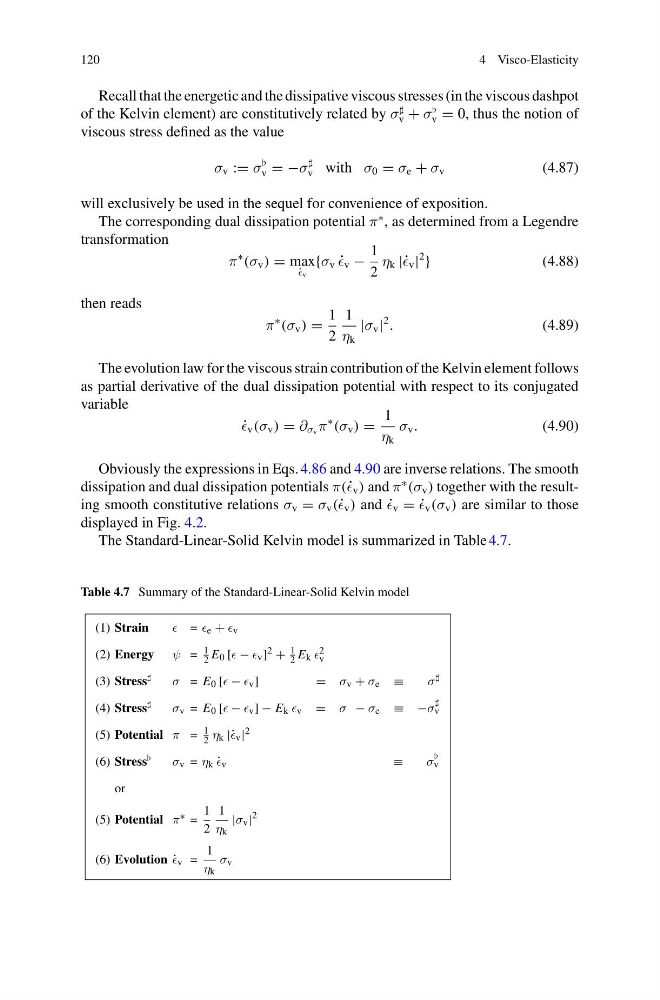
The Standard-Linear-Solid Kelvin model is summarized in Table 4.7.
Table 4.7 Summary of the Standard-Linear-Solid Kelvin model
(1) Strain
= e + v
(2) Energy ψ =
1
2 E 0 [ − v ] 2 +
1
2 E k 2
v
(3) Stress
σ = E 0 [ − v ]
= σ v + σ e ≡
σ
(4) Stress
σ v = E 0 [ − v ] − E k v = σ − σ e ≡ −σ
v
(5) Potential π =
1
2 η k |˙ v | 2
(6) Stress
σ v = η k ˙
v
≡
σ
v
or
(5) Potential π ∗ =
1
2
1
η k
|σ v |
2
(6) Evolution ˙
v =
1
η k
σ v
4 Visco-Elasticity
Recall that the energetic and the dissipative viscous stresses (in the viscous dashpot
of the Kelvin element) are constitutively related by σ
v + σ
v = 0, thus the notion of
viscous stress defined as the value
σ v := σ
v = −σ
v with σ 0 = σ e + σ v
(4.87)
will exclusively be used in the sequel for convenience of exposition.
The corresponding dual dissipation potential π
∗ , as determined from a Legendre
transformation
π
∗
(σ v ) = max
˙
v
{σ v ˙
v −
1
2
η k |˙ v |
2
}
(4.88)
then reads
π
∗
(σ v ) =
1
2
1
η k
|σ v |
2
.
(4.89)
The evolution law for the viscous strain contribution of the Kelvin element follows
as partial derivative of the dual dissipation potential with respect to its conjugated
variable
˙
v (σ v ) = ∂ σ v π
∗
(σ v ) =
1
η k
σ v .
(4.90)
Obviously the expressions in Eqs. 4.86 and 4.90 are inverse relations. The smooth
dissipation and dual dissipation potentials π(˙ v ) and π
∗
(σ v ) together with the resulting smooth constitutive relations σ v = σ v (˙ v ) and ˙
v = ˙
v (σ v ) are similar to those
displayed in Fig. 4.2.
The Standard-Linear-Solid Kelvin model is summarized in Table 4.7.
Table 4.7 Summary of the Standard-Linear-Solid Kelvin model
(1) Strain
= e + v
(2) Energy ψ =
1
2 E 0 [ − v ] 2 +
1
2 E k 2
v
(3) Stress
σ = E 0 [ − v ]
= σ v + σ e ≡
σ
(4) Stress
σ v = E 0 [ − v ] − E k v = σ − σ e ≡ −σ
v
(5) Potential π =
1
2 η k |˙ v | 2
(6) Stress
σ v = η k ˙
v
≡
σ
v
or
(5) Potential π ∗ =
1
2
1
η k
|σ v |
2
(6) Evolution ˙
v =
1
η k
σ v