

4.2 Kelvin Model
97
4.2 Kelvin Model
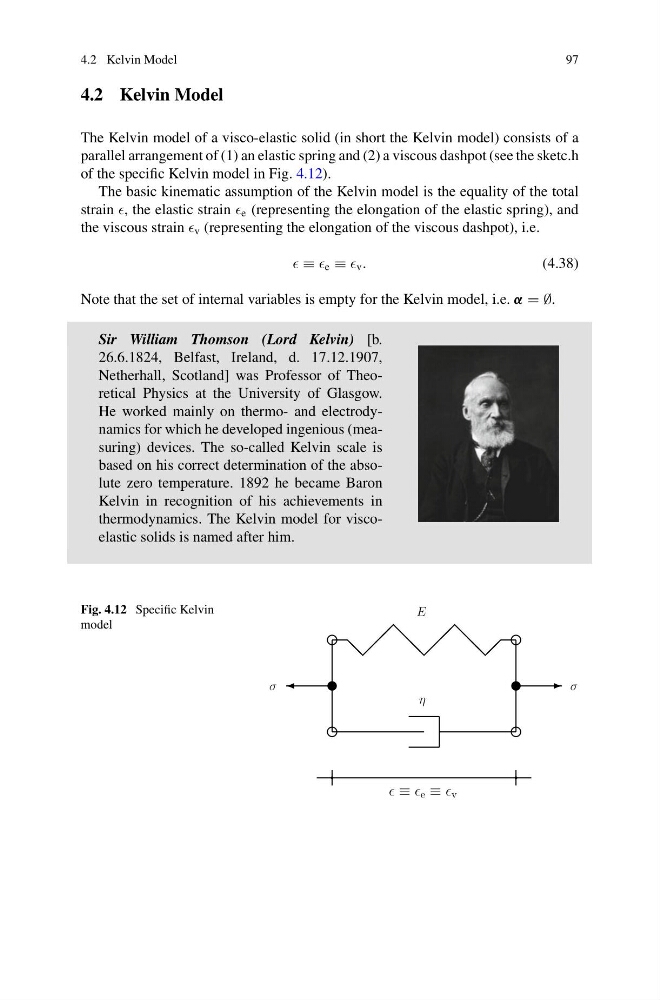
The Kelvin model of a visco-elastic solid (in short the Kelvin model) consists of a
parallel arrangement of (1) an elastic spring and (2) a viscous dashpot (see the sketc.h
of the specific Kelvin model in Fig. 4.12).
The basic kinematic assumption of the Kelvin model is the equality of the total
strain the elastic strain e (representing the elongation of the elastic spring), and
the viscous strain v (representing the elongation of the viscous dashpot), i.e.
≡ e ≡ v .
(4.38)
Note that the set of internal variables is empty for the Kelvin model, i.e. α = ∅.
Sir William Thomson (Lord Kelvin) [b.
26.6.1824, Belfast, Ireland, d. 17.12.1907,
Netherhall, Scotland] was Professor of Theoretical Physics at the University of Glasgow.
He worked mainly on thermo- and electrodynamics for which he developed ingenious (measuring) devices. The so-called Kelvin scale is
based on his correct determination of the absolute zero temperature. 1892 he became Baron
Kelvin in recognition of his achievements in
thermodynamics. The Kelvin model for viscoelastic solids is named after him.
Fig. 4.12 Specific Kelvin
model
σ
σ
≡ e ≡ v
E
η
97
4.2 Kelvin Model
The Kelvin model of a visco-elastic solid (in short the Kelvin model) consists of a
parallel arrangement of (1) an elastic spring and (2) a viscous dashpot (see the sketc.h
of the specific Kelvin model in Fig. 4.12).
The basic kinematic assumption of the Kelvin model is the equality of the total
strain the elastic strain e (representing the elongation of the elastic spring), and
the viscous strain v (representing the elongation of the viscous dashpot), i.e.
≡ e ≡ v .
(4.38)
Note that the set of internal variables is empty for the Kelvin model, i.e. α = ∅.
Sir William Thomson (Lord Kelvin) [b.
26.6.1824, Belfast, Ireland, d. 17.12.1907,
Netherhall, Scotland] was Professor of Theoretical Physics at the University of Glasgow.
He worked mainly on thermo- and electrodynamics for which he developed ingenious (measuring) devices. The so-called Kelvin scale is
based on his correct determination of the absolute zero temperature. 1892 he became Baron
Kelvin in recognition of his achievements in
thermodynamics. The Kelvin model for viscoelastic solids is named after him.
Fig. 4.12 Specific Kelvin
model
σ
σ
≡ e ≡ v
E
η