

44
Optical Classification of Water Types
Natural waters vary highly in their composition and thus also
in the extent to which they transmit light underwater. Thus,
oceanographers introduced ocean classification schemes
based on the optical properties of water. The classification
provided a broad indication of the water optical character.
Jerlov first attempted to classify open ocean waters into 5 (I,
IA, IB, II and III) and coastal waters into 9 different optical
water types (numbered from 1 to 9) based on spectral light
transmission curves (Jerlov 1976). Morel and Prieur (1977)
subsequently introduced the Case 1 (optical properties dominated by phytoplankton and covarying material) and Case 2
(optical properties dominated by suspended sediments and
CDOM that vary independently of phytoplankton) classification schemes (based on the shape of reflectance spectra,
Fig. 2).
Nature of Light and Light from the Sun
Light consists of numerous localized packets of electromagnetic energy, called photons moving with a velocity of
2.998 × 10
8
ms
−1
in vacuum. Each photon carries a linear and
an angular momentum. In addition, they also have an associated wavelength and frequency. Thus, photons exhibit both
particle and wave nature and both aspects are fundamental
for a proper understanding of light. Energy of a photon is
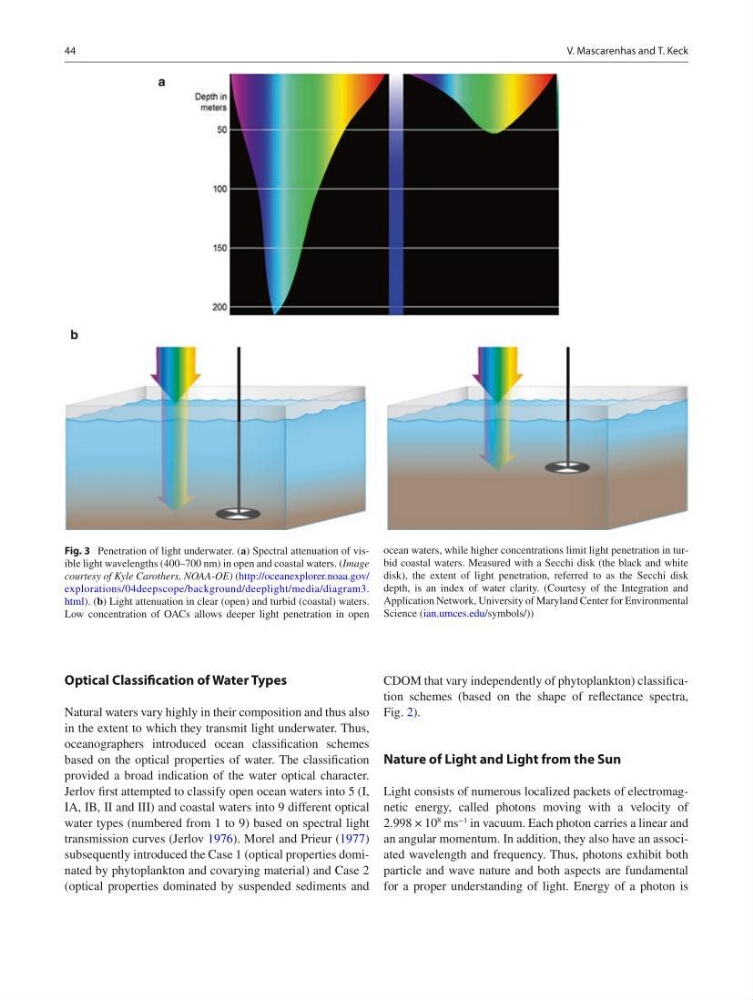
Fig. 3 Penetration of light underwater. (a) Spectral attenuation of visible light wavelengths (400–700 nm) in open and coastal waters. (Image
courtesy of Kyle Carothers, NOAA-OE) (http://oceanexplorer.noaa.gov/
explorations/04deepscope/background/deeplight/media/diagram3.
html). (b) Light attenuation in clear (open) and turbid (coastal) waters.
Low concentration of OACs allows deeper light penetration in open
ocean waters, while higher concentrations limit light penetration in turbid coastal waters. Measured with a Secchi disk (the black and white
disk), the extent of light penetration, referred to as the Secchi disk
depth, is an index of water clarity. (Courtesy of the Integration and
Application Network, University of Maryland Center for Environmental
Science (ian.umces.edu/symbols/))
V. Mascarenhas and T. Keck
Optical Classification of Water Types
Natural waters vary highly in their composition and thus also
in the extent to which they transmit light underwater. Thus,
oceanographers introduced ocean classification schemes
based on the optical properties of water. The classification
provided a broad indication of the water optical character.
Jerlov first attempted to classify open ocean waters into 5 (I,
IA, IB, II and III) and coastal waters into 9 different optical
water types (numbered from 1 to 9) based on spectral light
transmission curves (Jerlov 1976). Morel and Prieur (1977)
subsequently introduced the Case 1 (optical properties dominated by phytoplankton and covarying material) and Case 2
(optical properties dominated by suspended sediments and
CDOM that vary independently of phytoplankton) classification schemes (based on the shape of reflectance spectra,
Fig. 2).
Nature of Light and Light from the Sun
Light consists of numerous localized packets of electromagnetic energy, called photons moving with a velocity of
2.998 × 10
8
ms
−1
in vacuum. Each photon carries a linear and
an angular momentum. In addition, they also have an associated wavelength and frequency. Thus, photons exhibit both
particle and wave nature and both aspects are fundamental
for a proper understanding of light. Energy of a photon is
Fig. 3 Penetration of light underwater. (a) Spectral attenuation of visible light wavelengths (400–700 nm) in open and coastal waters. (Image
courtesy of Kyle Carothers, NOAA-OE) (http://oceanexplorer.noaa.gov/
explorations/04deepscope/background/deeplight/media/diagram3.
html). (b) Light attenuation in clear (open) and turbid (coastal) waters.
Low concentration of OACs allows deeper light penetration in open
ocean waters, while higher concentrations limit light penetration in turbid coastal waters. Measured with a Secchi disk (the black and white
disk), the extent of light penetration, referred to as the Secchi disk
depth, is an index of water clarity. (Courtesy of the Integration and
Application Network, University of Maryland Center for Environmental
Science (ian.umces.edu/symbols/))
V. Mascarenhas and T. Keck