

42
systems (Binding et al. 2008; Garaba et al. 2014; Holinde and
Zielinski 2016; Mascarenhas et al. 2017). The OACs in the
medium interact with the ambient light via processes of
absorption and scattering, which gives water its characteristic
color. The processes of absorption and scattering are referred
to as inherent optical properties (IOPs) of water and depend
solely on the OACs present in water. Spatial and temporal
variability in the type and abundance of these OACs subsequently induces variability in the IOPs of water. In addition to
the IOPs, water bodies are also characterized in terms of their
apparent optical properties (AOPs). The AOPs depend both
on the OACs and the incident light field.
Phytoplankton are drifting microscopic algae that photosynthesize and form the base of food webs in aquatic (marine
and freshwater) ecosystems. Chlorophyll, a green pigment in
the phytoplankton absorbs preferentially the blue and red
wavelengths of the visible light spectra and reflects green.
Therefore, oceans with high concentrations of phytoplankton appear in shades of blue-green depending on the type and
density of the phytoplankton population (e.g., North Sea
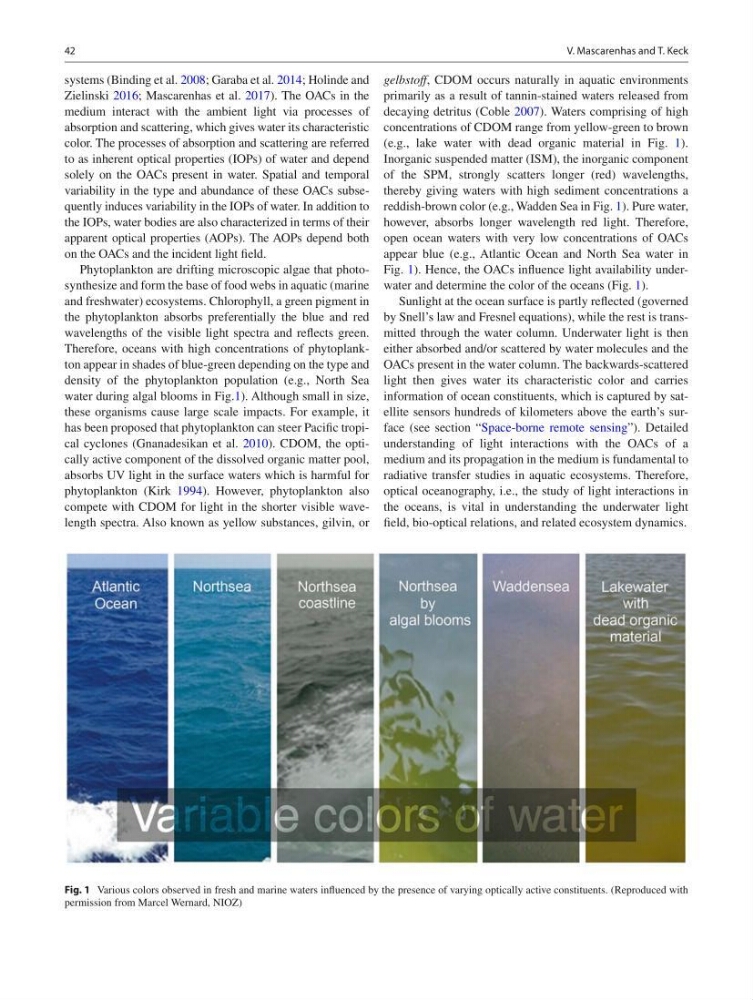
water during algal blooms in Fig.1). Although small in size,
these organisms cause large scale impacts. For example, it
has been proposed that phytoplankton can steer Pacific tropical cyclones (Gnanadesikan et al. 2010). CDOM, the optically active component of the dissolved organic matter pool,
absorbs UV light in the surface waters which is harmful for
phytoplankton (Kirk 1994). However, phytoplankton also
compete with CDOM for light in the shorter visible wavelength spectra. Also known as yellow substances, gilvin, or
gelbstoff, CDOM occurs naturally in aquatic environments
primarily as a result of tannin-stained waters released from
decaying detritus (Coble 2007). Waters comprising of high
concentrations of CDOM range from yellow-green to brown
(e.g., lake water with dead organic material in Fig. 1).
Inorganic suspended matter (ISM), the inorganic component
of the SPM, strongly scatters longer (red) wavelengths,
thereby giving waters with high sediment concentrations a
reddish-brown color (e.g., Wadden Sea in Fig. 1). Pure water,
however, absorbs longer wavelength red light. Therefore,
open ocean waters with very low concentrations of OACs
appear blue (e.g., Atlantic Ocean and North Sea water in
Fig. 1). Hence, the OACs influence light availability underwater and determine the color of the oceans (Fig. 1).
Sunlight at the ocean surface is partly reflected (governed
by Snell’s law and Fresnel equations), while the rest is transmitted through the water column. Underwater light is then
either absorbed and/or scattered by water molecules and the
OACs present in the water column. The backwards-scattered
light then gives water its characteristic color and carries
information of ocean constituents, which is captured by satellite sensors hundreds of kilometers above the earth’s surface (see section “Space-borne remote sensing”). Detailed
understanding of light interactions with the OACs of a
medium and its propagation in the medium is fundamental to
radiative transfer studies in aquatic ecosystems. Therefore,
optical oceanography, i.e., the study of light interactions in
the oceans, is vital in understanding the underwater light
field, bio-optical relations, and related ecosystem dynamics.
Fig. 1 Various colors observed in fresh and marine waters influenced by the presence of varying optically active constituents. (Reproduced with
permission from Marcel Wernard, NIOZ)
V. Mascarenhas and T. Keck
systems (Binding et al. 2008; Garaba et al. 2014; Holinde and
Zielinski 2016; Mascarenhas et al. 2017). The OACs in the
medium interact with the ambient light via processes of
absorption and scattering, which gives water its characteristic
color. The processes of absorption and scattering are referred
to as inherent optical properties (IOPs) of water and depend
solely on the OACs present in water. Spatial and temporal
variability in the type and abundance of these OACs subsequently induces variability in the IOPs of water. In addition to
the IOPs, water bodies are also characterized in terms of their
apparent optical properties (AOPs). The AOPs depend both
on the OACs and the incident light field.
Phytoplankton are drifting microscopic algae that photosynthesize and form the base of food webs in aquatic (marine
and freshwater) ecosystems. Chlorophyll, a green pigment in
the phytoplankton absorbs preferentially the blue and red
wavelengths of the visible light spectra and reflects green.
Therefore, oceans with high concentrations of phytoplankton appear in shades of blue-green depending on the type and
density of the phytoplankton population (e.g., North Sea
water during algal blooms in Fig.1). Although small in size,
these organisms cause large scale impacts. For example, it
has been proposed that phytoplankton can steer Pacific tropical cyclones (Gnanadesikan et al. 2010). CDOM, the optically active component of the dissolved organic matter pool,
absorbs UV light in the surface waters which is harmful for
phytoplankton (Kirk 1994). However, phytoplankton also
compete with CDOM for light in the shorter visible wavelength spectra. Also known as yellow substances, gilvin, or
gelbstoff, CDOM occurs naturally in aquatic environments
primarily as a result of tannin-stained waters released from
decaying detritus (Coble 2007). Waters comprising of high
concentrations of CDOM range from yellow-green to brown
(e.g., lake water with dead organic material in Fig. 1).
Inorganic suspended matter (ISM), the inorganic component
of the SPM, strongly scatters longer (red) wavelengths,
thereby giving waters with high sediment concentrations a
reddish-brown color (e.g., Wadden Sea in Fig. 1). Pure water,
however, absorbs longer wavelength red light. Therefore,
open ocean waters with very low concentrations of OACs
appear blue (e.g., Atlantic Ocean and North Sea water in
Fig. 1). Hence, the OACs influence light availability underwater and determine the color of the oceans (Fig. 1).
Sunlight at the ocean surface is partly reflected (governed
by Snell’s law and Fresnel equations), while the rest is transmitted through the water column. Underwater light is then
either absorbed and/or scattered by water molecules and the
OACs present in the water column. The backwards-scattered
light then gives water its characteristic color and carries
information of ocean constituents, which is captured by satellite sensors hundreds of kilometers above the earth’s surface (see section “Space-borne remote sensing”). Detailed
understanding of light interactions with the OACs of a
medium and its propagation in the medium is fundamental to
radiative transfer studies in aquatic ecosystems. Therefore,
optical oceanography, i.e., the study of light interactions in
the oceans, is vital in understanding the underwater light
field, bio-optical relations, and related ecosystem dynamics.
Fig. 1 Various colors observed in fresh and marine waters influenced by the presence of varying optically active constituents. (Reproduced with
permission from Marcel Wernard, NIOZ)
V. Mascarenhas and T. Keck