

26
future (Wang and Overland 2009; IPCC 2014). Nevertheless,
the impacts of these projections for the weather and climate
locally and elsewhere are not sufficiently well understood.
Numerous studies have been published on the relation
between Arctic sea ice decline and weather and climate.
While some have addressed the question how Arctic sea ice
decline impacts climate (Budikova 2009; Vihma 2014;
Semmler et al. 2016), Lang et al. (2017) and several others
have reviewed the recent decline in Arctic sea ice and the
processes responsible for it (Polyakov et al. 2012; Stroeve
et al. 2012; Barnes and Screen 2015). By far, the majority of
these studies focus on atmospheric pathways and, therefore,
our understanding of the mechanisms, pathways, and timescales by which the ocean controls or responds to these
changes remains quite limited.
Previous studies addressed how the inflow of the warm
Atlantic Water (AW) to the Arctic Ocean contributes to the
decline of the sea ice extent and thickness (e.g., Carmack
et al. 2015; Onarheim et al. 2014). Itkin et al. (2014) has
addressed this problem from the reverse perspective, and
showed in idealized experiments that a weaker (i.e., thinner)
sea ice cover allows higher momentum transfer into the
Arctic Ocean and impacts the surface and intermediate ocean
circulation. In other words, there is an intrinsic two-way
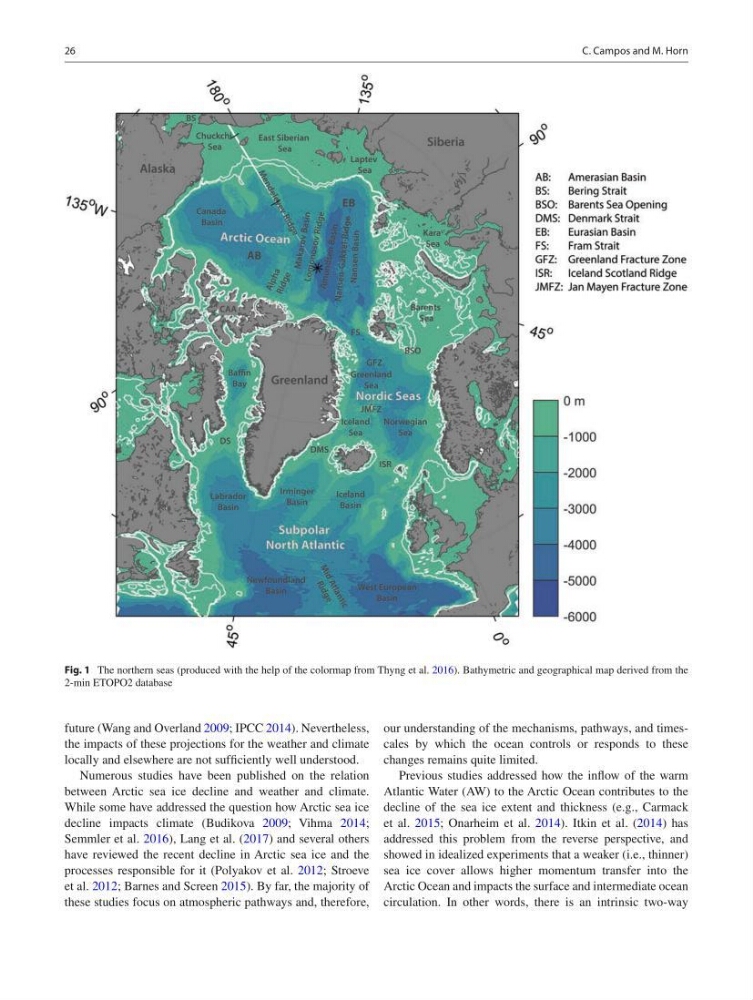
Fig. 1 The northern seas (produced with the help of the colormap from Thyng et al. 2016). Bathymetric and geographical map derived from the
2-min ETOPO2 database
C. Campos and M. Horn
future (Wang and Overland 2009; IPCC 2014). Nevertheless,
the impacts of these projections for the weather and climate
locally and elsewhere are not sufficiently well understood.
Numerous studies have been published on the relation
between Arctic sea ice decline and weather and climate.
While some have addressed the question how Arctic sea ice
decline impacts climate (Budikova 2009; Vihma 2014;
Semmler et al. 2016), Lang et al. (2017) and several others
have reviewed the recent decline in Arctic sea ice and the
processes responsible for it (Polyakov et al. 2012; Stroeve
et al. 2012; Barnes and Screen 2015). By far, the majority of
these studies focus on atmospheric pathways and, therefore,
our understanding of the mechanisms, pathways, and timescales by which the ocean controls or responds to these
changes remains quite limited.
Previous studies addressed how the inflow of the warm
Atlantic Water (AW) to the Arctic Ocean contributes to the
decline of the sea ice extent and thickness (e.g., Carmack
et al. 2015; Onarheim et al. 2014). Itkin et al. (2014) has
addressed this problem from the reverse perspective, and
showed in idealized experiments that a weaker (i.e., thinner)
sea ice cover allows higher momentum transfer into the
Arctic Ocean and impacts the surface and intermediate ocean
circulation. In other words, there is an intrinsic two-way
Fig. 1 The northern seas (produced with the help of the colormap from Thyng et al. 2016). Bathymetric and geographical map derived from the
2-min ETOPO2 database
C. Campos and M. Horn