

20
for the upcoming season. Unfortunately, most models perform very poorly with respect to the Atlantic Niño and can
provide hardly any predictive skill (Stockdale et al. 2006;
Richter et al. 2017).
One reason for these shortcomings is that a prerequisite to
simulate the variability of Atlantic cold tongue growth is a
model that produces a realistic cold tongue. Indeed, Ding
et al. (2015) showed that even a symptomatic – as opposed to
a dynamically motivated and hence more process-oriented –
reduction of the equatorial Atlantic SST bias in the KCM
greatly improves the ability of the model to track the observed
Atlantic Niño variability. This serves as an example of how
the mean state interacts with climate variability. How the
bias influences the predictive skill of the KCM for tropical
Atlantic SST and whether the real climate system actually
provides the potential to produce reliable forecasts of Atlantic
Niño variability a few months in advance are the subjects of
current research.
In general, the equatorial Atlantic warm bias has been an
important issue since the earliest attempts of coupled global
climate modeling (Davey et al. 2002) and continues to challenge the scientific community. It serves as an important
reminder that model output should not always be taken at
face value. Rather, models can struggle to represent observed
physical processes, even though their physical basis in the
form of the approximated Navier-Stokes equations is sound.
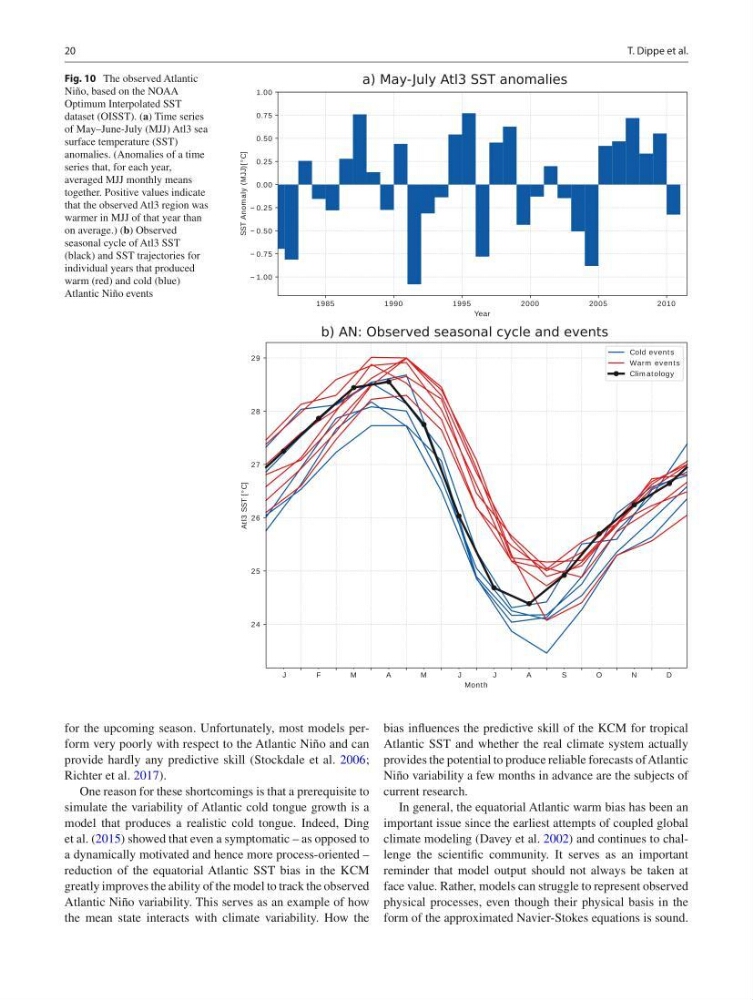
Fig. 10 The observed Atlantic
Niño, based on the NOAA
Optimum Interpolated SST
dataset (OISST). (a) Time series
of May–June-July (MJJ) Atl3 sea
surface temperature (SST)
anomalies. (Anomalies of a time
series that, for each year,
averaged MJJ monthly means
together. Positive values indicate
that the observed Atl3 region was
warmer in MJJ of that year than
on average.) (b) Observed
seasonal cycle of Atl3 SST
(black) and SST trajectories for
individual years that produced
warm (red) and cold (blue)
Atlantic Niño events
T. Dippe et al.
for the upcoming season. Unfortunately, most models perform very poorly with respect to the Atlantic Niño and can
provide hardly any predictive skill (Stockdale et al. 2006;
Richter et al. 2017).
One reason for these shortcomings is that a prerequisite to
simulate the variability of Atlantic cold tongue growth is a
model that produces a realistic cold tongue. Indeed, Ding
et al. (2015) showed that even a symptomatic – as opposed to
a dynamically motivated and hence more process-oriented –
reduction of the equatorial Atlantic SST bias in the KCM
greatly improves the ability of the model to track the observed
Atlantic Niño variability. This serves as an example of how
the mean state interacts with climate variability. How the
bias influences the predictive skill of the KCM for tropical
Atlantic SST and whether the real climate system actually
provides the potential to produce reliable forecasts of Atlantic
Niño variability a few months in advance are the subjects of
current research.
In general, the equatorial Atlantic warm bias has been an
important issue since the earliest attempts of coupled global
climate modeling (Davey et al. 2002) and continues to challenge the scientific community. It serves as an important
reminder that model output should not always be taken at
face value. Rather, models can struggle to represent observed
physical processes, even though their physical basis in the
form of the approximated Navier-Stokes equations is sound.
Fig. 10 The observed Atlantic
Niño, based on the NOAA
Optimum Interpolated SST
dataset (OISST). (a) Time series
of May–June-July (MJJ) Atl3 sea
surface temperature (SST)
anomalies. (Anomalies of a time
series that, for each year,
averaged MJJ monthly means
together. Positive values indicate
that the observed Atl3 region was
warmer in MJJ of that year than
on average.) (b) Observed
seasonal cycle of Atl3 SST
(black) and SST trajectories for
individual years that produced
warm (red) and cold (blue)
Atlantic Niño events
T. Dippe et al.