

180
to a certain extent, as the different sample matrices require
different sampling methods. Moreover, as replication of
samples is limited within a project, the high spatial and temporal variability of MPs in the various environments poses
another major challenge in MP research (Goldstein et al.
2013; Moreira et al. 2016; Imhof et al. 2017). Whereas some
recommendations for spatial replication have been made, no
general consensus exists about temporal replication (Hanke
et al. 2013). As a next step, the impact of the determined
environmental concentrations of MP on biota is interesting.
Parallel to monitoring studies, the toxicological implications
for biota have been addressed in many studies. So far, we
know that MPs are ingested by a wide range of organisms
from the base of the food web up to top predators. As the
environmental concentrations have not yet been sufficiently
analyzed, exposure to MPs in laboratory studies are applying
high concentrations to get first insights into possible effects
following ingestion. This chapter aims to summarize the
main results of the latest 3 years of research on sampling and
monitoring methods as well as to give an overview about
observed effects of MP exposure on biota.
Sampling Design
Previous research already addressed the problem of an
appropriate sampling design (Browne et al. 2015; Löder and
Gerdts 2015; Costa and Duarte 2017). A detailed review on
the topic is given by Underwood et al. (2017). Over the last
years, some studies focused on improving sampling design
(Chae et al. 2015; Kang et al. 2015; Barrows et al. 2017) and
aimed to investigate spatial and temporal patterns of MPs
(Goldstein et al. 2013; Heo et al. 2013; Besley et al. 2017;
Fisner et al. 2017; Imhof et al. 2017). Moreover, a few recommendations and protocols for sampling exist (Hanke et al.
2013; GESAMP 2016; Kovač Viršek et al. 2016). Potential
factors which need to be considered when sampling beach
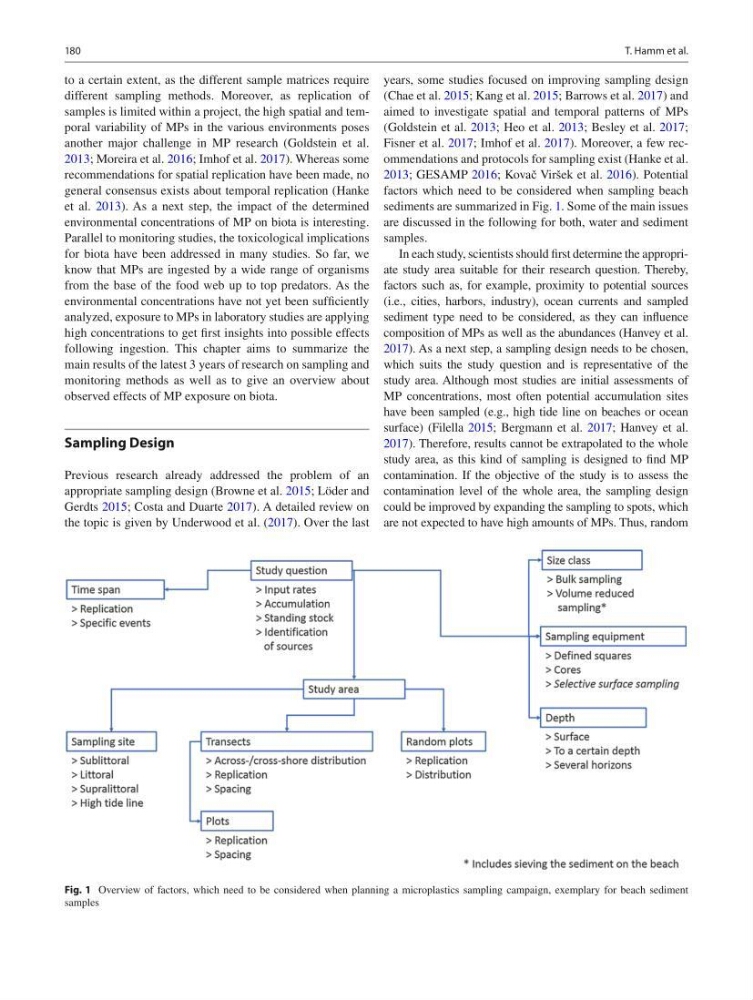
sediments are summarized in Fig. 1. Some of the main issues
are discussed in the following for both, water and sediment
samples.
In each study, scientists should first determine the appropriate study area suitable for their research question. Thereby,
factors such as, for example, proximity to potential sources
(i.e., cities, harbors, industry), ocean currents and sampled
sediment type need to be considered, as they can influence
composition of MPs as well as the abundances (Hanvey et al.
2017). As a next step, a sampling design needs to be chosen,
which suits the study question and is representative of the
study area. Although most studies are initial assessments of
MP concentrations, most often potential accumulation sites
have been sampled (e.g., high tide line on beaches or ocean
surface) (Filella 2015; Bergmann et al. 2017; Hanvey et al.
2017). Therefore, results cannot be extrapolated to the whole
study area, as this kind of sampling is designed to find MP
contamination. If the objective of the study is to assess the
contamination level of the whole area, the sampling design
could be improved by expanding the sampling to spots, which
are not expected to have high amounts of MPs. Thus, random
Fig. 1 Overview of factors, which need to be considered when planning a microplastics sampling campaign, exemplary for beach sediment
samples
T. Hamm et al.
to a certain extent, as the different sample matrices require
different sampling methods. Moreover, as replication of
samples is limited within a project, the high spatial and temporal variability of MPs in the various environments poses
another major challenge in MP research (Goldstein et al.
2013; Moreira et al. 2016; Imhof et al. 2017). Whereas some
recommendations for spatial replication have been made, no
general consensus exists about temporal replication (Hanke
et al. 2013). As a next step, the impact of the determined
environmental concentrations of MP on biota is interesting.
Parallel to monitoring studies, the toxicological implications
for biota have been addressed in many studies. So far, we
know that MPs are ingested by a wide range of organisms
from the base of the food web up to top predators. As the
environmental concentrations have not yet been sufficiently
analyzed, exposure to MPs in laboratory studies are applying
high concentrations to get first insights into possible effects
following ingestion. This chapter aims to summarize the
main results of the latest 3 years of research on sampling and
monitoring methods as well as to give an overview about
observed effects of MP exposure on biota.
Sampling Design
Previous research already addressed the problem of an
appropriate sampling design (Browne et al. 2015; Löder and
Gerdts 2015; Costa and Duarte 2017). A detailed review on
the topic is given by Underwood et al. (2017). Over the last
years, some studies focused on improving sampling design
(Chae et al. 2015; Kang et al. 2015; Barrows et al. 2017) and
aimed to investigate spatial and temporal patterns of MPs
(Goldstein et al. 2013; Heo et al. 2013; Besley et al. 2017;
Fisner et al. 2017; Imhof et al. 2017). Moreover, a few recommendations and protocols for sampling exist (Hanke et al.
2013; GESAMP 2016; Kovač Viršek et al. 2016). Potential
factors which need to be considered when sampling beach
sediments are summarized in Fig. 1. Some of the main issues
are discussed in the following for both, water and sediment
samples.
In each study, scientists should first determine the appropriate study area suitable for their research question. Thereby,
factors such as, for example, proximity to potential sources
(i.e., cities, harbors, industry), ocean currents and sampled
sediment type need to be considered, as they can influence
composition of MPs as well as the abundances (Hanvey et al.
2017). As a next step, a sampling design needs to be chosen,
which suits the study question and is representative of the
study area. Although most studies are initial assessments of
MP concentrations, most often potential accumulation sites
have been sampled (e.g., high tide line on beaches or ocean
surface) (Filella 2015; Bergmann et al. 2017; Hanvey et al.
2017). Therefore, results cannot be extrapolated to the whole
study area, as this kind of sampling is designed to find MP
contamination. If the objective of the study is to assess the
contamination level of the whole area, the sampling design
could be improved by expanding the sampling to spots, which
are not expected to have high amounts of MPs. Thus, random
Fig. 1 Overview of factors, which need to be considered when planning a microplastics sampling campaign, exemplary for beach sediment
samples
T. Hamm et al.