

170
potential consequences on the diversity of a region: i)
increase it due to the occurrence of a species that was not
present within the original pool and that could even facilitate
the arrival of other species or ii) diminish it by promoting the
loss of native species through competition or predation (Sax
and Gaines 2003, 2008), exceeding the gain that the introduction of a new species implies.
7
Even though the vast
majority of articles have focused on the negative consequences of exotic species, some authors are discussing the
introduction of species from a new perspective. Recent
7 An additional possibility will imply the generation of new species (and
eventually new functional traits) by hybridization between native and
non-native species. Please see Seehausen (2004) for a broad revision on
the topic.
works showed that from those species classified as endangered or extinct by the IUCN, a small percentage have exotic
species as the main or single cause of decline (the numbers
increase if only island regions are considered; Gurevitch and
Padilla 2004; Sax and Gaines 2008). Much of the evidence
on the negative impacts of exotic species is correlational (or
based on small scale experiments) and it cannot be discarded
that the spread of the new species was favored by the impacts
of other drivers on native communities. In addition,
worldwide evidence suggests that the number of species
introduced in a given region exceeds the number of extirpated ones, generating on average an increase of species
richness at the regional scale (Thomas 2013a, b). Therefore,
what at a global scale is only determined by the balance
between speciation and extinction, at a regional scale it is
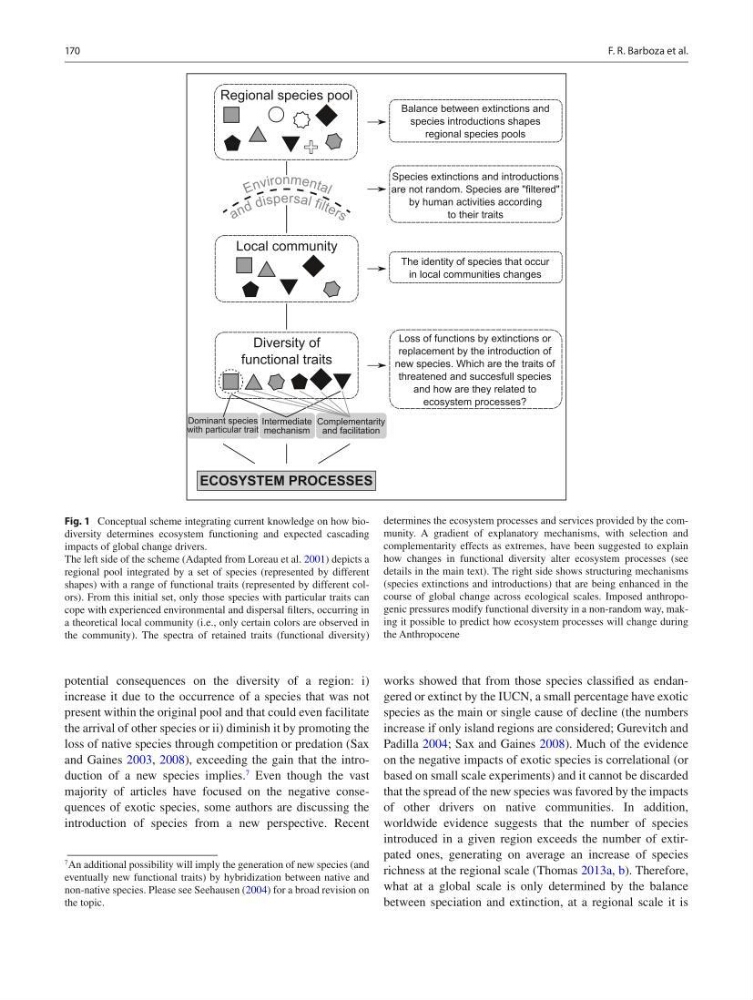
Fig. 1 Conceptual scheme integrating current knowledge on how biodiversity determines ecosystem functioning and expected cascading
impacts of global change drivers.
The left side of the scheme (Adapted from Loreau et al. 2001) depicts a
regional pool integrated by a set of species (represented by different
shapes) with a range of functional traits (represented by different colors). From this initial set, only those species with particular traits can
cope with experienced environmental and dispersal filters, occurring in
a theoretical local community (i.e., only certain colors are observed in
the community). The spectra of retained traits (functional diversity)
determines the ecosystem processes and services provided by the community. A gradient of explanatory mechanisms, with selection and
complementarity effects as extremes, have been suggested to explain
how changes in functional diversity alter ecosystem processes (see
details in the main text). The right side shows structuring mechanisms
(species extinctions and introductions) that are being enhanced in the
course of global change across ecological scales. Imposed anthropogenic pressures modify functional diversity in a non-random way, making it possible to predict how ecosystem processes will change during
the Anthropocene
F. R. Barboza et al.
potential consequences on the diversity of a region: i)
increase it due to the occurrence of a species that was not
present within the original pool and that could even facilitate
the arrival of other species or ii) diminish it by promoting the
loss of native species through competition or predation (Sax
and Gaines 2003, 2008), exceeding the gain that the introduction of a new species implies.
7
Even though the vast
majority of articles have focused on the negative consequences of exotic species, some authors are discussing the
introduction of species from a new perspective. Recent
7 An additional possibility will imply the generation of new species (and
eventually new functional traits) by hybridization between native and
non-native species. Please see Seehausen (2004) for a broad revision on
the topic.
works showed that from those species classified as endangered or extinct by the IUCN, a small percentage have exotic
species as the main or single cause of decline (the numbers
increase if only island regions are considered; Gurevitch and
Padilla 2004; Sax and Gaines 2008). Much of the evidence
on the negative impacts of exotic species is correlational (or
based on small scale experiments) and it cannot be discarded
that the spread of the new species was favored by the impacts
of other drivers on native communities. In addition,
worldwide evidence suggests that the number of species
introduced in a given region exceeds the number of extirpated ones, generating on average an increase of species
richness at the regional scale (Thomas 2013a, b). Therefore,
what at a global scale is only determined by the balance
between speciation and extinction, at a regional scale it is
Fig. 1 Conceptual scheme integrating current knowledge on how biodiversity determines ecosystem functioning and expected cascading
impacts of global change drivers.
The left side of the scheme (Adapted from Loreau et al. 2001) depicts a
regional pool integrated by a set of species (represented by different
shapes) with a range of functional traits (represented by different colors). From this initial set, only those species with particular traits can
cope with experienced environmental and dispersal filters, occurring in
a theoretical local community (i.e., only certain colors are observed in
the community). The spectra of retained traits (functional diversity)
determines the ecosystem processes and services provided by the community. A gradient of explanatory mechanisms, with selection and
complementarity effects as extremes, have been suggested to explain
how changes in functional diversity alter ecosystem processes (see
details in the main text). The right side shows structuring mechanisms
(species extinctions and introductions) that are being enhanced in the
course of global change across ecological scales. Imposed anthropogenic pressures modify functional diversity in a non-random way, making it possible to predict how ecosystem processes will change during
the Anthropocene
F. R. Barboza et al.