

129
Maxwell et al. 2017). One way in which seagrasses counteract sulphide toxicity is by transporting oxygen from the leaves
to the roots, thereby oxygenating the sediment (Borum et al.
2005). However, oxygen production is highly dependent on
photosynthesis and light availability, which will be decreased
during algal bloom conditions. This negative feedback loop
can ultimately result in increased losses of seagrass and subsequent replacement by algae, which in turn stimulates further seagrass loss through elevated decomposition rates
(Maxwell et al. 2017).
In regards to the connectivity between seagrass meadows
and other ecosystems, we can expect multiple disruptions of
important processes. For example, there are more than 50
records of seagrass shoots laying on the deep-sea floor
(>1000 m), and there is evidence that seagrass detritus is an
important subsidy to the deep-sea food web (Heck et al.
2008; Duarte and Krause-Jensen 2017). Seagrass has a relatively slow decomposition time compared to macroalgae
(degradation rate constants range from 0.001 to 0.018 d
–1
in
seagrass and from 0.02 to 0.26 d
–1
for Ulva spp.), enabling
seagrass detritus to reach the deep-sea floor (Flindt et al.
1999; Heck et al. 2008). Algae are also exported from seagrass communities, but they have more labile organic matter
than seagrasses and decompose before reaching the seafloor
(Flindt et al. 1999; Heck et al. 2008). This important organic
matter subsidy will be lost as seagrasses areas decline or
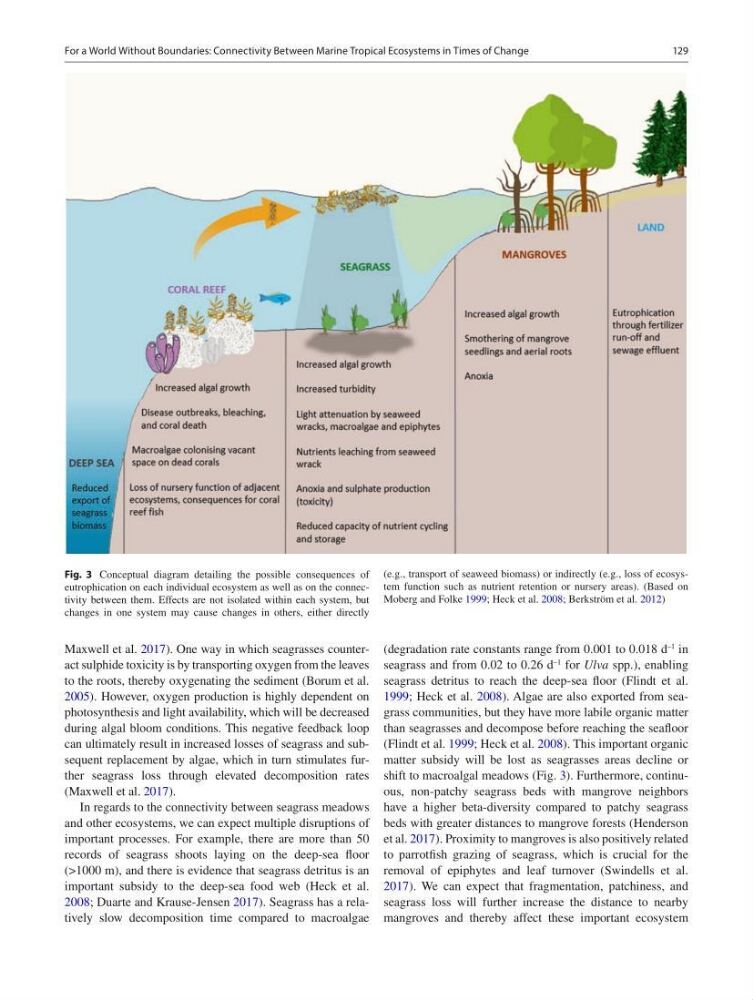
shift to macroalgal meadows (Fig. 3). Furthermore, continuous, non-patchy seagrass beds with mangrove neighbors
have a higher beta-diversity compared to patchy seagrass
beds with greater distances to mangrove forests (Henderson
et al. 2017). Proximity to mangroves is also positively related
to parrotfish grazing of seagrass, which is crucial for the
removal of epiphytes and leaf turnover (Swindells et al.
2017). We can expect that fragmentation, patchiness, and
seagrass loss will further increase the distance to nearby
mangroves and thereby affect these important ecosystem
Fig. 3 Conceptual diagram detailing the possible consequences of
eutrophication on each individual ecosystem as well as on the connectivity between them. Effects are not isolated within each system, but
changes in one system may cause changes in others, either directly
(e.g., transport of seaweed biomass) or indirectly (e.g., loss of ecosystem function such as nutrient retention or nursery areas). (Based on
Moberg and Folke 1999; Heck et al. 2008; Berkström et al. 2012)
For a World Without Boundaries: Connectivity Between Marine Tropical Ecosystems in Times of Change
Maxwell et al. 2017). One way in which seagrasses counteract sulphide toxicity is by transporting oxygen from the leaves
to the roots, thereby oxygenating the sediment (Borum et al.
2005). However, oxygen production is highly dependent on
photosynthesis and light availability, which will be decreased
during algal bloom conditions. This negative feedback loop
can ultimately result in increased losses of seagrass and subsequent replacement by algae, which in turn stimulates further seagrass loss through elevated decomposition rates
(Maxwell et al. 2017).
In regards to the connectivity between seagrass meadows
and other ecosystems, we can expect multiple disruptions of
important processes. For example, there are more than 50
records of seagrass shoots laying on the deep-sea floor
(>1000 m), and there is evidence that seagrass detritus is an
important subsidy to the deep-sea food web (Heck et al.
2008; Duarte and Krause-Jensen 2017). Seagrass has a relatively slow decomposition time compared to macroalgae
(degradation rate constants range from 0.001 to 0.018 d
–1
in
seagrass and from 0.02 to 0.26 d
–1
for Ulva spp.), enabling
seagrass detritus to reach the deep-sea floor (Flindt et al.
1999; Heck et al. 2008). Algae are also exported from seagrass communities, but they have more labile organic matter
than seagrasses and decompose before reaching the seafloor
(Flindt et al. 1999; Heck et al. 2008). This important organic
matter subsidy will be lost as seagrasses areas decline or
shift to macroalgal meadows (Fig. 3). Furthermore, continuous, non-patchy seagrass beds with mangrove neighbors
have a higher beta-diversity compared to patchy seagrass
beds with greater distances to mangrove forests (Henderson
et al. 2017). Proximity to mangroves is also positively related
to parrotfish grazing of seagrass, which is crucial for the
removal of epiphytes and leaf turnover (Swindells et al.
2017). We can expect that fragmentation, patchiness, and
seagrass loss will further increase the distance to nearby
mangroves and thereby affect these important ecosystem
Fig. 3 Conceptual diagram detailing the possible consequences of
eutrophication on each individual ecosystem as well as on the connectivity between them. Effects are not isolated within each system, but
changes in one system may cause changes in others, either directly
(e.g., transport of seaweed biomass) or indirectly (e.g., loss of ecosystem function such as nutrient retention or nursery areas). (Based on
Moberg and Folke 1999; Heck et al. 2008; Berkström et al. 2012)
For a World Without Boundaries: Connectivity Between Marine Tropical Ecosystems in Times of Change