

113
availability for invaders) are thus important determinants of
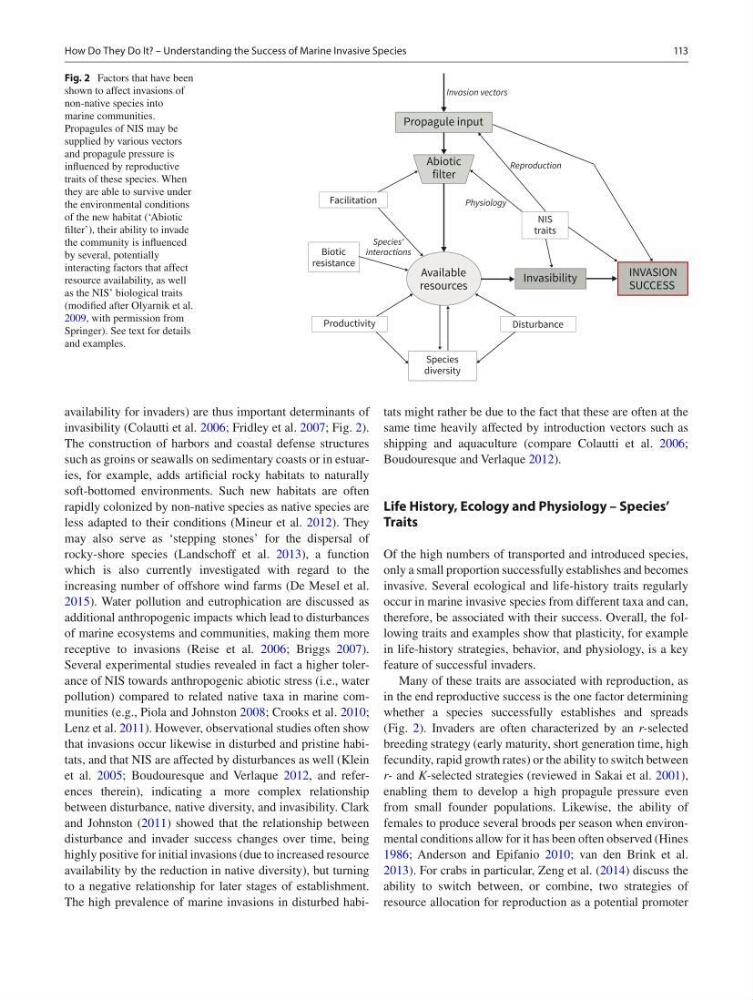
invasibility (Colautti et al. 2006; Fridley et al. 2007; Fig. 2).
The construction of harbors and coastal defense structures
such as groins or seawalls on sedimentary coasts or in estuaries, for example, adds artificial rocky habitats to naturally
soft-bottomed environments. Such new habitats are often
rapidly colonized by non-native species as native species are
less adapted to their conditions (Mineur et al. 2012). They
may also serve as ‘stepping stones’ for the dispersal of
rocky-shore species (Landschoff et al. 2013), a function
which is also currently investigated with regard to the
increasing number of offshore wind farms (De Mesel et al.
2015). Water pollution and eutrophication are discussed as
additional anthropogenic impacts which lead to disturbances
of marine ecosystems and communities, making them more
receptive to invasions (Reise et al. 2006; Briggs 2007).
Several experimental studies revealed in fact a higher tolerance of NIS towards anthropogenic abiotic stress (i.e., water
pollution) compared to related native taxa in marine communities (e.g., Piola and Johnston 2008; Crooks et al. 2010;
Lenz et al. 2011). However, observational studies often show
that invasions occur likewise in disturbed and pristine habitats, and that NIS are affected by disturbances as well (Klein
et al. 2005; Boudouresque and Verlaque 2012, and references therein), indicating a more complex relationship
between disturbance, native diversity, and invasibility. Clark
and Johnston (2011) showed that the relationship between
disturbance and invader success changes over time, being
highly positive for initial invasions (due to increased resource
availability by the reduction in native diversity), but turning
to a negative relationship for later stages of establishment.
The high prevalence of marine invasions in disturbed habitats might rather be due to the fact that these are often at the
same time heavily affected by introduction vectors such as
shipping and aquaculture (compare Colautti et al. 2006;
Boudouresque and Verlaque 2012).
Life History, Ecology and Physiology – Species’
Traits
Of the high numbers of transported and introduced species,
only a small proportion successfully establishes and becomes
invasive. Several ecological and life-history traits regularly
occur in marine invasive species from different taxa and can,
therefore, be associated with their success. Overall, the following traits and examples show that plasticity, for example
in life-history strategies, behavior, and physiology, is a key
feature of successful invaders.
Many of these traits are associated with reproduction, as
in the end reproductive success is the one factor determining
whether a species successfully establishes and spreads
(Fig. 2). Invaders are often characterized by an r-selected
breeding strategy (early maturity, short generation time, high
fecundity, rapid growth rates) or the ability to switch between
r- and K-selected strategies (reviewed in Sakai et al. 2001),
enabling them to develop a high propagule pressure even
from small founder populations. Likewise, the ability of
females to produce several broods per season when environmental conditions allow for it has been often observed (Hines
1986; Anderson and Epifanio 2010; van den Brink et al.
2013). For crabs in particular, Zeng et al. (2014) discuss the
ability to switch between, or combine, two strategies of
resource allocation for reproduction as a potential promoter
Fig. 2 Factors that have been
shown to affect invasions of
non-native species into
marine communities.
Propagules of NIS may be
supplied by various vectors
and propagule pressure is
influenced by reproductive
traits of these species. When
they are able to survive under
the environmental conditions
of the new habitat (‘Abiotic
filter’), their ability to invade
the community is influenced
by several, potentially
interacting factors that affect
resource availability, as well
as the NIS’ biological traits
(modified after Olyarnik et al.
2009, with permission from
Springer). See text for details
and examples.
How Do They Do It? – Understanding the Success of Marine Invasive Species
availability for invaders) are thus important determinants of
invasibility (Colautti et al. 2006; Fridley et al. 2007; Fig. 2).
The construction of harbors and coastal defense structures
such as groins or seawalls on sedimentary coasts or in estuaries, for example, adds artificial rocky habitats to naturally
soft-bottomed environments. Such new habitats are often
rapidly colonized by non-native species as native species are
less adapted to their conditions (Mineur et al. 2012). They
may also serve as ‘stepping stones’ for the dispersal of
rocky-shore species (Landschoff et al. 2013), a function
which is also currently investigated with regard to the
increasing number of offshore wind farms (De Mesel et al.
2015). Water pollution and eutrophication are discussed as
additional anthropogenic impacts which lead to disturbances
of marine ecosystems and communities, making them more
receptive to invasions (Reise et al. 2006; Briggs 2007).
Several experimental studies revealed in fact a higher tolerance of NIS towards anthropogenic abiotic stress (i.e., water
pollution) compared to related native taxa in marine communities (e.g., Piola and Johnston 2008; Crooks et al. 2010;
Lenz et al. 2011). However, observational studies often show
that invasions occur likewise in disturbed and pristine habitats, and that NIS are affected by disturbances as well (Klein
et al. 2005; Boudouresque and Verlaque 2012, and references therein), indicating a more complex relationship
between disturbance, native diversity, and invasibility. Clark
and Johnston (2011) showed that the relationship between
disturbance and invader success changes over time, being
highly positive for initial invasions (due to increased resource
availability by the reduction in native diversity), but turning
to a negative relationship for later stages of establishment.
The high prevalence of marine invasions in disturbed habitats might rather be due to the fact that these are often at the
same time heavily affected by introduction vectors such as
shipping and aquaculture (compare Colautti et al. 2006;
Boudouresque and Verlaque 2012).
Life History, Ecology and Physiology – Species’
Traits
Of the high numbers of transported and introduced species,
only a small proportion successfully establishes and becomes
invasive. Several ecological and life-history traits regularly
occur in marine invasive species from different taxa and can,
therefore, be associated with their success. Overall, the following traits and examples show that plasticity, for example
in life-history strategies, behavior, and physiology, is a key
feature of successful invaders.
Many of these traits are associated with reproduction, as
in the end reproductive success is the one factor determining
whether a species successfully establishes and spreads
(Fig. 2). Invaders are often characterized by an r-selected
breeding strategy (early maturity, short generation time, high
fecundity, rapid growth rates) or the ability to switch between
r- and K-selected strategies (reviewed in Sakai et al. 2001),
enabling them to develop a high propagule pressure even
from small founder populations. Likewise, the ability of
females to produce several broods per season when environmental conditions allow for it has been often observed (Hines
1986; Anderson and Epifanio 2010; van den Brink et al.
2013). For crabs in particular, Zeng et al. (2014) discuss the
ability to switch between, or combine, two strategies of
resource allocation for reproduction as a potential promoter
Fig. 2 Factors that have been
shown to affect invasions of
non-native species into
marine communities.
Propagules of NIS may be
supplied by various vectors
and propagule pressure is
influenced by reproductive
traits of these species. When
they are able to survive under
the environmental conditions
of the new habitat (‘Abiotic
filter’), their ability to invade
the community is influenced
by several, potentially
interacting factors that affect
resource availability, as well
as the NIS’ biological traits
(modified after Olyarnik et al.
2009, with permission from
Springer). See text for details
and examples.
How Do They Do It? – Understanding the Success of Marine Invasive Species