

96
Similar problems occur when tagging sharks or other
elasmobranchs. Due to their placoid scale epidermis, a noninvasive attachment procedure is almost impossible
(Hammerschlag et al. 2011). Most PATs are forcefully
implanted into the well-developed dorsal musculature, which
reduces the probability of premature release (Carlson et al.
2010; Campana et al. 2011; Hammerschlag et al. 2011). As
with dolphins, satellite transmitters are often attached to the
shark’s dorsal fin using bolts and pins, which can be a source
of infection or lead to fin damage (Meyer et al. 2010;
Hammerschlag et al. 2011; Jewell et al. 2011). Therefore,
new non-invasive attachment methods are currently being
tested and further developed. For example, a clamp system
was successfully used to attach a combined accelerometer
and magnetometer to the second dorsal fin of a whale shark
(Fig. 1) (Gleiss et al. 2009; Williams et al. 2017).
Most deployments on seabirds involve the attachment of
non-invasive bio-telemetry devices. Most commonly the tags
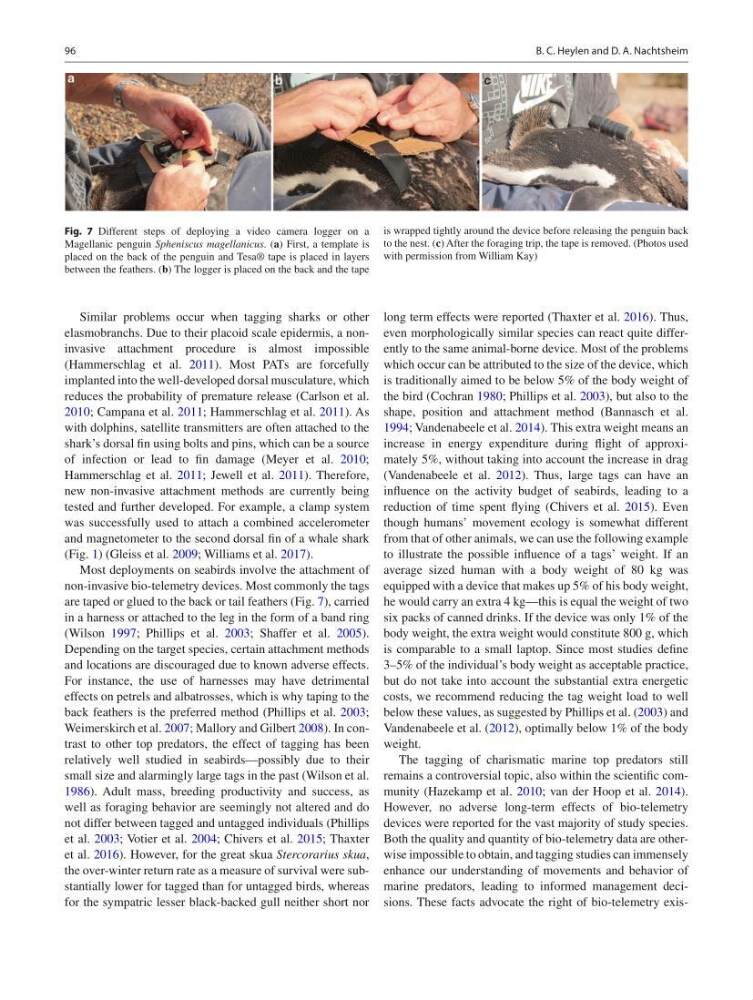
are taped or glued to the back or tail feathers (Fig. 7), carried
in a harness or attached to the leg in the form of a band ring
(Wilson 1997; Phillips et al. 2003; Shaffer et al. 2005).
Depending on the target species, certain attachment methods
and locations are discouraged due to known adverse effects.
For instance, the use of harnesses may have detrimental
effects on petrels and albatrosses, which is why taping to the
back feathers is the preferred method (Phillips et al. 2003;
Weimerskirch et al. 2007; Mallory and Gilbert 2008). In contrast to other top predators, the effect of tagging has been
relatively well studied in seabirds—possibly due to their
small size and alarmingly large tags in the past (Wilson et al.
1986). Adult mass, breeding productivity and success, as
well as foraging behavior are seemingly not altered and do
not differ between tagged and untagged individuals (Phillips
et al. 2003; Votier et al. 2004; Chivers et al. 2015; Thaxter
et al. 2016). However, for the great skua Stercorarius skua,
the over-winter return rate as a measure of survival were substantially lower for tagged than for untagged birds, whereas
for the sympatric lesser black-backed gull neither short nor
long term effects were reported (Thaxter et al. 2016). Thus,
even morphologically similar species can react quite differently to the same animal-borne device. Most of the problems
which occur can be attributed to the size of the device, which
is traditionally aimed to be below 5% of the body weight of
the bird (Cochran 1980; Phillips et al. 2003), but also to the
shape, position and attachment method (Bannasch et al.
1994; Vandenabeele et al. 2014). This extra weight means an
increase in energy expenditure during flight of approximately 5%, without taking into account the increase in drag
(Vandenabeele et al. 2012). Thus, large tags can have an
influence on the activity budget of seabirds, leading to a
reduction of time spent flying (Chivers et al. 2015). Even
though humans’ movement ecology is somewhat different
from that of other animals, we can use the following example
to illustrate the possible influence of a tags’ weight. If an
average sized human with a body weight of 80 kg was
equipped with a device that makes up 5% of his body weight,
he would carry an extra 4 kg—this is equal the weight of two
six packs of canned drinks. If the device was only 1% of the
body weight, the extra weight would constitute 800 g, which
is comparable to a small laptop. Since most studies define
3–5% of the individual’s body weight as acceptable practice,
but do not take into account the substantial extra energetic
costs, we recommend reducing the tag weight load to well
below these values, as suggested by Phillips et al. (2003) and
Vandenabeele et al. (2012), optimally below 1% of the body
weight.
The tagging of charismatic marine top predators still
remains a controversial topic, also within the scientific community (Hazekamp et al. 2010; van der Hoop et al. 2014).
However, no adverse long-term effects of bio-telemetry
devices were reported for the vast majority of study species.
Both the quality and quantity of bio-telemetry data are otherwise impossible to obtain, and tagging studies can immensely
enhance our understanding of movements and behavior of
marine predators, leading to informed management decisions. These facts advocate the right of bio-telemetry exisFig. 7 Different steps of deploying a video camera logger on a
Magellanic penguin Spheniscus magellanicus. (a) First, a template is
placed on the back of the penguin and Tesa® tape is placed in layers
between the feathers. (b) The logger is placed on the back and the tape
is wrapped tightly around the device before releasing the penguin back
to the nest. (c) After the foraging trip, the tape is removed. (Photos used
with permission from William Kay)
B. C. Heylen and D. A. Nachtsheim
Similar problems occur when tagging sharks or other
elasmobranchs. Due to their placoid scale epidermis, a noninvasive attachment procedure is almost impossible
(Hammerschlag et al. 2011). Most PATs are forcefully
implanted into the well-developed dorsal musculature, which
reduces the probability of premature release (Carlson et al.
2010; Campana et al. 2011; Hammerschlag et al. 2011). As
with dolphins, satellite transmitters are often attached to the
shark’s dorsal fin using bolts and pins, which can be a source
of infection or lead to fin damage (Meyer et al. 2010;
Hammerschlag et al. 2011; Jewell et al. 2011). Therefore,
new non-invasive attachment methods are currently being
tested and further developed. For example, a clamp system
was successfully used to attach a combined accelerometer
and magnetometer to the second dorsal fin of a whale shark
(Fig. 1) (Gleiss et al. 2009; Williams et al. 2017).
Most deployments on seabirds involve the attachment of
non-invasive bio-telemetry devices. Most commonly the tags
are taped or glued to the back or tail feathers (Fig. 7), carried
in a harness or attached to the leg in the form of a band ring
(Wilson 1997; Phillips et al. 2003; Shaffer et al. 2005).
Depending on the target species, certain attachment methods
and locations are discouraged due to known adverse effects.
For instance, the use of harnesses may have detrimental
effects on petrels and albatrosses, which is why taping to the
back feathers is the preferred method (Phillips et al. 2003;
Weimerskirch et al. 2007; Mallory and Gilbert 2008). In contrast to other top predators, the effect of tagging has been
relatively well studied in seabirds—possibly due to their
small size and alarmingly large tags in the past (Wilson et al.
1986). Adult mass, breeding productivity and success, as
well as foraging behavior are seemingly not altered and do
not differ between tagged and untagged individuals (Phillips
et al. 2003; Votier et al. 2004; Chivers et al. 2015; Thaxter
et al. 2016). However, for the great skua Stercorarius skua,
the over-winter return rate as a measure of survival were substantially lower for tagged than for untagged birds, whereas
for the sympatric lesser black-backed gull neither short nor
long term effects were reported (Thaxter et al. 2016). Thus,
even morphologically similar species can react quite differently to the same animal-borne device. Most of the problems
which occur can be attributed to the size of the device, which
is traditionally aimed to be below 5% of the body weight of
the bird (Cochran 1980; Phillips et al. 2003), but also to the
shape, position and attachment method (Bannasch et al.
1994; Vandenabeele et al. 2014). This extra weight means an
increase in energy expenditure during flight of approximately 5%, without taking into account the increase in drag
(Vandenabeele et al. 2012). Thus, large tags can have an
influence on the activity budget of seabirds, leading to a
reduction of time spent flying (Chivers et al. 2015). Even
though humans’ movement ecology is somewhat different
from that of other animals, we can use the following example
to illustrate the possible influence of a tags’ weight. If an
average sized human with a body weight of 80 kg was
equipped with a device that makes up 5% of his body weight,
he would carry an extra 4 kg—this is equal the weight of two
six packs of canned drinks. If the device was only 1% of the
body weight, the extra weight would constitute 800 g, which
is comparable to a small laptop. Since most studies define
3–5% of the individual’s body weight as acceptable practice,
but do not take into account the substantial extra energetic
costs, we recommend reducing the tag weight load to well
below these values, as suggested by Phillips et al. (2003) and
Vandenabeele et al. (2012), optimally below 1% of the body
weight.
The tagging of charismatic marine top predators still
remains a controversial topic, also within the scientific community (Hazekamp et al. 2010; van der Hoop et al. 2014).
However, no adverse long-term effects of bio-telemetry
devices were reported for the vast majority of study species.
Both the quality and quantity of bio-telemetry data are otherwise impossible to obtain, and tagging studies can immensely
enhance our understanding of movements and behavior of
marine predators, leading to informed management decisions. These facts advocate the right of bio-telemetry exisFig. 7 Different steps of deploying a video camera logger on a
Magellanic penguin Spheniscus magellanicus. (a) First, a template is
placed on the back of the penguin and Tesa® tape is placed in layers
between the feathers. (b) The logger is placed on the back and the tape
is wrapped tightly around the device before releasing the penguin back
to the nest. (c) After the foraging trip, the tape is removed. (Photos used
with permission from William Kay)
B. C. Heylen and D. A. Nachtsheim