

91
assumed that older individuals have learned to improve their
energy gain and lower their effort per feeding attempt, as illustrated in the Caspian Gull Larus cachinnans (Skórka and
Wójcik 2008). Another, more frequently observed defining
intrinsic factor of foraging efficiency is sex, which can be
observed in many taxa as a possible mechanism to reduce
intra-specific competition. Sexually distinct foraging strategies were observed, amongst others, in lesser black-backed
gulls Larus fuscus and harbor seals Phoca vitulina
(Camphuijsen et al. 2015; Wilson et al. 2015b). A healthy
body condition is also vital for efficient foraging. African penguins in low body condition after an energy-demanding breeding season may have difficulties in gaining enough fat reserves
to molt, and consequently forage less efficiently as feather
quality deteriorates, eventually leading to starvation (Crawford
et al. 2011). Lastly, brood demand is also an important factor.
In general, when offspring is present, net energy demand is
higher, which will affect parental feeding strategies (Pinaud
et al. 2005; O’Dwyer et al. 2007; Rishworth et al. 2014; Shoji
et al. 2015). Additionally, the increasing energetic demands of
developing progeny may make it even harder to deliver sufficient food as the breeding season progresses.
Movement, hence foraging ecology, is also significantly
determined by extrinsic factors, such as prey distribution and
availability, environmental features, intra- and interspecific
competition, and the presence of anthropogenic food sources
(Lewis et al. 2001; Grémillet et al. 2004; Biuw et al. 2007;
Dragon et al. 2010; Labrousse et al. 2015). For the latter,
fisheries discards are one of the most important drivers of
seabird distributions (Garthe et al. 1996; Bartumeus et al.
2010; Patrick et al. 2015; Krüger et al. 2017), while recreational fisheries, offshore wind farms, and terrestrial refuse
tips can play a role too (Griffiths et al. 2004). Environmental
factors, such as sea surface temperature (SST), oceanographic features, sea ice conditions, and atmospheric conditions, are also highly important, since they are the main
drivers for prey distribution and availability (Tremblay et al.
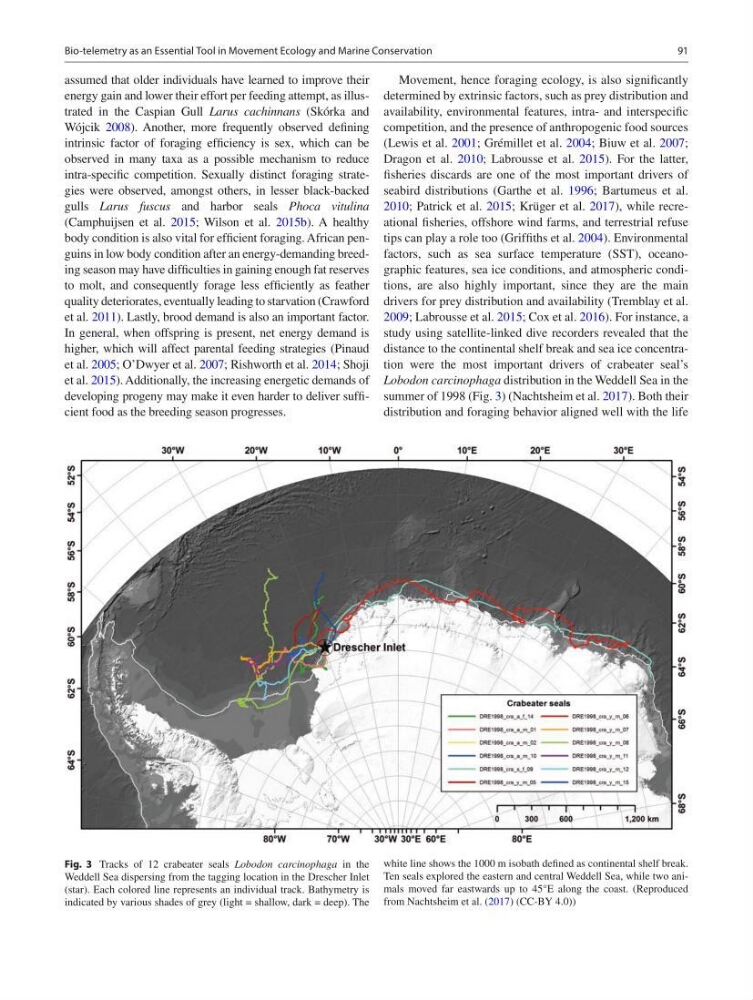
2009; Labrousse et al. 2015; Cox et al. 2016). For instance, a
study using satellite-linked dive recorders revealed that the
distance to the continental shelf break and sea ice concentration were the most important drivers of crabeater seal’s
Lobodon carcinophaga distribution in the Weddell Sea in the
summer of 1998 (Fig. 3) (Nachtsheim et al. 2017). Both their
distribution and foraging behavior aligned well with the life
Fig. 3 Tracks of 12 crabeater seals Lobodon carcinophaga in the
Weddell Sea dispersing from the tagging location in the Drescher Inlet
(star). Each colored line represents an individual track. Bathymetry is
indicated by various shades of grey (light = shallow, dark = deep). The
white line shows the 1000 m isobath defined as continental shelf break.
Ten seals explored the eastern and central Weddell Sea, while two animals moved far eastwards up to 45°E along the coast. (Reproduced
from Nachtsheim et al. (2017) (CC-BY 4.0))
Bio-telemetry as an Essential Tool in Movement Ecology and Marine Conservation
assumed that older individuals have learned to improve their
energy gain and lower their effort per feeding attempt, as illustrated in the Caspian Gull Larus cachinnans (Skórka and
Wójcik 2008). Another, more frequently observed defining
intrinsic factor of foraging efficiency is sex, which can be
observed in many taxa as a possible mechanism to reduce
intra-specific competition. Sexually distinct foraging strategies were observed, amongst others, in lesser black-backed
gulls Larus fuscus and harbor seals Phoca vitulina
(Camphuijsen et al. 2015; Wilson et al. 2015b). A healthy
body condition is also vital for efficient foraging. African penguins in low body condition after an energy-demanding breeding season may have difficulties in gaining enough fat reserves
to molt, and consequently forage less efficiently as feather
quality deteriorates, eventually leading to starvation (Crawford
et al. 2011). Lastly, brood demand is also an important factor.
In general, when offspring is present, net energy demand is
higher, which will affect parental feeding strategies (Pinaud
et al. 2005; O’Dwyer et al. 2007; Rishworth et al. 2014; Shoji
et al. 2015). Additionally, the increasing energetic demands of
developing progeny may make it even harder to deliver sufficient food as the breeding season progresses.
Movement, hence foraging ecology, is also significantly
determined by extrinsic factors, such as prey distribution and
availability, environmental features, intra- and interspecific
competition, and the presence of anthropogenic food sources
(Lewis et al. 2001; Grémillet et al. 2004; Biuw et al. 2007;
Dragon et al. 2010; Labrousse et al. 2015). For the latter,
fisheries discards are one of the most important drivers of
seabird distributions (Garthe et al. 1996; Bartumeus et al.
2010; Patrick et al. 2015; Krüger et al. 2017), while recreational fisheries, offshore wind farms, and terrestrial refuse
tips can play a role too (Griffiths et al. 2004). Environmental
factors, such as sea surface temperature (SST), oceanographic features, sea ice conditions, and atmospheric conditions, are also highly important, since they are the main
drivers for prey distribution and availability (Tremblay et al.
2009; Labrousse et al. 2015; Cox et al. 2016). For instance, a
study using satellite-linked dive recorders revealed that the
distance to the continental shelf break and sea ice concentration were the most important drivers of crabeater seal’s
Lobodon carcinophaga distribution in the Weddell Sea in the
summer of 1998 (Fig. 3) (Nachtsheim et al. 2017). Both their
distribution and foraging behavior aligned well with the life
Fig. 3 Tracks of 12 crabeater seals Lobodon carcinophaga in the
Weddell Sea dispersing from the tagging location in the Drescher Inlet
(star). Each colored line represents an individual track. Bathymetry is
indicated by various shades of grey (light = shallow, dark = deep). The
white line shows the 1000 m isobath defined as continental shelf break.
Ten seals explored the eastern and central Weddell Sea, while two animals moved far eastwards up to 45°E along the coast. (Reproduced
from Nachtsheim et al. (2017) (CC-BY 4.0))
Bio-telemetry as an Essential Tool in Movement Ecology and Marine Conservation