

6.2 The Model
83
6.2 The Model
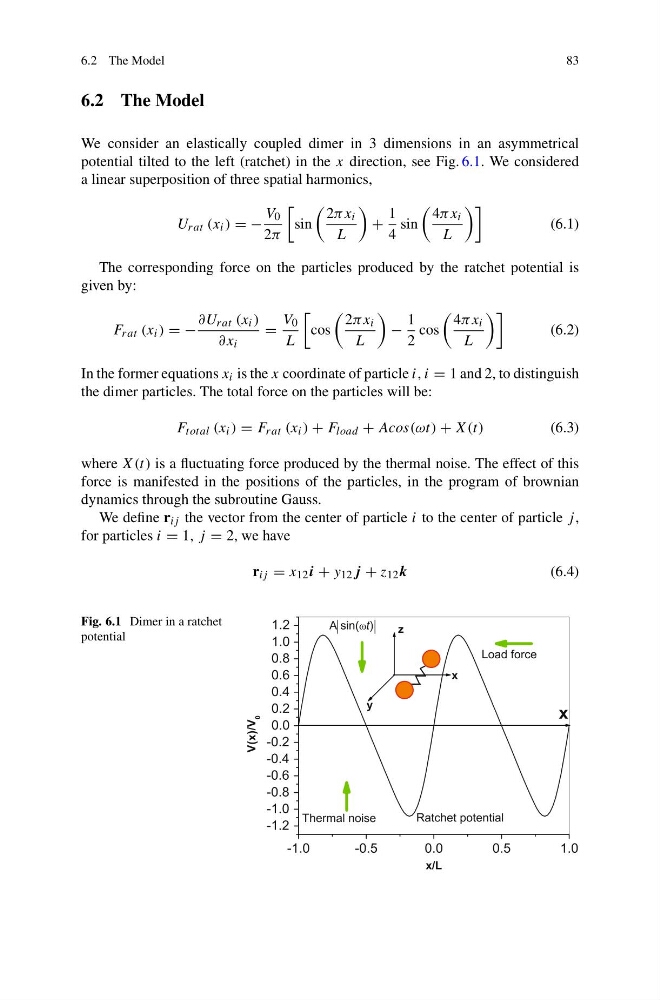
We consider an elastically coupled dimer in 3 dimensions in an asymmetrical
potential tilted to the left (ratchet) in the x direction, see Fig. 6.1. We considered
a linear superposition of three spatial harmonics,
U rat (x i ) = −
V 0
2π
sin
2πx i
L
+
1
4
sin
4πx i
L
(6.1)
The corresponding force on the particles produced by the ratchet potential is
given by:
F rat (x i ) = −
∂U rat (x i )
∂x i
=
V 0
L
cos
2πx i
L
−
1
2
cos
4πx i
L
(6.2)
In the former equations x i is the x coordinate of particle i, i = 1 and 2, to distinguish
the dimer particles. The total force on the particles will be:
F total (x i ) = F rat (x i ) + F load + Acos(ωt) + X(t)
(6.3)
where X(t) is a fluctuating force produced by the thermal noise. The effect of this
force is manifested in the positions of the particles, in the program of brownian
dynamics through the subroutine Gauss.
We define r ij the vector from the center of particle i to the center of particle j ,
for particles i = 1, j = 2, we have
r ij = x 12 i + y 12 j + z 12 k
(6.4)
Fig. 6.1 Dimer in a ratchet
potential
83
6.2 The Model
We consider an elastically coupled dimer in 3 dimensions in an asymmetrical
potential tilted to the left (ratchet) in the x direction, see Fig. 6.1. We considered
a linear superposition of three spatial harmonics,
U rat (x i ) = −
V 0
2π
sin
2πx i
L
+
1
4
sin
4πx i
L
(6.1)
The corresponding force on the particles produced by the ratchet potential is
given by:
F rat (x i ) = −
∂U rat (x i )
∂x i
=
V 0
L
cos
2πx i
L
−
1
2
cos
4πx i
L
(6.2)
In the former equations x i is the x coordinate of particle i, i = 1 and 2, to distinguish
the dimer particles. The total force on the particles will be:
F total (x i ) = F rat (x i ) + F load + Acos(ωt) + X(t)
(6.3)
where X(t) is a fluctuating force produced by the thermal noise. The effect of this
force is manifested in the positions of the particles, in the program of brownian
dynamics through the subroutine Gauss.
We define r ij the vector from the center of particle i to the center of particle j ,
for particles i = 1, j = 2, we have
r ij = x 12 i + y 12 j + z 12 k
(6.4)
Fig. 6.1 Dimer in a ratchet
potential