

4.2 Chemical Kinetics
55
1
T
=
2 0
h
=
2(
1
2 k B T )
h
=
k B T
h
(4.25)
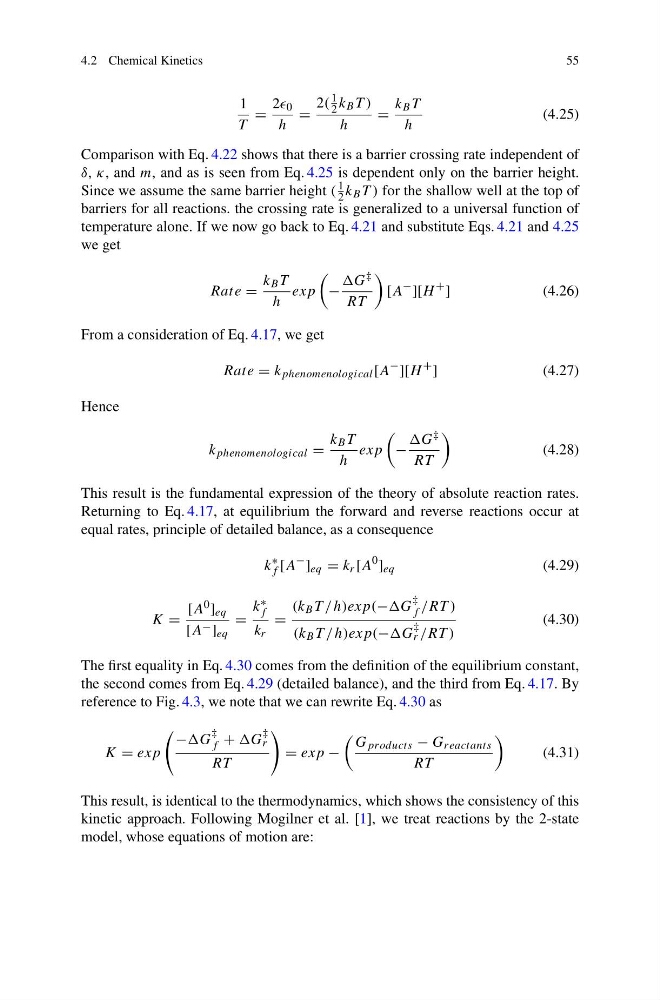
Comparison with Eq. 4.22 shows that there is a barrier crossing rate independent of
δ, κ, and m, and as is seen from Eq. 4.25 is dependent only on the barrier height.
Since we assume the same barrier height (
1
2 k B T ) for the shallow well at the top of
barriers for all reactions. the crossing rate is generalized to a universal function of
temperature alone. If we now go back to Eq. 4.21 and substitute Eqs. 4.21 and 4.25
we get
Rate =
k B T
h
exp
−
G ‡
RT
[A
−
][H
+
]
(4.26)
From a consideration of Eq. 4.17, we get
Rate = k phenomenological [A
−
][H
+
]
(4.27)
Hence
k phenomenological =
k B T
h
exp
−
G ‡
RT
(4.28)
This result is the fundamental expression of the theory of absolute reaction rates.
Returning to Eq. 4.17, at equilibrium the forward and reverse reactions occur at
equal rates, principle of detailed balance, as a consequence
k
∗
f [A
−
] eq = k r [A
0
] eq
(4.29)
K =
[A 0 ] eq
[A − ] eq
=
k ∗
f
k r
=
(k B T /h)exp(−G
‡
f /RT )
(k B T /h)exp(−G
‡
r /RT )
(4.30)
The first equality in Eq. 4.30 comes from the definition of the equilibrium constant,
the second comes from Eq. 4.29 (detailed balance), and the third from Eq. 4.17. By
reference to Fig. 4.3, we note that we can rewrite Eq. 4.30 as
K = exp
−G
‡
f + G
‡
r
RT
= exp −
G products − G reactants
RT
(4.31)
This result, is identical to the thermodynamics, which shows the consistency of this
kinetic approach. Following Mogilner et al. [1], we treat reactions by the 2-state
model, whose equations of motion are:
55
1
T
=
2 0
h
=
2(
1
2 k B T )
h
=
k B T
h
(4.25)
Comparison with Eq. 4.22 shows that there is a barrier crossing rate independent of
δ, κ, and m, and as is seen from Eq. 4.25 is dependent only on the barrier height.
Since we assume the same barrier height (
1
2 k B T ) for the shallow well at the top of
barriers for all reactions. the crossing rate is generalized to a universal function of
temperature alone. If we now go back to Eq. 4.21 and substitute Eqs. 4.21 and 4.25
we get
Rate =
k B T
h
exp
−
G ‡
RT
[A
−
][H
+
]
(4.26)
From a consideration of Eq. 4.17, we get
Rate = k phenomenological [A
−
][H
+
]
(4.27)
Hence
k phenomenological =
k B T
h
exp
−
G ‡
RT
(4.28)
This result is the fundamental expression of the theory of absolute reaction rates.
Returning to Eq. 4.17, at equilibrium the forward and reverse reactions occur at
equal rates, principle of detailed balance, as a consequence
k
∗
f [A
−
] eq = k r [A
0
] eq
(4.29)
K =
[A 0 ] eq
[A − ] eq
=
k ∗
f
k r
=
(k B T /h)exp(−G
‡
f /RT )
(k B T /h)exp(−G
‡
r /RT )
(4.30)
The first equality in Eq. 4.30 comes from the definition of the equilibrium constant,
the second comes from Eq. 4.29 (detailed balance), and the third from Eq. 4.17. By
reference to Fig. 4.3, we note that we can rewrite Eq. 4.30 as
K = exp
−G
‡
f + G
‡
r
RT
= exp −
G products − G reactants
RT
(4.31)
This result, is identical to the thermodynamics, which shows the consistency of this
kinetic approach. Following Mogilner et al. [1], we treat reactions by the 2-state
model, whose equations of motion are: