

36
3 Biased Brownian Motion
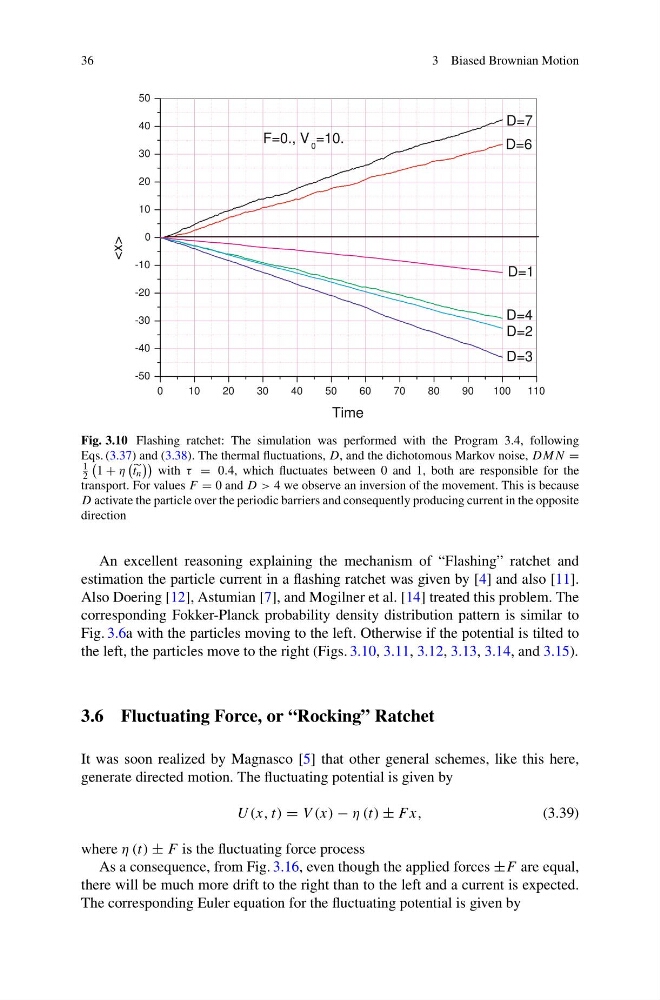
Fig. 3.10 Flashing ratchet: The simulation was performed with the Program 3.4, following
Eqs. (3.37) and (3.38). The thermal fluctuations, D, and the dichotomous Markov noise, DMN =
1
2
1 + η
t n
with τ = 0.4, which fluctuates between 0 and 1, both are responsible for the
transport. For values F = 0 and D > 4 we observe an inversion of the movement. This is because
D activate the particle over the periodic barriers and consequently producing current in the opposite
direction
An excellent reasoning explaining the mechanism of “Flashing” ratchet and
estimation the particle current in a flashing ratchet was given by [4] and also [11].
Also Doering [12], Astumian [7], and Mogilner et al. [14] treated this problem. The
corresponding Fokker-Planck probability density distribution pattern is similar to
Fig. 3.6a with the particles moving to the left. Otherwise if the potential is tilted to
the left, the particles move to the right (Figs. 3.10, 3.11, 3.12, 3.13, 3.14, and 3.15).
3.6 Fluctuating Force, or “Rocking” Ratchet
It was soon realized by Magnasco [5] that other general schemes, like this here,
generate directed motion. The fluctuating potential is given by
U(x, t) = V (x) − η (t) ± F x,
(3.39)
where η (t) ± F is the fluctuating force process
As a consequence, from Fig. 3.16, even though the applied forces ±F are equal,
there will be much more drift to the right than to the left and a current is expected.
The corresponding Euler equation for the fluctuating potential is given by
3 Biased Brownian Motion
Fig. 3.10 Flashing ratchet: The simulation was performed with the Program 3.4, following
Eqs. (3.37) and (3.38). The thermal fluctuations, D, and the dichotomous Markov noise, DMN =
1
2
1 + η
t n
with τ = 0.4, which fluctuates between 0 and 1, both are responsible for the
transport. For values F = 0 and D > 4 we observe an inversion of the movement. This is because
D activate the particle over the periodic barriers and consequently producing current in the opposite
direction
An excellent reasoning explaining the mechanism of “Flashing” ratchet and
estimation the particle current in a flashing ratchet was given by [4] and also [11].
Also Doering [12], Astumian [7], and Mogilner et al. [14] treated this problem. The
corresponding Fokker-Planck probability density distribution pattern is similar to
Fig. 3.6a with the particles moving to the left. Otherwise if the potential is tilted to
the left, the particles move to the right (Figs. 3.10, 3.11, 3.12, 3.13, 3.14, and 3.15).
3.6 Fluctuating Force, or “Rocking” Ratchet
It was soon realized by Magnasco [5] that other general schemes, like this here,
generate directed motion. The fluctuating potential is given by
U(x, t) = V (x) − η (t) ± F x,
(3.39)
where η (t) ± F is the fluctuating force process
As a consequence, from Fig. 3.16, even though the applied forces ±F are equal,
there will be much more drift to the right than to the left and a current is expected.
The corresponding Euler equation for the fluctuating potential is given by