

Appendix H
H.1 Electrical and Mechanical Systems Analogies
The establishment of a formal analogy between the differential equations expressing
two different types of problems permits a formal transfer of known solutions of
problems of one type to those of the other. The method of complex amplitudes
developed in connection with electric circuits has a useful application in mechanical
problems where generalized definitions of mechanical impedances or susceptibilities are involved.
The differential equation of a simple (L,R,C)-circuit acted upon by a sinusoidal
electromotive force is
L
di
dt
+ Ri +
1
C
t
0
i dt = E
(H.1)
Differentiating Eq. H.1 we obtain
L
d 2 i
dt 2 + R
di
dt
+
i
C
=
dE
dt
(H.2)
Consider, on the other hand, a mechanical system of a damped oscillator excited by
an external sinusoidal force. Its equation is
m
d 2 x
dt 2 + b
dx
dt
+ kx = F
(H.3)
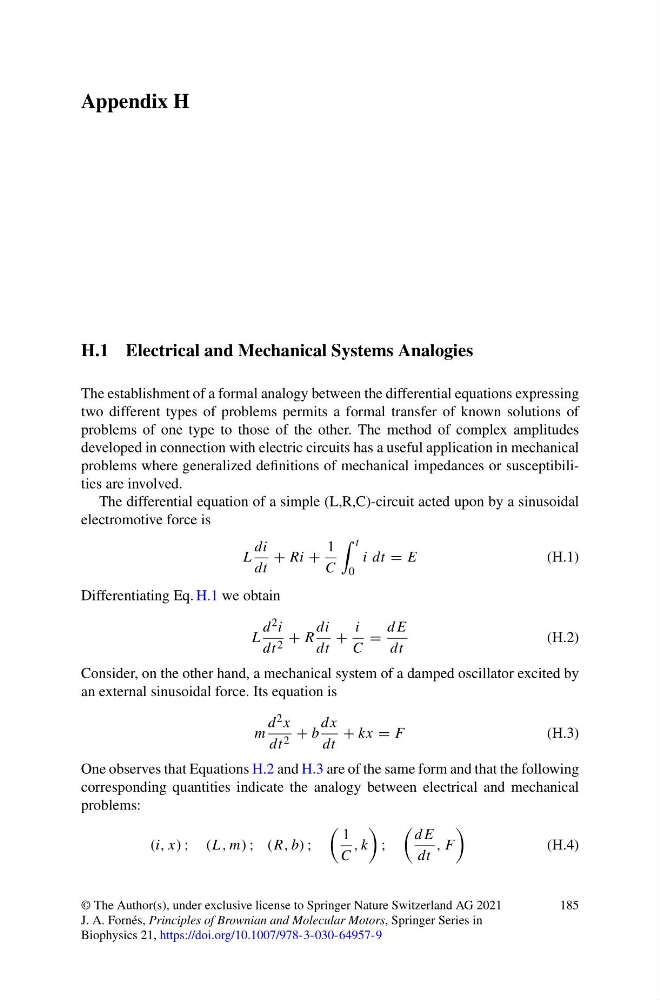
One observes that Equations H.2 and H.3 are of the same form and that the following
corresponding quantities indicate the analogy between electrical and mechanical
problems:
(i, x) ; (L, m) ; (R, b) ;
1
C
, k
;
dE
dt
, F
(H.4)
© The Author(s), under exclusive license to Springer Nature Switzerland AG 2021
J. A. Fornés, Principles of Brownian and Molecular Motors, Springer Series in
Biophysics 21, https://doi.org/10.1007/978-3-030-64957-9
185
H.1 Electrical and Mechanical Systems Analogies
The establishment of a formal analogy between the differential equations expressing
two different types of problems permits a formal transfer of known solutions of
problems of one type to those of the other. The method of complex amplitudes
developed in connection with electric circuits has a useful application in mechanical
problems where generalized definitions of mechanical impedances or susceptibilities are involved.
The differential equation of a simple (L,R,C)-circuit acted upon by a sinusoidal
electromotive force is
L
di
dt
+ Ri +
1
C
t
0
i dt = E
(H.1)
Differentiating Eq. H.1 we obtain
L
d 2 i
dt 2 + R
di
dt
+
i
C
=
dE
dt
(H.2)
Consider, on the other hand, a mechanical system of a damped oscillator excited by
an external sinusoidal force. Its equation is
m
d 2 x
dt 2 + b
dx
dt
+ kx = F
(H.3)
One observes that Equations H.2 and H.3 are of the same form and that the following
corresponding quantities indicate the analogy between electrical and mechanical
problems:
(i, x) ; (L, m) ; (R, b) ;
1
C
, k
;
dE
dt
, F
(H.4)
© The Author(s), under exclusive license to Springer Nature Switzerland AG 2021
J. A. Fornés, Principles of Brownian and Molecular Motors, Springer Series in
Biophysics 21, https://doi.org/10.1007/978-3-030-64957-9
185