

E.1 Stochastic Dynamics
169
=
t+t
0
A
X(t
), t
dt
+
t+t
0
B
X(t
), t
ξ(t
)dt
(E.13)
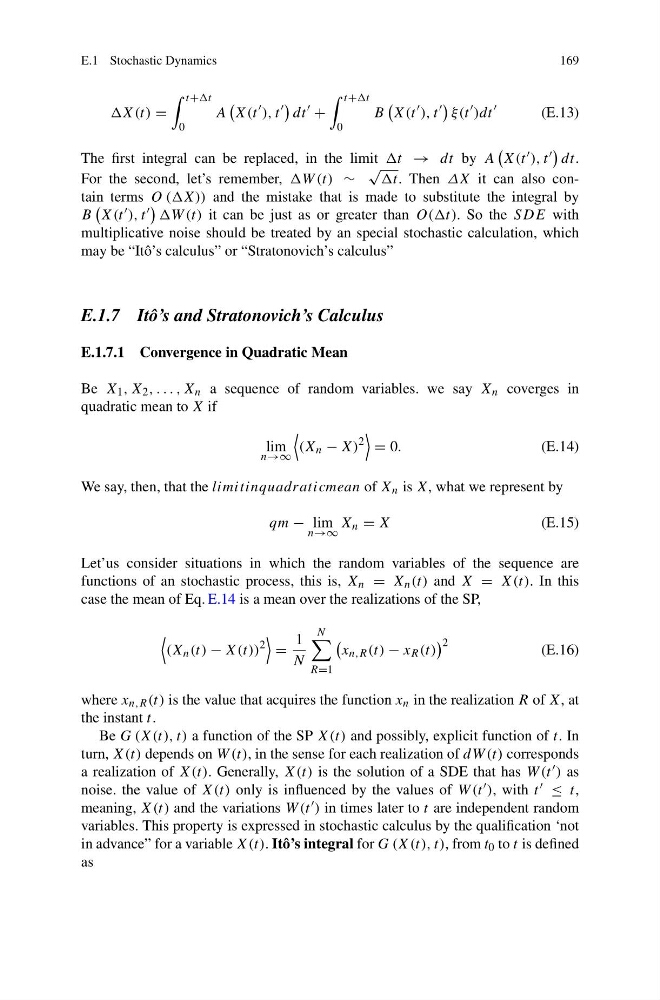
The first integral can be replaced, in the limit t → dt by A
X(t ), t
dt.
For the second, let’s remember, (t) ∼
√
t. Then ΔX it can also contain terms O (X)) and the mistake that is made to substitute the integral by
B
X(t ), t
(t) it can be just as or greater than O((t). So the SDE with
multiplicative noise should be treated by an special stochastic calculation, which
may be “Itô’s calculus” or “Stratonovich’s calculus”
E.1.7 Itô’s and Stratonovich’s Calculus
E.1.7.1 Convergence in Quadratic Mean
Be X 1 , X 2 , . . . , X n a sequence of random variables. we say X n coverges in
quadratic mean to X if
lim
n→∞
(X n − X)
2
= 0.
(E.14)
We say, then, that the limitinquadraticmean of X n is X, what we represent by
qm − lim
n→∞
X n = X
(E.15)
Let’us consider situations in which the random variables of the sequence are
functions of an stochastic process, this is, X n = X n (t) and X = X(t). In this
case the mean of Eq. E.14 is a mean over the realizations of the SP,
(X n (t) − X(t))
2
=
1
N
N
R=1
x n,R (t) − x R (t)
2
(E.16)
where x n,R (t) is the value that acquires the function x n in the realization R of X, at
the instant t.
Be G (X(t), t) a function of the SP X(t) and possibly, explicit function of t. In
turn, X(t) depends on W (t), in the sense for each realization of dW (t) corresponds
a realization of X(t). Generally, X(t) is the solution of a SDE that has W (t ) as
noise. the value of X(t) only is influenced by the values of W (t ), with t ≤ t,
meaning, X(t) and the variations W (t ) in times later to t are independent random
variables. This property is expressed in stochastic calculus by the qualification ‘not
in advance” for a variable X(t). Itô’s integral for G (X(t), t), from t 0 to t is defined
as
169
=
t+t
0
A
X(t
), t
dt
+
t+t
0
B
X(t
), t
ξ(t
)dt
(E.13)
The first integral can be replaced, in the limit t → dt by A
X(t ), t
dt.
For the second, let’s remember, (t) ∼
√
t. Then ΔX it can also contain terms O (X)) and the mistake that is made to substitute the integral by
B
X(t ), t
(t) it can be just as or greater than O((t). So the SDE with
multiplicative noise should be treated by an special stochastic calculation, which
may be “Itô’s calculus” or “Stratonovich’s calculus”
E.1.7 Itô’s and Stratonovich’s Calculus
E.1.7.1 Convergence in Quadratic Mean
Be X 1 , X 2 , . . . , X n a sequence of random variables. we say X n coverges in
quadratic mean to X if
lim
n→∞
(X n − X)
2
= 0.
(E.14)
We say, then, that the limitinquadraticmean of X n is X, what we represent by
qm − lim
n→∞
X n = X
(E.15)
Let’us consider situations in which the random variables of the sequence are
functions of an stochastic process, this is, X n = X n (t) and X = X(t). In this
case the mean of Eq. E.14 is a mean over the realizations of the SP,
(X n (t) − X(t))
2
=
1
N
N
R=1
x n,R (t) − x R (t)
2
(E.16)
where x n,R (t) is the value that acquires the function x n in the realization R of X, at
the instant t.
Be G (X(t), t) a function of the SP X(t) and possibly, explicit function of t. In
turn, X(t) depends on W (t), in the sense for each realization of dW (t) corresponds
a realization of X(t). Generally, X(t) is the solution of a SDE that has W (t ) as
noise. the value of X(t) only is influenced by the values of W (t ), with t ≤ t,
meaning, X(t) and the variations W (t ) in times later to t are independent random
variables. This property is expressed in stochastic calculus by the qualification ‘not
in advance” for a variable X(t). Itô’s integral for G (X(t), t), from t 0 to t is defined
as