

166
Appendix E
I (ω) =
1
2π
∞
−∞
X(t + τ )X(t) exp (−iωτ ) dτ
(E.1)
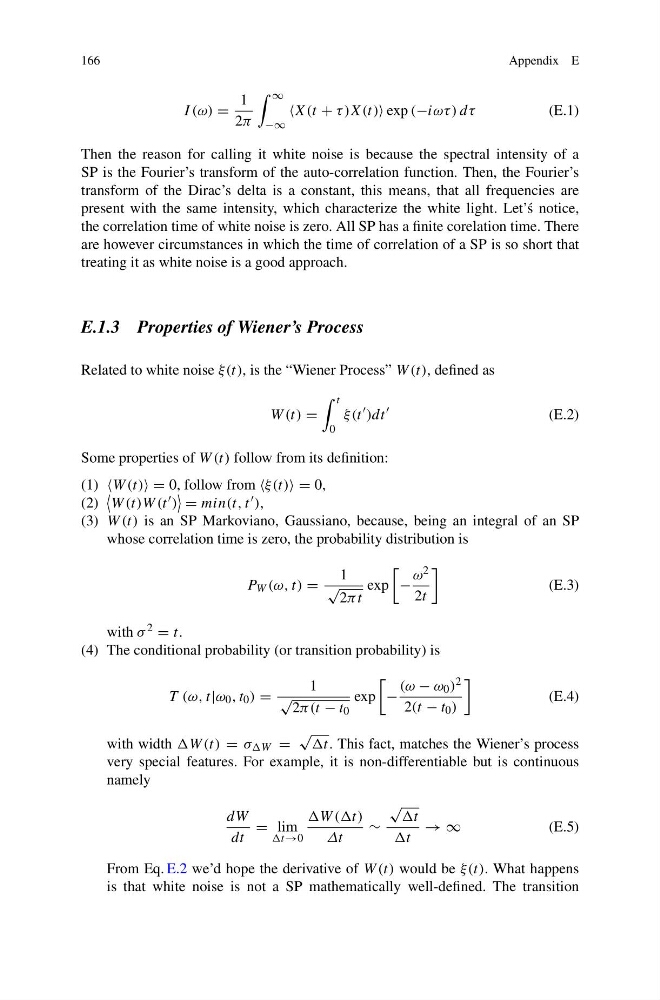
Then the reason for calling it white noise is because the spectral intensity of a
SP is the Fourier’s transform of the auto-correlation function. Then, the Fourier’s
transform of the Dirac’s delta is a constant, this means, that all frequencies are
present with the same intensity, which characterize the white light. Let’´ s notice,
the correlation time of white noise is zero. All SP has a finite corelation time. There
are however circumstances in which the time of correlation of a SP is so short that
treating it as white noise is a good approach.
E.1.3 Properties of Wiener’s Process
Related to white noise ξ(t), is the “Wiener Process” W (t), defined as
W (t) =
t
0
ξ(t
)dt
(E.2)
Some properties of W (t) follow from its definition:
(1) W (t) = 0, follow from ξ(t) = 0,
(2)
W (t)W (t )
= min(t, t ),
(3) W (t) is an SP Markoviano, Gaussiano, because, being an integral of an SP
whose correlation time is zero, the probability distribution is
P W (ω, t) =
1
√
2πt
exp
−
ω 2
2t
(E.3)
with σ 2 = t.
(4) The conditional probability (or transition probability) is
T (ω, t|ω 0 , t 0 ) =
1
√
2π(t − t 0
exp
−
(ω − ω 0 ) 2
2(t − t 0 )
(E.4)
with width W (t) = σ W =
√
t. This fact, matches the Wiener’s process
very special features. For example, it is non-differentiable but is continuous
namely
dW
dt
= lim
t→0
W ((t)
Δt
∼
√
t
t
→ ∞
(E.5)
From Eq. E.2 we’d hope the derivative of W (t) would be ξ(t). What happens
is that white noise is not a SP mathematically well-defined. The transition
Appendix E
I (ω) =
1
2π
∞
−∞
X(t + τ )X(t) exp (−iωτ ) dτ
(E.1)
Then the reason for calling it white noise is because the spectral intensity of a
SP is the Fourier’s transform of the auto-correlation function. Then, the Fourier’s
transform of the Dirac’s delta is a constant, this means, that all frequencies are
present with the same intensity, which characterize the white light. Let’´ s notice,
the correlation time of white noise is zero. All SP has a finite corelation time. There
are however circumstances in which the time of correlation of a SP is so short that
treating it as white noise is a good approach.
E.1.3 Properties of Wiener’s Process
Related to white noise ξ(t), is the “Wiener Process” W (t), defined as
W (t) =
t
0
ξ(t
)dt
(E.2)
Some properties of W (t) follow from its definition:
(1) W (t) = 0, follow from ξ(t) = 0,
(2)
W (t)W (t )
= min(t, t ),
(3) W (t) is an SP Markoviano, Gaussiano, because, being an integral of an SP
whose correlation time is zero, the probability distribution is
P W (ω, t) =
1
√
2πt
exp
−
ω 2
2t
(E.3)
with σ 2 = t.
(4) The conditional probability (or transition probability) is
T (ω, t|ω 0 , t 0 ) =
1
√
2π(t − t 0
exp
−
(ω − ω 0 ) 2
2(t − t 0 )
(E.4)
with width W (t) = σ W =
√
t. This fact, matches the Wiener’s process
very special features. For example, it is non-differentiable but is continuous
namely
dW
dt
= lim
t→0
W ((t)
Δt
∼
√
t
t
→ ∞
(E.5)
From Eq. E.2 we’d hope the derivative of W (t) would be ξ(t). What happens
is that white noise is not a SP mathematically well-defined. The transition